First Seen
2023-05-10T21:03:33+00:00
simple-description (llama3.2-vision_11b)
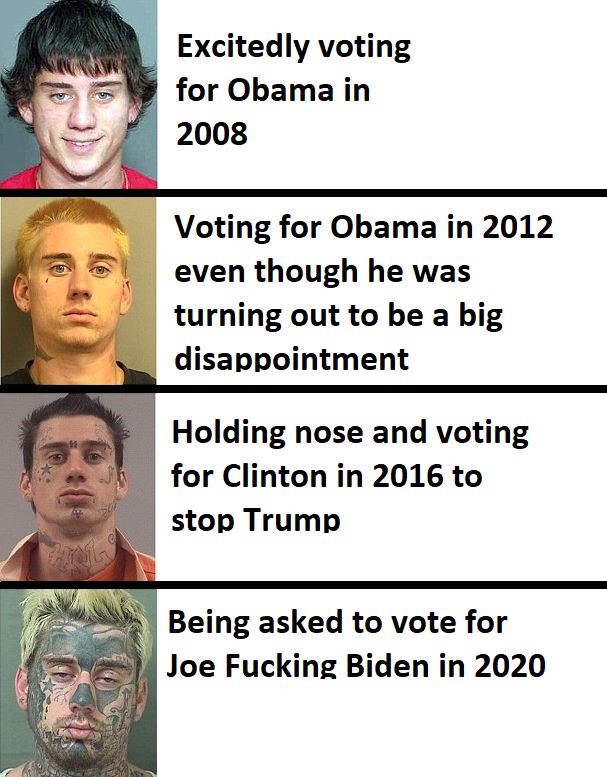
This meme is a commentary on the perceived shift in political ideologies and the changing nature of the internet's influence on politics. The meme uses a series of images depicting individuals who have become increasingly radicalized and extreme in their political views, with each image representing a specific year or event. The text accompanying the images reads: "Excitedly voting for Obama in 2008, Voting for Obama in 2012 even though he was turning out to be a big disappointment, Holding nose and voting for Clinton in 2016 to stop Trump, Being asked to vote for Joe Biden in 2020."
The meme is a commentary on the changing nature of politics and the impact of the internet on the way people think and vote. It highlights the shift in the way people have become more extreme and radicalized, and the way the internet has changed the way we think and the way we vote.
detailed-analysis (gemma3-27b-vision)
Okay, here's an analysis of the image, broken down into sections as you requested, focusing on the sections that apply given the visual and textual content. It's important to note this is interpretation, and the image is open to a variety of readings.
Image Overview
The image is a four-panel grid of what appears to be a single individual's mugshot/police booking photograph, each panel altered to depict evolving emotional states and political engagement over the period of four presidential elections (2008-2020). Each image is paired with text indicating the election and a description of the individual's political engagement. The alterations to the photograph (makeup, tattoos) progressively become more dramatic and disheveled, indicating a growing sense of disillusionment and emotional exhaustion.
1. Visual Description
- Subject: The subject is a young white male with visible tattoos. His appearance is progressively altered in each frame with makeup and body art.
- Progression: The first image shows a relatively clean-cut individual, exhibiting a hopeful or enthusiastic expression. Subsequent images show increasing modifications: in the second image, his hair is slicked back, and his eyebrows are furrowed. In the third image, heavy black makeup is used around his eyes. By the fourth image, his face is covered in blue paint and appears heavily distressed, with tears streaming down his face.
- Mood & Composition: The progression is clearly meant to convey a trajectory from optimism and hope to growing despair, frustration, and ultimately, a crisis of faith in the political process. The grid format emphasizes this sense of relentless, repeated participation.
- Symbolism: The changing appearance can be interpreted as a visual metaphor for the erosion of hope, the weight of political disappointment, and the feeling of being "marked" or "damaged" by the political process.
2. Foucauldian Genealogical Discourse Analysis
This image is ripe for a Foucauldian reading. The progressively altered mugshot is a powerful articulation of power/knowledge.
- Discourse of Citizenship/Politics: The images participate in a discourse of citizenship. The act of voting, the expression of political hope, and the experience of disappointment are all embedded within power structures. The individual isn’t simply exercising “free will”; they are subject to the rules, norms, and expectations of the political system.
- Discipline and Surveillance: The mugshot itself is a product of disciplinary power – a record of an encounter with the law, a moment of being categorized and controlled. The repeated use of this form—a visual document of control—highlights how political participation is itself a form of subjection.
- Genealogy of Disillusionment: A genealogical analysis could trace the history of this disillusionment. How did the promises of Obama give way to disappointment? How did the fear of Trump compel a "nose-holding" vote for Clinton? What conditions led to the ultimate crisis of faith expressed in the final panel? This is not a linear progression, but rather a complex interplay of historical forces, discourses, and power relations.
- The Subject as Constructed: The individual’s identity is not fixed or essential, but is constructed through the interplay of power and discourse. The changing appearance reflects an ongoing negotiation with the demands of the political system and the weight of its failures.
3. Critical Theory (Frankfurt School/Horkheimer/Adorno)
This image could be interpreted through the lens of Critical Theory, specifically the concept of reification and false consciousness.
- Reification of Political Process: The image implies that the political process has become a self-perpetuating system, divorced from genuine social change. The individual is trapped in a cycle of participation that offers only diminishing returns. The mugshot format, repeated four times, emphasizes this sense of being trapped and objectified.
- False Consciousness: The initial image ("Excitedly voting for Obama in 2008") suggests a belief in the possibility of meaningful change. Subsequent images reveal the disillusionment that followed, suggesting that the individual was subjected to a system of ideological control that obscured the true nature of power. The individual’s initial optimism can be seen as a form of “false consciousness” – a belief in a system that ultimately serves to maintain the status quo.
- The Culture Industry: The image can be seen as a critique of the “culture industry,” which produces standardized and commodified forms of political engagement. The constant cycle of elections, campaigns, and promises becomes a form of spectacle that distracts from underlying social problems.
4. Postmodernism
The image embodies several key postmodern characteristics.
- Fragmentation and Loss of Grand Narratives: The breakdown of the individual's hopeful demeanor mirrors the postmodern rejection of overarching ideologies or "grand narratives." The initial belief in a better future gives way to a fragmented, disoriented sense of reality.
- Simulation & Hyperreality: The image could be interpreted as a commentary on the simulation of politics—where representation has become detached from genuine substance. The repeated mugshot, altered with makeup, suggests a blurring of the lines between reality and representation. The act of voting is no longer about achieving meaningful change, but about participating in a performance of citizenship.
- Irony and Parody: The image exhibits a strong sense of irony—the contrast between the initial optimism and the final despair. The progressively degraded appearance could be seen as a parody of the American political system.
Let me know if you'd like me to elaborate on any particular aspect of this analysis or explore other theoretical frameworks.
simple-description (llama3.2-vision)
This meme is a humorous comparison of the evolution of young people's voting habits. The image features a series of photos of young men with increasingly outrageous hairstyles and facial hair, accompanied by captions that describe their supposed voting preferences. The text reads: "In 2008: Excitedly voted for Obama. In 2012: Still voted for Obama, but was slightly disappointed. In 2016: Held nose and voted for Clinton to stop Trump. In 2020: Asked to vote for Biden."
tesseract-ocr
oo Excitedly voting d : for Obama in 2008 5 | - o ‘ Voting for Obama in 2012 h ™= =) even though he was § — | turning out to be a big =". disappointment bee) Holding nose and voting ver for Clinton in 2016 to =) stop Trump Soa . i ; in Being asked to vote for 3 =) | Joe Fucking Biden in 2020 rae id