First Seen
2023-05-10T21:03:33+00:00
simple-description (llama3.2-vision_11b)
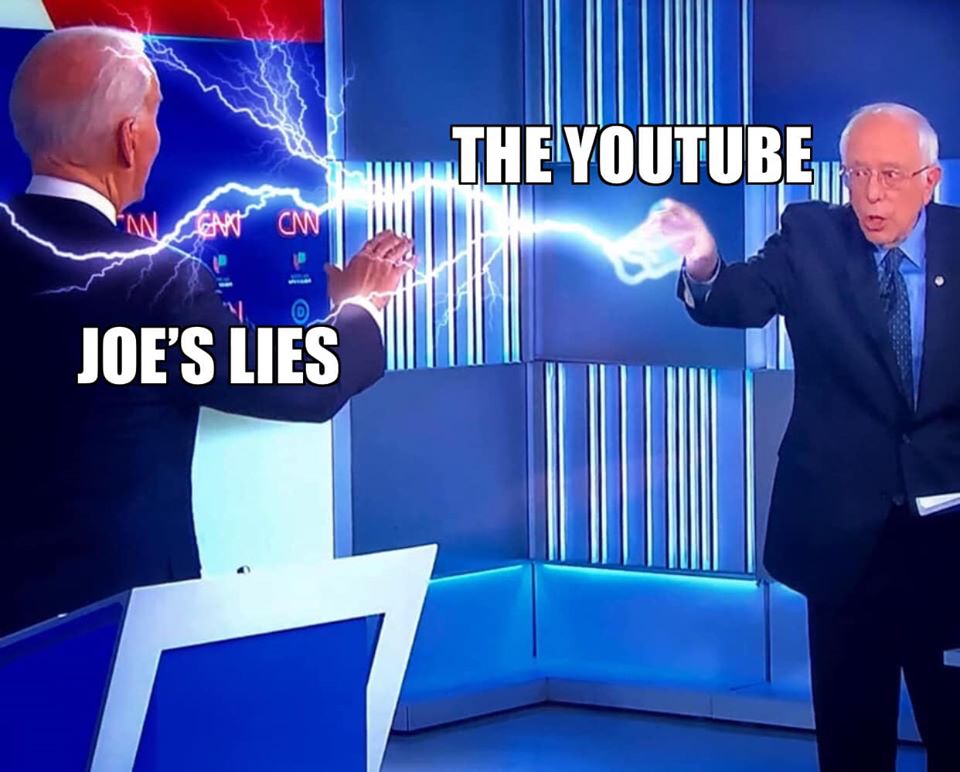
This meme is a commentary on the perceived bias of YouTube's algorithms, with Joe Biden and Bernie Sanders, two presidential candidates, attempting to control the narrative on the platform. The image shows them trying to "zap" the YouTube logo with their hands, with the text "Joe's Lies" and "The YouTube" above and below them, respectively. The meme is a satirical take on the idea that the platform's algorithms are biased towards certain content, with the two politicians trying to "zap" the platform's control.
detailed-analysis (gemma3-27b-vision)
Here's an analysis of the image, broken down by the requested theoretical lenses. Given the nature of the image, some lenses will be more applicable than others.
Visual Description
The image depicts a digitally manipulated scene featuring US President Joe Biden. On the left, Biden is rendered with a digitally-added lightning effect around his head, and text reading "JOE'S LIES" is overlaid. He is positioned behind a white lectern. On the right, the same Biden is shown projecting lightning bolts from his hands towards a series of vertical, glowing blue bars, labeled “THE YOUTUBE.” The background is a cool, stylized blue set that resembles a debate stage or studio, complete with CNN logos. The overall aesthetic is intentionally dramatic and reminiscent of a comic book supervillain facing off against a digital platform.
Foucauldian Genealogical Discourse Analysis
This image is ripe for a Foucauldian analysis. The image constructs a discourse around truth and power, specifically concerning political communication.
- Power/Knowledge: The image posits Biden (representing political authority) as a source of “lies” which are being actively projected at YouTube. This suggests that YouTube is being framed as a site where truth is contested or manipulated. The lightning imagery implies a forceful imposition of this discourse. Power isn't just repressive (suppressing information) but also productive - it creates the very categories of "truth" and "lie" it then uses to control.
- Genealogy: The image taps into a historical genealogy of mistrust in political figures and institutions. The lightning imagery evokes a sense of dramatic, almost mythical, conflict. The claim of "lies" is a longstanding rhetorical tactic in political discourse. The image suggests a lineage of accusations about manipulation of information.
- Disciplinary Power: While not direct, the image hints at the broader disciplinary power of media. By portraying Biden as a force against a digital platform, it implies that platforms like YouTube should be regulated or controlled to prevent the spread of falsehoods.
Critical Theory
The image can be interpreted through the lens of the Frankfurt School's Critical Theory, particularly regarding the culture industry.
- Mass Deception & Manipulation: Critical Theory argues that the culture industry (which includes media like YouTube and political discourse) promotes a form of mass deception. This image explicitly claims Biden engages in "lies," reinforcing a narrative of distrust and manipulation.
- Commodification of Information: The visual style suggests a heightened, sensationalized presentation of political information. This fits the Critical Theory's critique of how information is commodified and presented for consumption, often prioritizing entertainment value over factual accuracy.
- Loss of Critical Thinking: The simplistic "lies vs. YouTube" framing discourages nuanced understanding of complex political issues. It suggests a reduction of public debate to easily digestible, emotionally charged narratives.
Marxist Conflict Theory
While not a primary focus, Marxist conflict theory can illuminate aspects of the image.
- Ideological Struggle: The image can be seen as a representation of an ideological struggle. The "lies" are tools of the dominant power structure (represented by Biden) attempting to control the narrative. YouTube, in this framing, might be seen as a potential site of resistance (though the image doesn’t fully support this).
- Control of Information as Power: The image underscores how control over information (and the narrative surrounding it) is a key form of power. The attempt to "attack" YouTube with "lies" suggests an attempt to maintain ideological hegemony.
Postmodernism
Postmodernism offers several avenues for interpreting this image.
- Simulacra & Simulation: The digitally altered nature of the image itself reinforces the postmodern concept of simulacra – copies that precede and ultimately replace the real. What is truth in this digitally constructed reality? The image challenges the notion of an objective, verifiable truth.
- Deconstruction of Authority: The depiction of the President as a source of "lies" directly undermines traditional notions of authority. The image embodies a skepticism towards established institutions and power structures.
- Hyperreality: The dramatic imagery (lightning, digital effects) contribute to a hyperreality – a situation where simulations and representations become more real than the real itself.
Queer Feminist Intersectional Analysis
This lens is less directly applicable, but some connections can be drawn:
- Power Dynamics and Discourse: The image illustrates how power operates through discourse. "Lies" are a way of exerting control and silencing opposing voices. Feminist and queer theory emphasize how discourse can be used to marginalize and oppress specific groups.
- Digital Spaces and Power: The inclusion of YouTube as a target highlights the increasing importance of digital spaces as sites of both empowerment and control. Examining who controls these platforms and how they shape narratives is crucial.
Disclaimer: Interpretations of images are subjective and depend on the theoretical framework employed. This analysis offers one potential reading based on the given lenses.
simple-description (llama3.2-vision)
This meme is a humorous image of a presidential debate between Joe Biden and Bernie Sanders. The image depicts Biden and Sanders standing in a debate stage, but instead of speaking, they're both shouting "CNN" and "YouTube" respectively, as if they're trying to out-shout each other. The text "Joe's Lies" and "The Truth" are written on the image, with the latter being crossed out.
tesseract-ocr
A me ® 6)! | JOE'S LIES aT | & ae