First Seen
2023-05-10T21:03:33+00:00
simple-description (llama3.2-vision_11b)
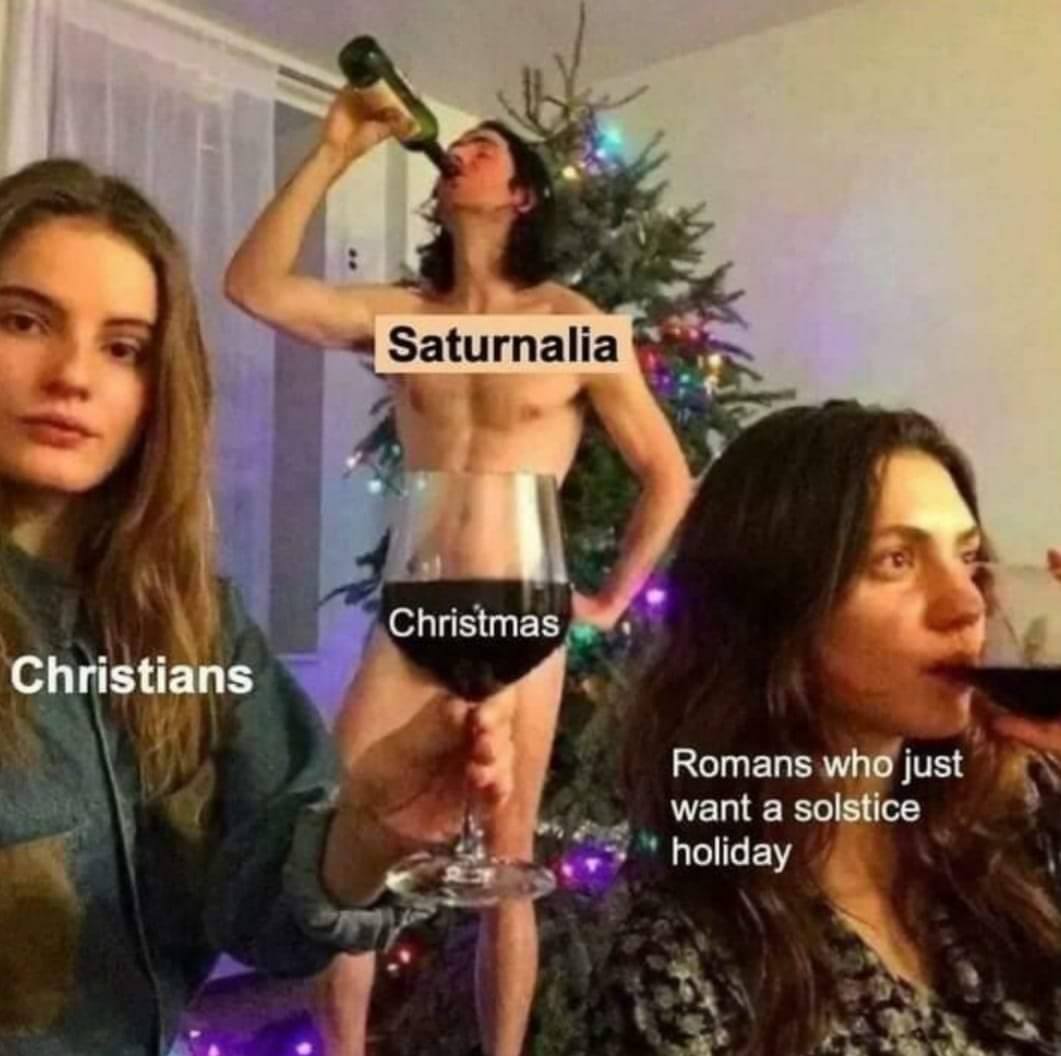
This meme is a humorous take on the holiday season, specifically Christmas, from a satirical anti-Christianity perspective. The image depicts a group of people enjoying Christmas, but one person, labeled "Saturnalia", is drinking wine and acting out of character, implying that he is a pagan who is not celebrating Christmas as a Christian would. The text "Saturnalia" is a reference to the ancient Roman festival of the same name, which was a time of celebration and indulgence, and is being used to poke fun at the idea of a Christian's Christmas celebration being "in the spirit of Saturnalia".
detailed-analysis (gemma3-27b-vision)
Okay, let's break down this meme using the frameworks you've requested. I will only include sections that genuinely lend themselves to analysis based on the image.
Visual Description
The image is a digitally altered "photo" that appears to be taken indoors, likely in a home setting. Three individuals are present, each digitally labeled and positioned in a way that creates a comparison.
- Left: A woman with long dark hair, wearing a dark jacket, is positioned on the left side of the frame. She looks somewhat stoic and reserved. She is labeled “Christians”.
- Center: A shirtless man wearing underwear is standing in front of a Christmas tree and lifting a bottle of sparkling wine as if to toast. He is labeled “Christmas”.
- Right: A woman with long dark hair, wearing dark clothing, is positioned on the right side of the frame. She looks to be looking off in the distance. She is labeled “Romans who just want a solstice holiday”.
The overall aesthetic is informal and suggests a playful, slightly ironic commentary on the origins of Christmas traditions. The central figure is highlighted.
Foucauldian Genealogical Discourse Analysis
This meme lends itself well to Foucauldian analysis. Michel Foucault's genealogical method traces the history of concepts to reveal how power relations have shaped their meanings.
- Discursive Formation: The meme engages with the discourse surrounding Christmas. It presents a genealogy (albeit simplified and meme-ified) suggesting Christmas isn't a purely "Christian" invention, but an evolution from earlier Roman traditions (Saturnalia). The label “Saturnalia” is on the shirtless man, insinuating that the traditions of excess and unrestrained celebration (traditionally associated with Saturnalia) are the underlying force of Christmas celebration.
- Power/Knowledge: The meme subtly critiques the power/knowledge relationship. By highlighting the Roman roots, it implies that Christian institutions exercised power by subsuming and re-branding pre-existing pagan rituals, creating a narrative of Christian origin that obscures the truth. The "knowledge" of these pre-Christian origins becomes a tool to deconstruct the accepted narrative.
- Archaeology & Genealogy: The meme engages in a genealogical approach by connecting contemporary traditions (Christmas) back to historical practices (Saturnalia). It doesn’t try to find a single origin, but to trace the ruptures and transformations that have led to the current state of affairs. The meme suggests a transition – from unrestrained Roman celebration to the more regulated and (often) religiously framed celebration of Christmas.
- Reconstructing the Narrative: The meme reconstructs the narrative of the holiday, suggesting that Christian institutions built upon pre-existing foundations, and that a celebration of the solstice is the true origin of the festivities.
Critical Theory
From a Critical Theory perspective (drawing on the Frankfurt School), this meme can be analyzed through the lens of ideology and commodification.
- Ideology: The meme deconstructs the dominant ideology surrounding Christmas, which often presents it as solely a Christian celebration with purely religious origins. By pointing to the Roman roots of the holiday, it challenges the narrative of cultural purity and exposes the way dominant cultures absorb and re-purpose traditions from others.
- Commodification & Spectacle: Though not directly shown in the image, the context of Christmas is heavily linked to consumerism and spectacle. The image playfully suggests a foundation of excess and indulgence (the shirtless man, the wine) that foreshadows the modern commercialization of Christmas. The meme hints that the "spirit" of Saturnalia – unrestrained celebration – is actually the driving force behind the commercial aspects of the holiday.
- False Consciousness: The meme can be interpreted as an attempt to awaken viewers from a "false consciousness"—the state of being unaware of the true historical and cultural roots of a social practice. By highlighting the non-Christian origins of Christmas, it invites a critical examination of the beliefs and values associated with the holiday.
Postmodernism
The meme embodies several key aspects of Postmodern thought:
- Deconstruction of Metanarratives: Postmodernism rejects overarching "metanarratives" – totalizing explanations of history and culture. The meme actively deconstructs the metanarrative of Christmas as a purely Christian holiday, revealing its composite nature.
- Intertextuality & Pastiche: The meme itself is an example of intertextuality—the way texts (in this case, images, words, and cultural references) borrow from and interact with other texts. It blends references to Christian tradition, Roman history, and contemporary meme culture. It can also be viewed as a form of pastiche—a playful imitation or parody of existing styles.
- Relativism & Fragmentation: Postmodernism emphasizes the subjectivity of truth and the fragmentation of experience. The meme’s juxtaposition of different figures and labels suggests that there isn’t a single, "authentic" Christmas tradition, but rather a complex and evolving blend of influences.
- Irony & Playfulness: The meme embraces irony and playfulness, subverting traditional narratives with a touch of humor.
Let me know if you’d like me to elaborate on any of these sections or apply other theoretical frameworks.
simple-description (llama3.2-vision)
This meme is a humorous take on the ancient Roman calendar. It features a person dressed as a Roman god, specifically Saturn, standing in front of a Christmas tree. The text "Saturnalia" appears above the person, while "In the Roman calendar, December 25th was originally a festival in honor of Saturn" is written above the tree.
tesseract-ocr
\ AG Ae y - a Pa . & Pi fy - Saturnalia Wy ay ; SY he Meta dl = \ CTU U a. ; SY Bs ; Romans who just v Sse # , want a solstice “a oe RS \ \ AES a0 8) aie » = a j ‘ ot % " ys ? A , ‘4 aS i " 7 - ~ 7% i * ee