First Seen
2023-05-10T21:03:33+00:00
simple-description (llama3.2-vision_11b)
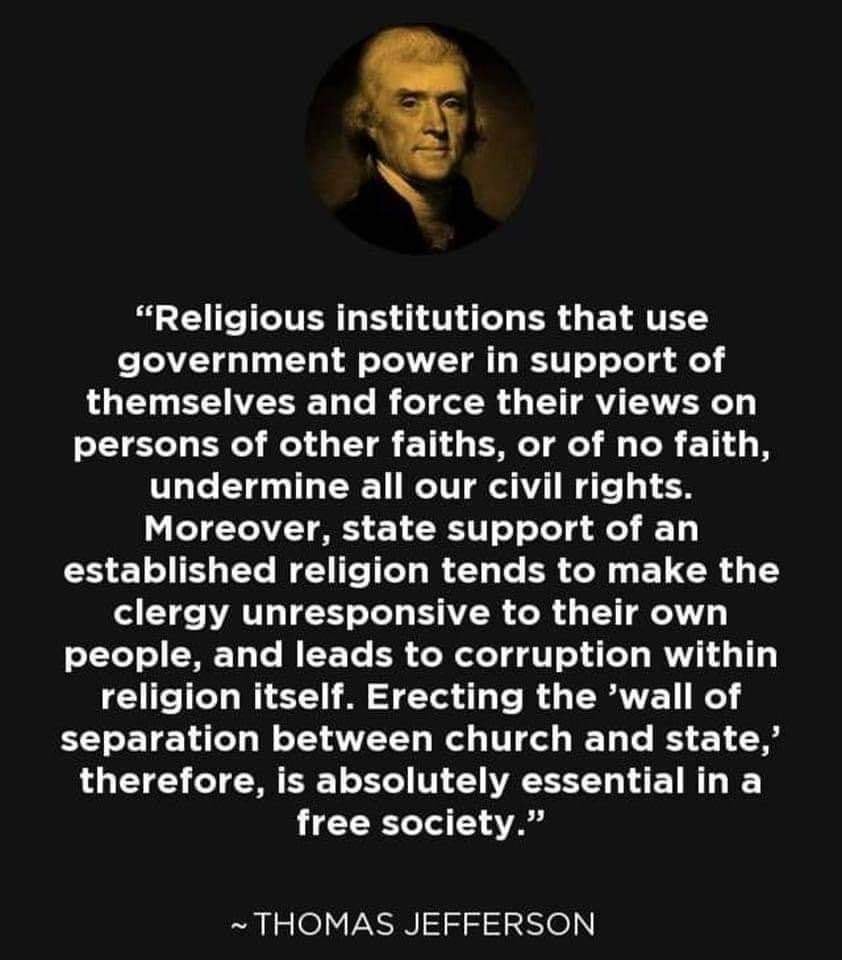
The meme is a quote from Thomas Jefferson, a founding father of the United States, criticizing the influence of Christianity in the government. The quote suggests that the separation of church and state is essential to maintaining a free society. The meme is likely used to criticize the influence of Christianity in politics and the need for a separation of church and state.
detailed-analysis (gemma3-27b-vision)
Okay, let's break down the image and quote through the lens of several theoretical frameworks as requested.
Visual Description
The image is a digitally rendered portrait of Thomas Jefferson. He is depicted in a somewhat classical style, with dark hair, a high collar, and a stern expression. The background is black, creating a sense of seriousness and solemnity. Below the portrait is a block of white text containing a quote attributed to Jefferson, followed by his name in a smaller font. The visual presentation emphasizes Jefferson as an authority figure, presenting his words as wisdom worthy of consideration. The darkness behind him can create the impression that the text is being delivered from a bygone era.
Foucauldian Genealogical Discourse Analysis
This quote is ripe for Foucauldian analysis. Foucault's genealogy examines how power operates through discourse, shaping what is considered ‘truth’ and ‘knowledge’. Jefferson's statement isn’t simply a statement about freedom, but a declaration about how power operates through religion.
- Discourse of Religious Authority: Before Jefferson, religious institutions held immense political and social power, defining morality, legality, and societal norms. This quote can be understood as an attempt to deconstruct that discourse—to expose how religious authority was used to justify control and oppression.
- Power/Knowledge: Jefferson argues that state support of religion leads to corruption within religion itself. This demonstrates a clear understanding of the power/knowledge dynamic—how power structures shape religious beliefs and interpretations, and how these interpretations are then used to legitimize power.
- Discipline & Surveillance: Jefferson highlights the danger of imposing religious views on others, thus, the quote can be seen as resisting the disciplinary and surveillant tendencies of religiously-backed state power. This implies a concern about religious institutions controlling thought and behavior.
- Genealogy of ‘Freedom’: A genealogical approach might explore how the concept of ‘freedom’ itself was constructed, and how Jefferson’s understanding of freedom differed from previous norms rooted in religious dogma.
Critical Theory
The quote aligns strongly with the aims of Critical Theory, particularly the Frankfurt School.
- Ideology Critique: Jefferson’s statement is a clear indictment of how religion can function as an ideological tool for the state. He reveals how seemingly neutral religious tenets can conceal underlying power structures and legitimize social inequalities.
- Domination and Emancipation: The call for a “wall of separation” between church and state directly reflects the Critical Theory concern with identifying and dismantling systems of domination. The goal is to create a society where individuals are not subjected to external forces that restrict their autonomy.
- Reason & Enlightenment: Jefferson’s quote is a testament to Enlightenment ideals. He advocates for reason and individual liberty, rejecting the blind acceptance of religious authority. Critical Theorists would acknowledge that even Enlightenment reason isn't neutral, but it's still a step towards critical self-reflection.
Marxist Conflict Theory
While the quote isn't explicitly economic, it can be understood through a Marxist lens.
- Superstructure and Base: Religion, in a Marxist framework, functions as part of the ‘superstructure’—the institutions that maintain and legitimize the ‘base’ (economic relations). Jefferson's critique suggests that state support of religion serves to maintain a specific social order that benefits certain classes or groups.
- False Consciousness: Imposing religious views on others can be seen as a form of ideological control that creates ‘false consciousness’—preventing individuals from recognizing their true interests and challenging existing power structures.
- Class Struggle: Although not directly stated, the quote implies that religious authority can be used to suppress dissent and maintain the status quo, thereby hindering potential class struggle.
Postmodernism
A Postmodern interpretation would be more nuanced.
- Deconstruction of Grand Narratives: The quote can be seen as a rejection of the ‘grand narrative’ of a unified, monolithic religion dictating morality and social order. Jefferson calls for a pluralistic society where diverse beliefs can coexist.
- Critique of Power/Knowledge: Postmodernists would agree with the Foucauldian analysis of how power and knowledge are intertwined in religious institutions. They would emphasize that there is no objective ‘truth’ in religion, only different interpretations shaped by power dynamics.
- Relativism (with caveats): While postmodernism acknowledges the relativity of truth, Jefferson's emphasis on a "wall" implies a need for boundaries, potentially challenging a purely relativistic stance.
Queer Feminist Intersectional Analysis
This is where the analysis becomes more complex and requires extrapolation, as the quote doesn’t directly address gender or sexuality.
- Intersectionality of Oppression: A Queer Feminist lens would ask who is most affected by the imposition of religious views. Historically, it has often been marginalized groups—women, LGBTQ+ individuals, people of color—who have suffered the most from religious dogma and control.
- Patriarchy & Religious Authority: Religious institutions have frequently been used to enforce patriarchal norms and restrict women’s autonomy. The quote implicitly challenges these structures by advocating for freedom of belief.
- Queer Rights & Religious Oppression: LGBTQ+ individuals have historically faced persecution based on religious interpretations. This quote's call for separation of church and state can be seen as a step towards protecting queer rights and creating a more inclusive society.
- Critique of Normativity: By advocating against the imposition of any single belief system, the quote pushes against the assumption that there is one “correct” way to live or believe, which is a core tenet of Queer Feminist thought.
Let me know if you'd like me to elaborate on any of these analyses, or explore additional theoretical frameworks.
simple-description (llama3.2-vision)
The meme is a humorous take on the concept of the separation of church and state, with a quote from Thomas Jefferson. The image likely shows a cartoonish illustration of a church and a state building, with a red line or a "wall" between them, symbolizing the separation. The text of the meme reads: "In 1789, Thomas Jefferson wrote, 'The separation of church and state, is a wall between the church and the state. This wall keeps the church out of the government and the government out of the church.'"
tesseract-ocr
‘ “Religious institutions that use government power in support of themselves and force their views on persons of other faiths, or of no faith, undermine all our civil rights. Moreover, state support of an established religion tends to make the clergy unresponsive to their own people, and leads to corruption within religion itself. Erecting the ’wall of separation between church and state,’ therefore, is absolutely essential in a free society.” ~THOMAS JEFFERSON