First Seen
2023-05-10T21:03:33+00:00
simple-description (llama3.2-vision_11b)
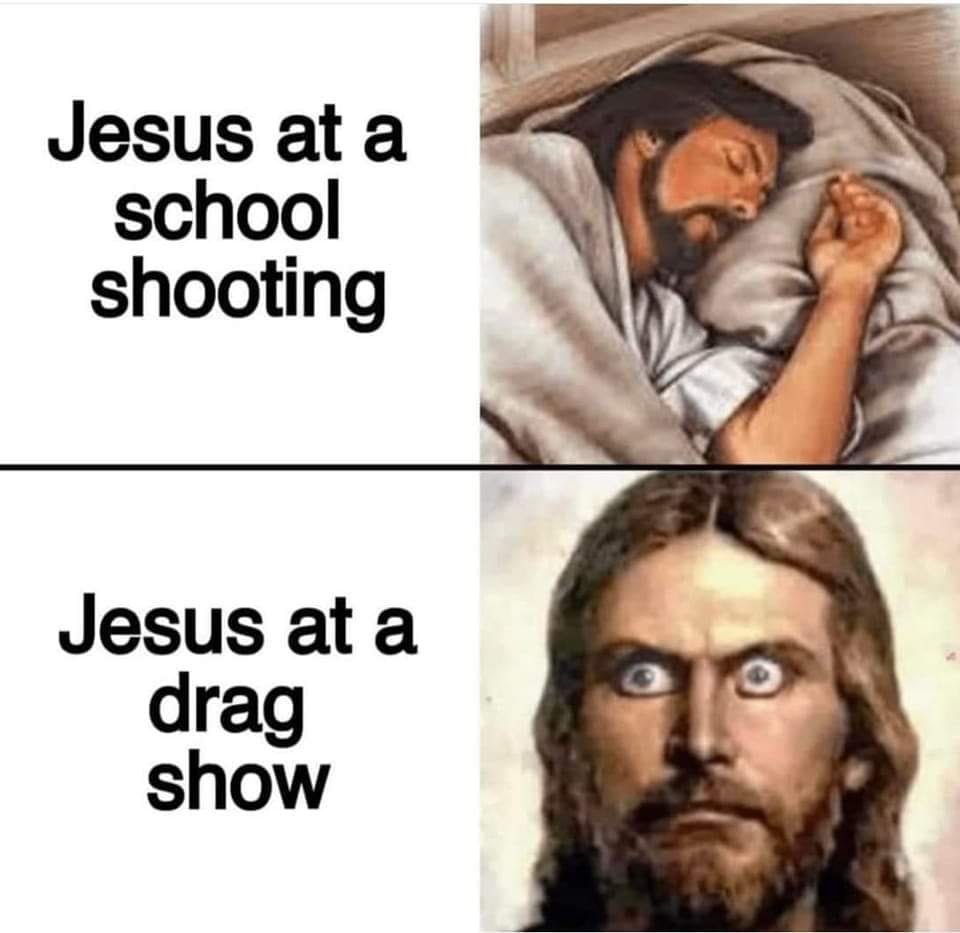
This meme is a humorous comparison between the idea of Jesus Christ, the biblical figure, being present at two vastly different and contrasting events: a school shooting and a drag show. The meme juxtaposes these two scenarios to highlight the absurdity of expecting Jesus to be present in both situations, implying that his presence in a drag show would be as unlikely as his presence in a school shooting. The meme is meant to be humorous and satirical, poking fun at the idea of a Christian deity being present in both situations.
detailed-analysis (gemma3-27b-vision)
Okay, let's break down this meme using the requested theoretical frameworks. It’s a provocative image, and the analysis will be nuanced given the sensitive topics involved.
Visual Description
The meme is a two-panel format using images of Jesus.
- Top Panel: Displays a Renaissance-style painting of Jesus, covered with a white cloth, seemingly recoiling with hands raised to cover his eyes. The pose suggests horror, distress, or a desire to shield oneself.
- Bottom Panel: Presents a close-up of a Renaissance-style Jesus painting, but digitally altered to have wide, exaggerated eyes, creating a look of exaggerated "shock" or discomfort.
The juxtaposition implies a comparison between Jesus’ response to two different events – a school shooting and a drag show. The humor, if any, is derived from the perceived incongruity of the response.
Foucauldian Genealogical Discourse Analysis
This meme can be analyzed through a Foucauldian lens by examining the historical discourses surrounding violence, morality, and sexuality that shape our understanding of the events depicted.
- The School Shooting Discourse: The image of Jesus "covering his eyes" at a school shooting taps into the discourse of innocence, victimhood, and helplessness surrounding mass shootings. It implies a powerlessness even in the face of horrific events, but also subtly frames Jesus as a spectator, not an active agent. The discourse assumes the event is exceptional and devastating, prompting a feeling of pain.
- The Drag Show Discourse: The digitally altered image of Jesus with wide eyes at a drag show connects to discourses around sexuality, gender performance, and religious morality. Traditionally, Christian (and related) discourses have often framed drag (and LGBTQ+ identities more broadly) as transgressive, sinful, or "unnatural." The widened eyes suggest a perceived affront to traditional morality, coded within the meme.
- Genealogy of Morality: A genealogical approach would trace the historical development of these discourses, showing how they were constructed through power relations and social norms. This meme leverages the historically rooted opposition between "good" (traditional morality, protection of innocence) and "bad" (transgression, perceived threats to religious values).
- Power/Knowledge: The meme itself exercises power/knowledge by reinforcing or subverting these existing discourses. It relies on pre-existing assumptions about how Jesus "would" react to these situations.
Critical Theory
This meme can be dissected from a Critical Theory perspective, specifically through the lens of ideology.
- Ideological Critique: The meme implicitly critiques the selective outrage and moral panics often present in contemporary society. It suggests that some events (school shootings) evoke widespread grief and calls for change, while others (drag shows) are met with moral condemnation.
- Hegemony: The meme challenges the hegemonic (dominant) discourses that normalize certain forms of violence (through desensitization) while demonizing others (through moralizing). It asks why a school shooting is often seen as a tragedy requiring universal empathy, while a drag show can be framed as a moral failing.
- False Consciousness: The meme could be interpreted as a comment on "false consciousness," the idea that dominant ideologies can obscure social inequalities and prevent people from recognizing their own oppression. It suggests that the outrage at a drag show is misdirected and serves to reinforce existing power structures.
Marxist Conflict Theory
While seemingly unrelated, we can interpret the meme through a Marxist lens by focusing on the underlying social contradictions it exposes.
- Ideology as a Tool of Domination: The meme exposes how ideology functions to maintain the status quo. The differing reactions to the two events reflect class and cultural power dynamics. The outrage at a drag show can be seen as a way to distract from the systemic issues that lead to school shootings (e.g., poverty, lack of access to mental health care, gun violence).
- Culture Wars as Class Struggle: The meme points to the culture wars (e.g., debates about sexuality, gender identity) as a manifestation of underlying class conflict. The focus on these issues deflects attention from material conditions and economic inequalities.
- Commodity Fetishism: One could extend the analysis by arguing that the meme itself is a commodity produced within a capitalist system. The shock value and potential for social media engagement are what drive its circulation, even though it tackles serious issues.
Postmodernism
From a postmodern perspective, the meme plays with the concepts of simulation, irony, and the deconstruction of meaning.
- Irony and Parody: The meme relies heavily on irony and parody. It juxtaposes a figure traditionally associated with morality and compassion with two events that are subject to intense ideological debate.
- Deconstruction of Meaning: The meme challenges the notion of a fixed or essential meaning. It forces the viewer to question their own assumptions about morality, sexuality, and the appropriate emotional response to different events.
- Hyperreality: The meme creates a "hyperreality" by combining images and discourses in a way that blurs the line between the real and the simulated. The altered image of Jesus with widened eyes is a prime example of this.
- Fragmentation: The meme’s form itself reflects the fragmentation of contemporary culture, where information is often presented in short, digestible fragments.
Queer Feminist Intersectional Analysis
This is where the meme becomes especially rich for analysis.
- Moral Panic and Homophobia/Transphobia: The meme exposes the historical and ongoing moral panics surrounding LGBTQ+ identities. The exaggerated reaction attributed to Jesus at the drag show taps into a long history of demonizing queer and transgender people.
- Intersectional Oppression: The meme implicitly acknowledges the intersection of multiple forms of oppression. The response to school shootings is often framed as a universal tragedy, but the impact of gun violence disproportionately affects marginalized communities (e.g., Black and Brown communities). By juxtaposing this with the condemnation of drag, the meme highlights how different groups are subjected to different forms of violence and oppression.
- Gender Performance and Religious Authority: The meme challenges the traditional association of religious authority with patriarchal norms. Drag is a form of gender performance that subverts these norms, and the meme's implication that Jesus is “shocked” by it reinforces the idea that traditional religious beliefs are often rooted in gender essentialism.
- Critique of Heteronormativity: By positioning drag as something that elicits a negative reaction, the meme subtly reinforces the dominant heteronormative framework that prioritizes traditional gender roles and sexualities.
Important Disclaimer: It’s crucial to acknowledge the potentially harmful implications of this meme. By conflating school shootings with drag shows, it could inadvertently minimize the trauma of gun violence or reinforce harmful stereotypes about LGBTQ+ people. A thorough analysis requires a careful consideration of these ethical concerns.
I hope this detailed breakdown is helpful! Let me know if you'd like me to elaborate on any of these points or explore other theoretical frameworks.
simple-description (llama3.2-vision)
This meme is a humorous comparison between two extreme situations. The first panel shows a calm and peaceful Jesus, with the text "Jesus at a school shooting". The second panel shows a shocked and terrified Jesus, with the text "Jesus at a drag show". The meme is implying that Jesus would be more traumatized by a drag show than a school shooting, which is a darkly comedic and ironic commentary on societal norms.
tesseract-ocr
& = — . Jesus ata , SN school \ \& >») shooting wt a ) 7 § a ata < r rag , a. show » = >