First Seen
2023-06-09T21:14:35+00:00
simple-description (qwen3.5_2b-q8_0)
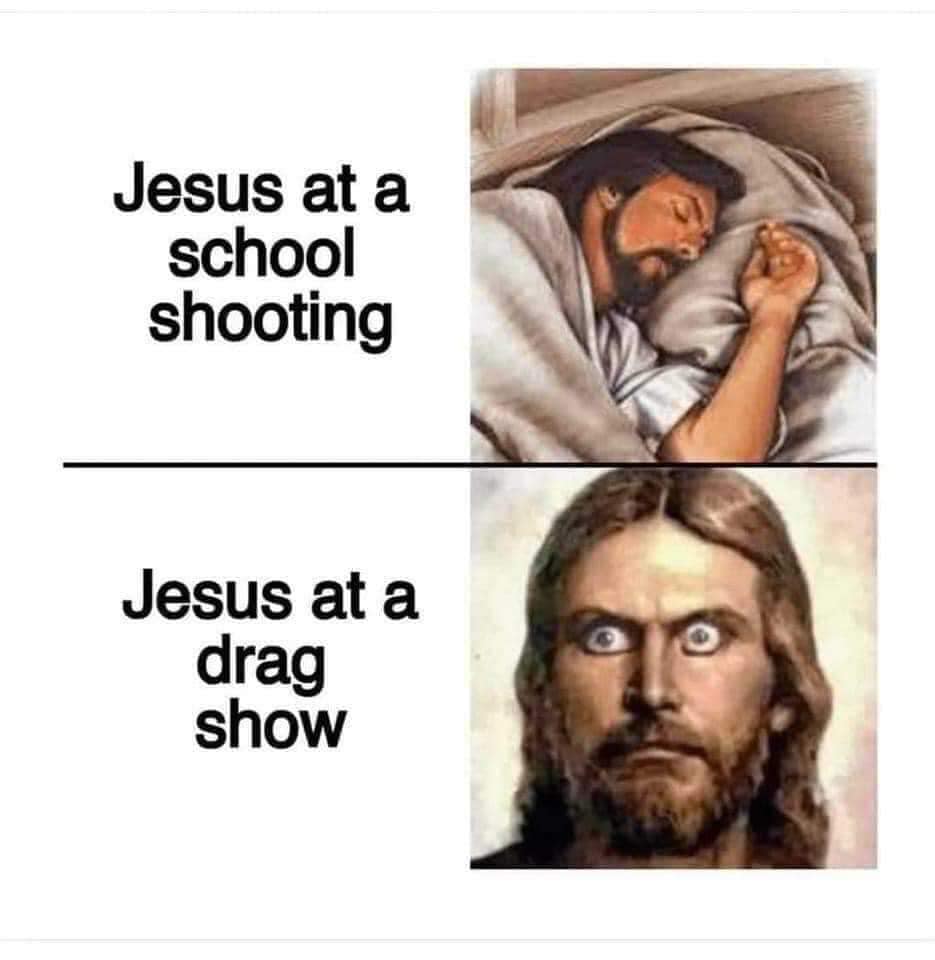
This meme plays on the stark contrast between the innocent, peaceful appearance of Jesus in religious paintings and the violent reality of modern tragedies. The top half shows a sleeping Jesus during a school shooting, while the bottom half shows him staring in terror at a drag show. The text "Jesus at a school shooting" juxtaposes his slumber with the violence of an actual tragedy. The second line, "Jesus at a drag show," creates a surreal and frightening scenario, implying that the horror is being performed by the holy figure himself.
simple-description (llama3.2-vision_11b)
This meme is a satirical commentary on the perceived hypocrisy of Christians, specifically the contrast between their values and their actions. The image juxtaposes two scenarios: Jesus, the symbol of peace and love, is first depicted as a gentle figure, and then as a violent one, highlighting the absurdity of a peaceful person being involved in a violent event. The text "Jesus at a school shooting / Jesus at a drag show" underscores the hypocrisy of a Christian being involved in two contrasting and often contradictory events, implying that Christians are not as peaceful as they claim to be.
detailed-analysis (gemma3-27b-vision)
Okay, let's break down this meme using the requested theoretical frameworks. It's a provocative image, and the analysis will reflect that. Please note that meme analysis can be subjective, and these interpretations aren't the only valid readings.
Visual Description
The meme is a two-panel image following the “drakeposting” format, where an image of Drake expresses disapproval of one thing and approval of another.
- Panel 1 (Top): Depicts a Renaissance-style painting of Jesus, in a pose of anguish, with his hands raised and head bowed. The lighting and composition suggest suffering and despair. The text above reads, “Jesus at a school shooting.”
- Panel 2 (Bottom): Features a digitally altered image of the same Jesus figure, but his face has been digitally altered to appear as if he is wearing drag makeup, with exaggerated eyelashes, eyeshadow, and blush. The text reads, “Jesus at a drag show.”
- Overall: The juxtaposition is stark. It contrasts an event traditionally associated with profound grief and tragedy (a school shooting) with a form of performance art (a drag show) that's often associated with liberation, creativity, and queer culture. The visual style aims for shock value.
Foucauldian Genealogical Discourse Analysis
This meme allows for interesting Foucauldian analysis, focusing on the power/knowledge nexus and the construction of meaning around concepts like suffering, morality, and sexuality.
- Discourse and Power: The meme implicitly suggests a discourse around acceptable and unacceptable displays of emotion. It posits that Jesus's anguish is expected in the context of a tragedy like a school shooting, reinforcing a culturally ingrained response. However, the image implies that this same Jesus is more comfortable (or, rather, the meme-maker suggests he should be more comfortable) in a space of queer performance. This challenges the discourse of traditional Christian morality and its often-negative view of queerness.
- Genealogy of Morality: We can trace a genealogy of the concepts presented. The image implicitly critiques the association of Christianity with condemnation of certain practices (like drag) while simultaneously linking it to the expression of grief in a seemingly passive manner. The meme asks: why is grief acceptable and even expected while joy and celebration of marginalized identities are often demonized?
- Power/Knowledge: The meme’s visual statement relies on existing power dynamics surrounding religious imagery, the media's depiction of tragedies, and the stigmatization of drag performance. It subtly subverts these by presenting a Jesus figure that seems to "prefer" the drag show, thereby questioning the established knowledge base about both religious expectation and cultural disapproval.
Critical Theory
Through the lens of Critical Theory, the meme reveals a critique of societal norms and power structures.
- Ideology: The meme exposes the ideological underpinnings of seemingly "natural" reactions to tragedy versus artistic expression. It questions why we prioritize expressions of grief over expressions of joy, especially when those joyful expressions are associated with marginalized groups.
- Hegemony: The meme challenges the hegemonic narrative that equates certain types of performance (like school shootings) with horror and others (like drag shows) with transgression. It attempts to disrupt that binary by suggesting a re-evaluation of what is considered appropriate or "holy" expression.
- Social Critique: The image can be read as a commentary on the inadequacy of traditional institutions (like the church) to address contemporary social issues. It implies that the church's emphasis on suffering and repentance may be out of touch with the needs and desires of a diverse population.
Queer Feminist Intersectional Analysis
This meme is ripe for a Queer Feminist Intersectional analysis, exploring the intersection of religious iconography, gender expression, and social justice.
- Deconstruction of Gender: The altered image of Jesus wearing drag makeup directly challenges traditional representations of masculinity and the binary gender system. It destabilizes the idea that Jesus (often depicted as hypermasculine) is confined to a rigid gender role.
- Queer Resistance: The meme can be seen as a form of queer resistance. Drag itself is a performance of gender that subverts societal norms and challenges dominant power structures. By placing Jesus within that space, the meme implies a kind of solidarity with the queer community and a rejection of heteronormative expectations.
- Intersectional Critique: The meme implicitly critiques the ways in which religious institutions have historically marginalized LGBTQ+ people. It suggests a need for more inclusive and affirming spaces within the church and challenges the idea that religious faith and queer identity are mutually exclusive.
- Subversion of Religious Iconography: The meme deliberately uses the figure of Jesus to challenge the established norms surrounding gender, sexuality, and religious expression. It’s a provocative act that seeks to reclaim religious iconography for queer liberation.
Important Considerations:
- Humor and Offense: This meme is intentionally provocative and may be offensive to some. Its effectiveness depends on the viewer's own beliefs and experiences.
- Context Matters: The meaning of the meme will change depending on the context in which it is shared and interpreted.
- Oversimplification: The meme, by its very nature, is an oversimplification of complex issues. However, it can serve as a starting point for a more nuanced discussion.
Let me know if you’d like me to elaborate on any of these points or explore additional theoretical frameworks.
simple-description (llama3.2-vision)
This meme is a humorous comparison between two situations where Jesus Christ would be shocked or surprised. The first panel shows Jesus at a school shooting, implying that he would be deeply disturbed by such a violent event. The second panel juxtaposes this with a more absurd and humorous scenario, "Jesus at a drag show", implying that Jesus would be equally shocked and surprised by the spectacle of a drag show, but in a more playful and ironic way.
tesseract-ocr
4 Z - 4 Jesus ata =“ > shooting A & AN * ) an ata "eh rag show 7 = ,