First Seen
2023-12-12T21:27:51+00:00
simple-description (qwen3.5_2b-q8_0)
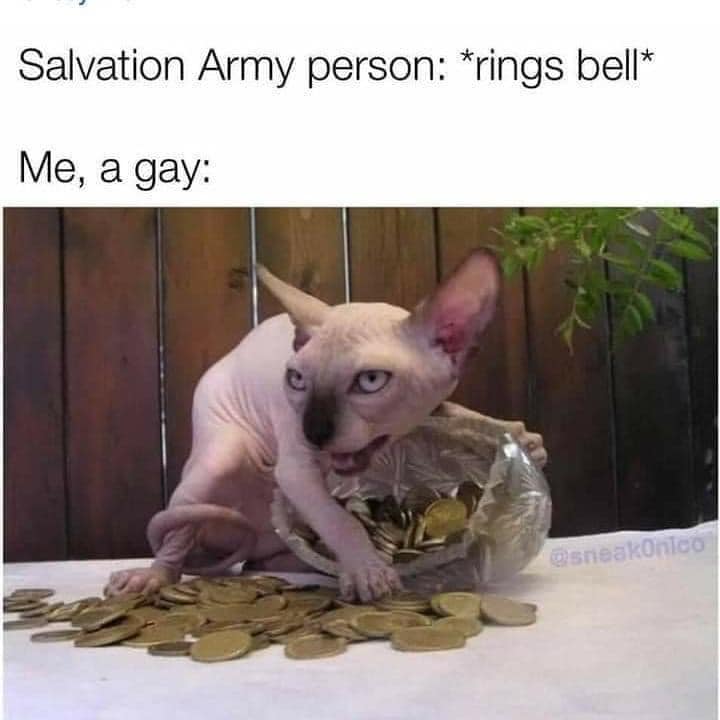
This meme plays on a stereotype suggesting that gay people are "salvaged" or found by the Salvation Army. The bottom text "Me, a gay:" is followed by a picture of a hairless cat staring at a pile of coins, implying that the person is being "saved" or rescued by the charity. The Salvation Army bell at the top signifies the bell that rings when someone is saved by a Christian charity.
simple-description (llama3.2-vision_11b)
This meme is a humorous take on the idea that some people, particularly those with conservative or fundamentalist Christian views, are intolerant of LGBTQ+ individuals and may even view them as "sinners" or "abominations." The image is of a cat with a shocked expression, implying that the cat is reacting to a person from the Salvation Army (a Christian organization) saying "God loves you" to a gay person. The text "God loves you" is likely meant to be ironic or sarcastic, implying that the person is not actually loved by God due to their sexual orientation.
detailed-analysis (gemma3-27b-vision)
Okay, let's break down this meme through the requested theoretical lenses. It’s important to note that a meme like this, while seemingly simple, can be surprisingly rich with potential interpretations when viewed through these frameworks.
Visual Description
The image depicts a hairless cat (likely a Sphynx) with a highly expressive, almost frantic expression, seemingly pawing desperately at a fishbowl filled with gold coins. The cat appears to be leaning into the bowl, fully consumed by the pursuit of the coins. The background is a simple wooden fence and some greenery. The text at the top reads "Salvation Army person: rings bell," and the text underneath reads "Me, a gay:" with the cat representing the response.
Queer Feminist Intersectional Analysis
This is where the meme resonates most strongly. The juxtaposition of the Salvation Army (an organization with a historically problematic stance on LGBTQ+ rights) and the "gay" identity (represented by the cat) creates a moment of darkly comedic rebellion.
- Intersectional Tension: The meme highlights the tension between historically oppressive institutions and marginalized identities. The Salvation Army's stance historically clashed with queer liberation, and this meme visually embodies that conflict.
- "Greed" as a Subversion: The cat’s obsessive pursuit of coins can be read as a playful subversion of the stereotypical association of “greed” with sin (a concept often emphasized by religious organizations like the Salvation Army). The “gay” identity embraces what is traditionally deemed “wrong” or “sinful.” It's a reclamation of desire.
- The Sphynx Cat as Queer Signifier: The hairless cat itself can be read as a queer symbol. Its unique, unconventional appearance challenges societal norms of beauty and acceptability, mirroring the challenges faced by LGBTQ+ individuals. It’s “othered” and stands out – a metaphor for queer visibility and the reaction it often provokes.
- Playful Defiance: The meme isn’t necessarily advocating for stealing. Instead, it’s a humorous way to express frustration and resistance against systems that historically marginalized queer people. It says, “You judge us, we’re going to ‘indulge’ in what you condemn.”
Postmodernism
The meme leans heavily into postmodern principles:
- Irony & Parody: It's fundamentally ironic. The earnestness of the Salvation Army’s bell-ringing is juxtaposed with the cat’s frantic, almost comical greed. It's a parody of both the religious appeal and the anxieties of desire.
- Deconstruction of Meaning: It destabilizes the traditional association of charity and morality. The meme isn't asking us to feel sympathy for those in need; it's presenting a chaotic, self-interested desire. It breaks down the expected meaning of both the act of bell-ringing and the representation of a “gay” identity.
- Fragmentation of Identity: The meme is based on a binary opposition: the “Salvation Army person” vs. “Me, a gay.” This fragmentation, while simple, plays into the postmodern idea that identity is not fixed but constructed through difference.
- Simulacra & Hyperreality: The meme is a simulation of a feeling/reaction, a hyperreal expression of discontent or playful rebellion. It’s not a genuine act of charity or greed but a representation of those things.
Critical Theory
We can view the meme through the lens of Critical Theory, specifically examining power dynamics:
- Power & Domination: The Salvation Army historically represented a form of social power (moral authority, institutional influence). The “gay” identity, often marginalized and oppressed, is positioned in opposition. The cat's actions can be seen as a symbolic attempt to seize something from that power structure.
- Ideology & Hegemony: The meme challenges the dominant ideology that equates charity with moral virtue. It suggests that beneath the surface of selfless giving, there may be more complex, self-interested motivations. It's a cynical, but amusing, disruption of that ideological framework.
- Subversion of Norms: The meme actively subverts social norms surrounding both religion and sexuality. It presents a playful, almost irreverent challenge to established authority.
Marxist Conflict Theory
While not the most direct application, we can see conflict theory at play:
- Resource Competition: The coins in the fishbowl represent a limited resource (wealth, power, societal acceptance). The cat's frantic pursuit can be interpreted as a struggle for those resources.
- Class Struggle (Metaphorically): The "Salvation Army person" can be seen as representing a traditional power structure. The “gay” identity, historically marginalized, can be seen as challenging that structure. This is a metaphorical rather than literal application, as it’s dealing with identity and ideology rather than economic class.
- Exploitation (Interpreted): One could argue that the “Salvation Army person” symbolically extracts donations from the public, while the “gay” identity is attempting to claim some of that “wealth” for itself. This is a stretch, but it reflects the underlying conflict dynamic.
Foucauldian Genealogical Discourse Analysis
This lens allows us to examine the historical construction of meaning around these terms.
- Discourse on Sexuality: The very labeling of "Me, a gay" reveals a historical discourse surrounding sexuality – a discourse that has categorized, regulated, and often pathologized queer identities. The meme, by self-identifying, participates in and simultaneously disrupts that discourse.
- Discourse on Charity & Morality: The Salvation Army's appeal relies on a specific discourse of charity, morality, and redemption. The meme deconstructs that discourse by presenting a self-interested, almost predatory desire.
- Genealogy of Power/Knowledge: Foucault argues that power and knowledge are intertwined. The meme reveals how the very categories of “gay” and “charity” are constructed through power relations. The meme subverts this by presenting a chaotic juxtaposition that destabilizes these definitions.
In conclusion, this seemingly simple meme is surprisingly rich in meaning when analyzed through various theoretical frameworks. It's a clever and subversive expression of identity, frustration, and resistance against power structures. The meme's effectiveness lies in its ability to tap into complex social and political themes in a humorous and accessible way.
tesseract-ocr
Salvation Army person: *rings bell* Me, a gay: — y ob Pe Eo : 3 7
simple-description (llama3.2-vision)
This meme is a humorous image of a cat sitting on a pile of coins, with a caption that pokes fun at the idea of a Salvation Army bell ringer being a "good" person. The image is accompanied by the text "In 2-3 sentences, describe this meme for someone who cannot see it."