First Seen
2023-05-10T20:59:59+00:00
simple-description (llama3.2-vision_11b)
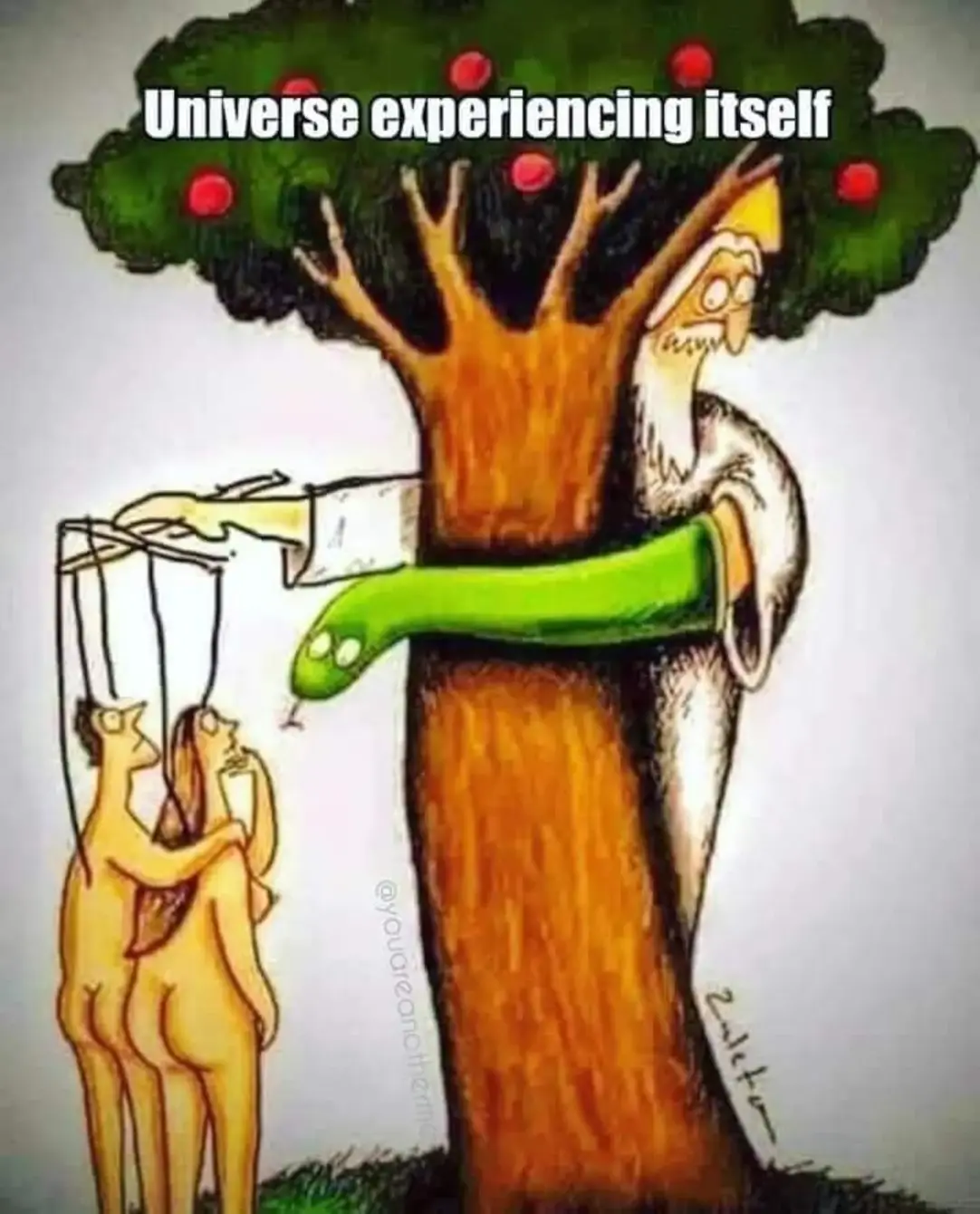
This meme is a satirical critique of Christianity's concept of the Fall of Man, where Adam and Eve are punished for eating the forbidden fruit. The image depicts a cartoonish, twisted version of the biblical story, where Adam and Eve are being punished by a giant serpent (representing Satan) who is being held by God, who is also being held by a giant tree (representing God's omnipotence). The text "You are your own worst enemy" is written above the image, highlighting the idea that humanity's self-destructive nature is a result of our own actions, rather than a divine punishment.
detailed-analysis (gemma3-27b-vision)
Okay, let's break down this provocative image through the requested theoretical lenses.
Please be advised: This image is highly suggestive and deals with religious and sexual themes. The following analysis will explore these themes in a scholarly, theoretical manner.
1. Visual Description
The artwork is a darkly humorous, and intentionally unsettling interpretation of the biblical story of Adam and Eve. It depicts a tree representing the Tree of Knowledge, though it’s oddly shaped like a body. The "tree trunk" is textured like skin and blends into the figure of an elderly, bearded man (presumably God) who is intimately connected to it. A large green serpent is positioned prominently, appearing as a phallic extension from God towards Eve, who along with Adam are depicted nude and suspended by strings like marionettes. Above them hangs a scroll that appears to be the biblical passage of the Ten Commandments. Red apples are suspended in the branches of the “tree.” The style is cartoonish, with exaggerated features and dark shading. The overall tone is ironic, provocative, and challenges traditional interpretations of the biblical narrative.
2. Foucauldian Genealogical Discourse Analysis
This image is ripe for Foucauldian analysis. Foucault would focus on the discourse surrounding the Adam and Eve story, and how power operates within it.
- Power/Knowledge: The image deconstructs the traditional power dynamic of God as the all-powerful creator. By visually connecting God physically to the act of temptation, it challenges the idea that God is separate from and above the actions of the serpent and the choices of Adam and Eve. Knowledge, in this context, isn’t about revelation from a benevolent deity, but about the embodied, potentially manipulative, nature of power itself.
- Genealogy: A genealogical approach would trace the historical development of the story. The image suggests that the narrative of original sin isn't a neutral recounting of events, but a carefully constructed discourse designed to regulate sexuality and impose moral control. The imagery of puppetry highlights the sense that humans are not free agents, but are controlled by external forces (or, in this reading, the power dynamics within the story itself).
- Disciplinary Power: The scroll of commandments symbolizes the rules and regulations imposed upon humanity. The marionette strings visually represent the disciplinary control exerted over humans, their bodies, and their desires. The image suggests that the ‘sin’ isn’t a transgression against divine law, but an assertion of agency—an attempt to break free from these strings.
3. Critical Theory
Applying Critical Theory, particularly the Frankfurt School tradition, we can see the image as a critique of religion and ideology.
- Domination and Repression: The image represents a critique of the way religion can be used as a tool for social control. The manipulation of Adam and Eve through the serpent—acting as an extension of the creator—suggests that ‘sin’ is not a spontaneous act of rebellion, but a result of being positioned within a power structure.
- False Consciousness: The image could be interpreted as revealing the “false consciousness” inherent in religious belief. If the creator is fundamentally involved in the temptation, then the narrative of “sin” and “redemption” becomes a self-serving mechanism for maintaining control.
- Critique of Authority: The image challenges the traditional authority of religious institutions and the patriarchal structures that often underpin them.
4. Marxist Conflict Theory
From a Marxist perspective, the image can be analyzed through the lens of class struggle and the exploitation of labor and desire.
- Power Dynamics: The image demonstrates a clear power dynamic, with God wielding absolute control over Adam and Eve. This can be seen as a metaphor for the ruling class exploiting the working class.
- Alienation: Adam and Eve, as marionettes, are alienated from their own agency and their own desires. They are puppets of a higher power, lacking control over their own lives.
- Control of Desire: The serpent, acting as an extension of God, represents the manipulation of desire for the purposes of control. This can be seen as a metaphor for the capitalist system, which exploits our desires to drive consumption and profit.
5. Queer Feminist Intersectional Analysis
This is where the analysis becomes particularly complex and resonant.
- Patriarchal Structures: The image challenges traditional gender roles and patriarchal structures by portraying God as a controlling and manipulative figure. The serpent can be seen as a phallic symbol, representing the patriarchal imposition of desire and control onto Eve.
- Female Subordination: Eve, as the target of the serpent's temptation, is presented as a passive object of desire and manipulation. This reinforces the historical portrayal of women as being more susceptible to temptation and sin.
- Intersectionality: The image can be analyzed through an intersectional lens by considering the ways in which gender, sexuality, and religion intersect to create systems of oppression. The portrayal of Eve as a passive object of desire reinforces the historical marginalization of women and the objectification of female bodies.
- Subversion of the Gaze: The image intentionally challenges the traditional male gaze by portraying God as intimately connected to the act of temptation. This can be seen as a subversion of patriarchal power dynamics and a reclamation of female agency.
6. Postmodernism
From a postmodern perspective, the image deconstructs the grand narratives of religion and morality.
- Deconstruction: The image dismantles the traditional interpretation of the Adam and Eve story by presenting a chaotic and ambiguous portrayal of the events. It challenges the notion of a singular, authoritative truth and opens up space for multiple interpretations.
- Irony and Parody: The image employs irony and parody to subvert the traditional reverence associated with the story. The cartoonish style and exaggerated features undermine the seriousness of the religious narrative.
- Fragmentation and Ambiguity: The image is fragmented and ambiguous, leaving room for multiple interpretations. This reflects the postmodern rejection of grand narratives and the embrace of subjectivity.
Disclaimer: This is a complex image, and these analyses are interpretations. Other theoretical lenses and perspectives could also be applied to understand its meaning. The purpose is to illustrate how different theoretical frameworks can illuminate the image’s complexities and challenge our assumptions.
simple-description (llama3.2-vision)
The meme depicts a tree with a snake wrapped around its trunk, with a caption "In a universe where everything is a metaphor for itself." The image shows a tree with a snake around its trunk, and a smaller tree-like creature in the foreground with a snake around its neck. The text above the image reads "In a universe where everything is a metaphor for itself".
tesseract-ocr
y Wey ST ETAT x ) ) nM 7 ly \ | \) A Lace