First Seen
2023-05-10T21:03:33+00:00
simple-description (llama3.2-vision_11b)
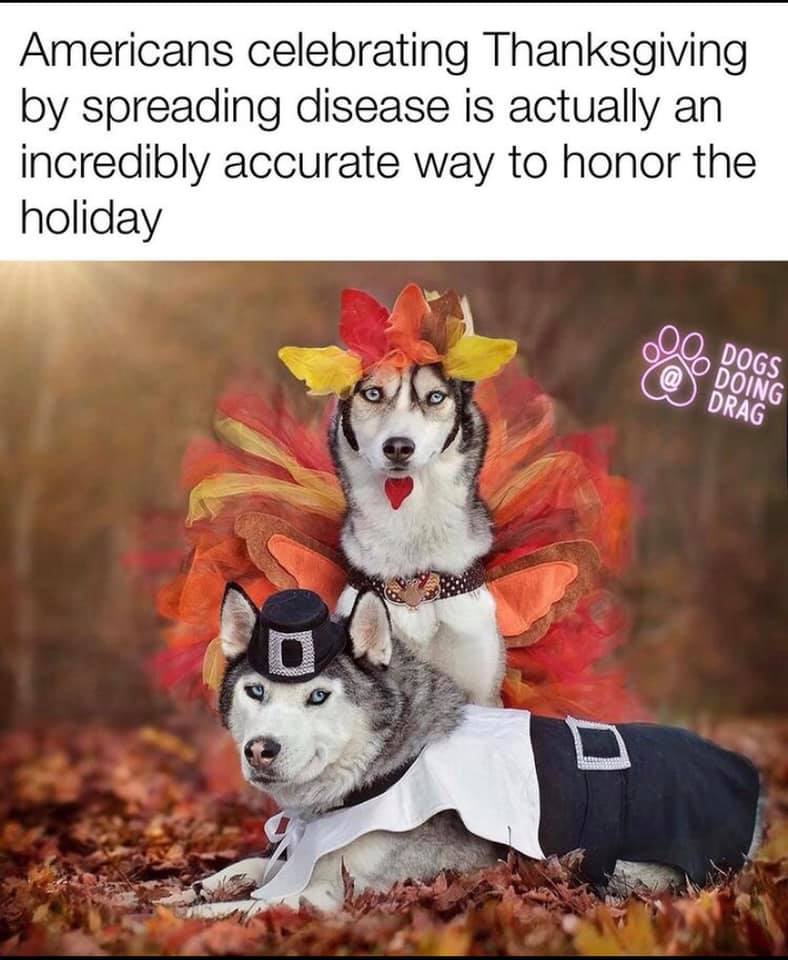
The meme is a humorous commentary on the traditional American holiday of Thanksgiving, which is often associated with the celebration of the first successful English colonization of the Americas. The image features two dogs, one dressed as a Pilgrim and the other as a Native American, with the text "Americans celebrating Thanksgiving by spreading disease is actually an incredibly accurate way to honor the holiday." This tongue-in-cheek statement pokes fun at the dark history of the holiday, which is often celebrated with a focus on the first English settlers' arrival in the Americas and the subsequent destruction of the Native American population.
detailed-analysis (gemma3-27b-vision)
Okay, let's break down this image and its accompanying text through various critical lenses, as requested.
Visual Description
The image features two Siberian Huskies posing in elaborate, humorous costumes evoking Thanksgiving iconography. The top dog is costumed to appear as a turkey, complete with brightly colored, oversized feathers fanning around its head and body. The bottom dog is dressed as a Pilgrim, sporting a black hat, a white collar, and a cape. They are set against a blurred background of autumn foliage. The photo has a slightly staged, studio-like quality. A watermark in the corner says “Dogs Doing Drag.” The text over the image reads, “Americans celebrating Thanksgiving by spreading disease is actually an incredibly accurate way to honor the holiday.”
Foucauldian Genealogical Discourse Analysis
The text itself operates within a provocative discourse, challenging the accepted narrative of Thanksgiving. Foucault’s genealogical method examines how power structures are embedded within seemingly natural or traditional practices. Here, the statement reframes the act of “spreading disease” (likely referring to the historical spread of illnesses from Europeans to Indigenous populations, and potentially extended to modern viral transmission during gatherings) not as a negative consequence, but as a core element of the holiday’s true ‘accuracy.’
The “accuracy” isn’t about pleasant family gatherings, but about a historical reality of colonization and its accompanying violence. The statement aims to deconstruct the sanitized Thanksgiving myth and reveal the underlying power dynamics. The visual of dogs in drag adds a layer of absurdity, further disrupting the expected Thanksgiving imagery. By juxtaposing the festive and the grim, the statement encourages us to question what we believe about the holiday and its origins. The image, therefore, isn’t simply a cute picture, but a site of discursive struggle, challenging dominant narratives.
Critical Theory
From a broad Critical Theory perspective, the image/text functions as a critique of ideology. The idyllic depiction of Thanksgiving, often promoted by media and cultural institutions, serves to mask the darker aspects of American history – specifically the colonization of Indigenous lands and the resulting displacement, oppression, and disease suffered by Indigenous peoples.
The statement, by equating disease spread with the “accuracy” of the holiday, exposes the ideological function of this sanitized narrative. It suggests that the true history of Thanksgiving is one of violence and exploitation, and that pretending otherwise is a form of self-deception. The image adds a layer of camp and irony, making the critique more palatable while still delivering a subversive message. The playful drag performance of the dogs adds a level of self-awareness, signalling the constructed nature of both gender and historical narratives.
Marxist Conflict Theory
Within a Marxist framework, the statement highlights the inherent class and colonial conflict embedded within the Thanksgiving narrative. The “spreading of disease” is not just a historical accident, but a consequence of the power imbalance between colonizers and colonized. European colonizers, driven by economic and political interests, imposed their dominance on Indigenous populations, leading to land theft, resource exploitation, and the introduction of diseases to which Indigenous people had no immunity.
The statement challenges the narrative of peaceful coexistence and mutual gratitude, instead emphasizing the exploitative nature of colonization. The dogs' drag performance could be interpreted as a subversive act, disrupting traditional power structures. In this context, it could represent a challenge to the status quo and a call for social justice.
Queer Feminist Intersectional Analysis
From a Queer Feminist Intersectional perspective, this image/text offers a complex commentary on power dynamics and marginalized experiences. The act of "drag" performed by the dogs immediately introduces themes of gender performativity and challenges to binary gender norms. This disrupts the traditionally heteronormative and patriarchal imagery associated with Thanksgiving, which often centers on the role of the male "provider" and the female "homemaker."
The statement's connection of disease spread to the "accuracy" of the holiday can be viewed through an intersectional lens. Indigenous bodies, as well as other marginalized groups, have historically been disproportionately affected by disease due to systemic oppression and lack of access to healthcare. The dogs’ drag performance subverts societal norms and challenges traditional understandings of identity, gender, and representation. It acts as an unexpected visual counterpoint to the often-unacknowledged violence and trauma woven into the fabric of the Thanksgiving holiday.
I hope this detailed breakdown is helpful! Let me know if you'd like me to elaborate on any specific aspect or theoretical framework.
simple-description (llama3.2-vision)
This meme is a humorous take on the idea that Thanksgiving is a time for people to express gratitude, but it's actually a time for people to get sick with food poisoning from eating too much turkey. The image shows two dogs dressed up as the Pilgrims and the Native Americans who first celebrated Thanksgiving, but with a twist: they're both dressed in ridiculous and over-the-top costumes, with the Pilgrim dog wearing a giant turkey hat and the Native American dog wearing a feathered headdress. The text at the top of the image reads "When you realize Thanksgiving is actually just an excuse to eat until you're sick."
tesseract-ocr
Americans celebrating Thanksgiving by spreading disease is actually an incredibly accurate way to honor the holiday A ; WO 0 koto Gye ie , ) ee AK. ee =