First Seen
2023-05-10T21:03:33+00:00
simple-description (llama3.2-vision_11b)
The meme is a satirical commentary on the historical and ongoing impact of colonialism on indigenous peoples. The image depicts a Canadian child being buried in a grave with Canadian symbols of patriotism and national pride, while the child's body is actually a skeleton with a Canadian flag and a totem pole in the background. The text "Canada's 150 years of genocide" appears in the image, highlighting the country's history of violence and oppression against indigenous peoples.
detailed-analysis (gemma3-27b-vision)
Okay, here's an analysis of the image, broken down into sections addressing the requested theoretical frameworks. It's important to note that a single image can be interpreted through multiple lenses, and these frameworks aren't mutually exclusive. I'll flag sections that don't heavily apply.
Visual Description
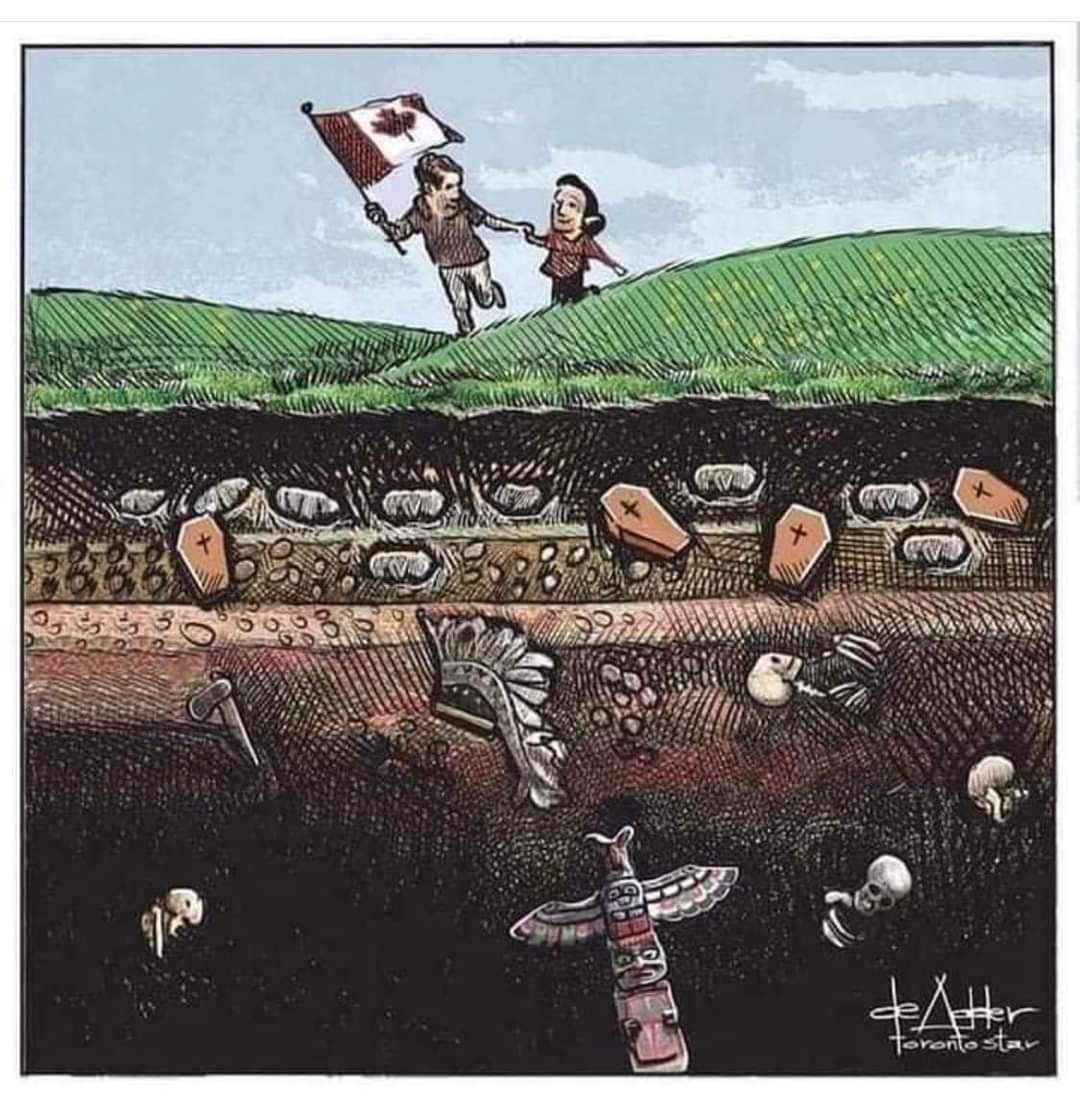
The image is a darkly-toned cartoon/illustration in a cross-section style, almost like an archeological dig. The upper portion shows a sunny green hill with a young boy and girl running up it, waving a Canadian flag. The lower portion, making up the majority of the image, is an archeological ‘cutaway’ revealing layers of soil and buried objects. These objects consist of broken crosses, skeletal remains (skulls and bones), metal weaponry (bayonets, cannon parts), and a shattered totem pole. The visual style is stark, with a lot of shading and texture emphasizing the earth and buried items. The contrast between the bright, hopeful surface and the dark, unsettling underbelly is striking. The artist’s signature is visible in the lower right corner.
Foucauldian Genealogical Discourse Analysis
This image lends itself very well to Foucauldian analysis. Michel Foucault's genealogical method seeks to uncover the historical conditions that produced our current understandings and power structures.
- Discourse & Power: The image reveals a discourse of national identity (represented by the Canadian flag) built upon a suppressed history of violence and dispossession. The running children seemingly represent a continuation of this national narrative, unaware or unconcerned with the foundation it's built on.
- Archaeology of Knowledge: The cross-section literally represents an archaeological dig, uncovering layers of buried history. Foucault would argue that these layers aren't simply "past" but continue to inform present power relations. The buried objects aren't just relics; they constitute the conditions of possibility for the present.
- Power/Knowledge: The act of burying these objects is itself an act of power. It's a way of controlling the narrative, silencing the voices of those who were victims of violence and dispossession, and constructing a particular version of the past. The running children, carrying the flag, are participating in and perpetuating this constructed reality.
- Episteme: The image suggests a shift in episteme (a system of thought and knowledge) where the violence against Indigenous peoples and other marginalized groups is rendered invisible or minimized in favor of a national narrative of progress and unity.
Critical Theory
Critical Theory, broadly, focuses on exposing power structures and ideologies that maintain social inequalities. This image is deeply resonant with Critical Theory.
- Ideology: The image critiques the dominant ideology of Canadian nationalism. The cheerful presentation of the flag-waving children contrasts sharply with the violent and traumatic history beneath the surface. It suggests that the national identity is constructed on a foundation of obscured suffering.
- Hegemony: The image challenges the idea of a benevolent, unified national identity. The cheerful surface represents the "hegemony" – the dominance of a particular worldview that masks underlying contradictions and injustices.
- Unmasking Oppression: The image “unmasks” the historical roots of contemporary social inequalities. It demonstrates that the present is not simply the result of natural processes but is shaped by past and ongoing systems of power and oppression.
- False Consciousness: The children, unaware of the buried history, can be seen as representing a form of "false consciousness"—a lack of awareness of one's true social position and the forces that shape it.
Marxist Conflict Theory
While the image is less directly about class struggle, Marxist Conflict Theory can still illuminate certain aspects.
- Historical Materialism: The buried objects – weapons, remnants of colonial encounters, and cultural artifacts – represent the "material" conditions of history. The image suggests that these material conditions are inherently conflictual and rooted in power imbalances. The conflict isn't just about ideology but about control over resources and the means of production (and, in this case, land and culture).
- Oppressor and Oppressed: The image clearly establishes a relationship between an oppressor (represented by the forces responsible for the buried violence) and the oppressed (represented by the skeletal remains, shattered totem pole, and the erasure of Indigenous history).
- Superstructure & Base: The running children and the flag represent the “superstructure” (ideology, culture) built upon the “base” (material conditions, economic relations). The image suggests that the superstructure is fundamentally shaped by and serves to legitimize the underlying power structures of the base.
Postmodernism
Postmodernism is less directly applicable than other frameworks, but aspects are present.
- Deconstruction: The image performs a form of “deconstruction” of the national narrative. It disrupts the simplistic, unified view of Canada by exposing the fragmented, violent history that underpins it.
- Meta-Narratives: The image critiques the “meta-narrative” of national progress and unity. It challenges the idea that history is a linear progression towards a better future, revealing the contradictions and exclusions inherent in this narrative.
- Relativism & Subjectivity: While not a primary focus, the image implicitly suggests that history is not a single, objective truth but is constructed through different perspectives and experiences.
Queer Feminist Intersectional Analysis
This is a strong lens through which to view the image.
- Intersectionality: The image powerfully demonstrates how different forms of oppression intersect. Indigenous genocide, colonial violence, and the erasure of Indigenous culture are all interconnected. The broken totem pole specifically points to the loss of Indigenous systems of knowledge, spirituality, and community.
- Gendered Violence: While not explicit, colonial violence has historically been and continues to be gendered. Indigenous women have been disproportionately affected by colonization, displacement, and violence. The image raises questions about the gendered dimensions of this history.
- Erasure & Silencing: The buried remains and shattered artifacts represent the erasure of Indigenous voices, histories, and experiences. This erasure is a form of violence in itself, denying Indigenous peoples their agency and autonomy.
- Decolonization: The image implicitly calls for decolonization—the process of dismantling colonial structures and reclaiming Indigenous sovereignty. The contrast between the sunny surface and the dark underbelly suggests that true progress requires confronting and acknowledging the violent foundations of the nation.
I hope this detailed analysis is helpful! Let me know if you'd like me to elaborate on any specific section or theoretical framework.
simple-description (llama3.2-vision)
This meme is a play on the classic "Canadian apology" stereotype, where a Canadian is forced to apologize for something that isn't their fault. The image shows a Canadian digging a hole in a graveyard, where the grave of a Canadian is being dug up. The text "Sorry" is written in the dirt, referencing the stereotype that Canadians are always apologizing for things that aren't their fault.
tesseract-ocr
As 3 ; a eS \ RX Sony WO aay RASS SSSSSARRRVRQAASSST AN MASc PANS DO KORN Sse ASG PSE ST KES YSSS SWE Sw AWA INS RS a SA Oma URNA ARR ANAL ROLES co FRSA SNES SSS cod RA eee gra MURILLO Beh WAR Nadine. | abso Pars SSSA ESS BSA Aes sens C7 Ree ORNATE z \ Oi SAL Pais y } NCE Ee Nu KUL Ae eQ Gu) & Poise AO SOW Se G apy > A uy = =X) ee FEN SE ON CAS 3. Nee YES BA ee Ps NW LY PRS RYE: Hl NN PS EEO WEN ase es NAS a WS OR N/a . yo ins A AN A yo : yi Re 7 ne Rs : See re ) y ae oh St wr 3 PN | lait 52) & eB 7 Sc Se uN ue ee cote