First Seen
2023-05-25T19:00:06+00:00
simple-description (qwen3.5_2b-q8_0)
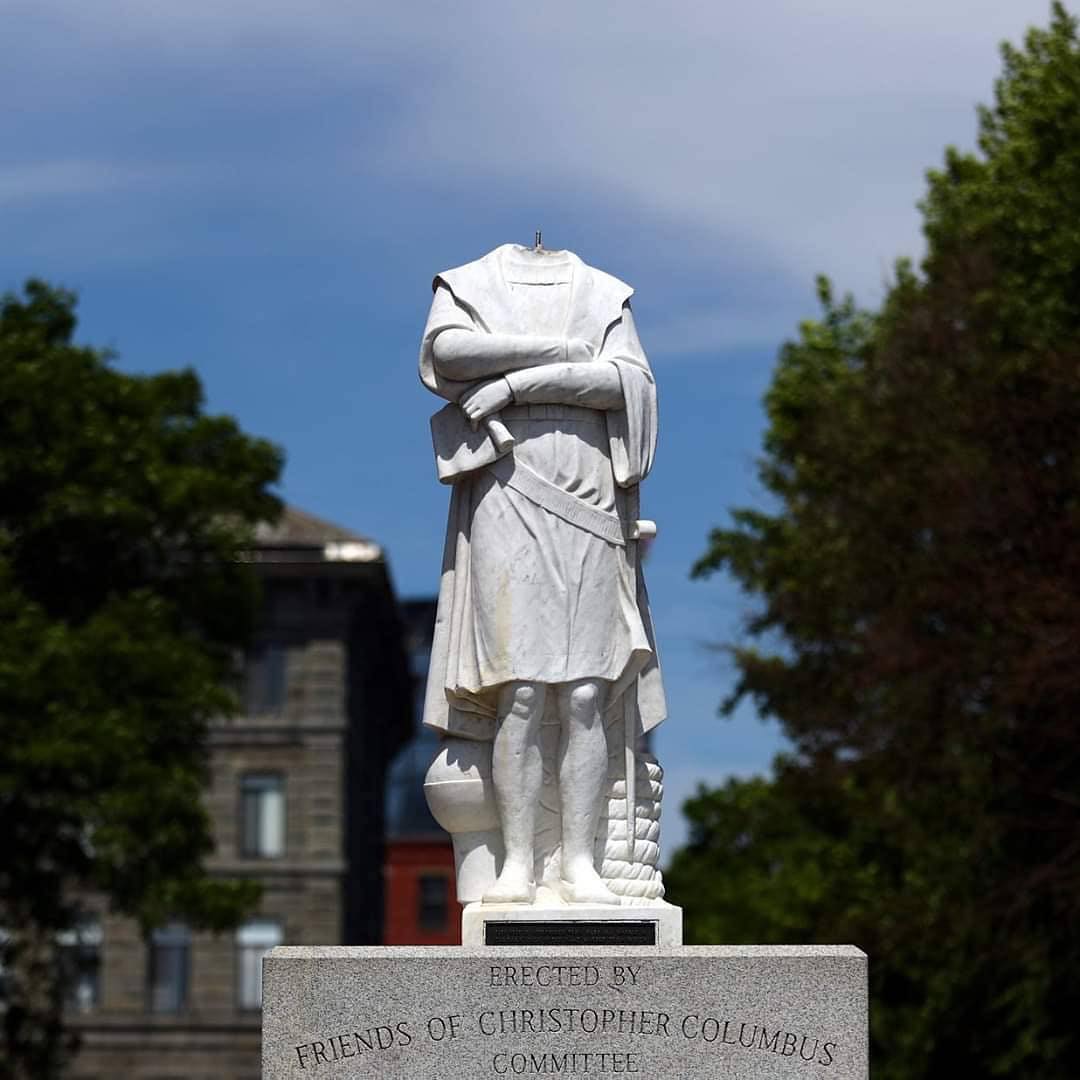
This popular internet meme satirizes the concept of Anti-Colonialism by showing a headless statue of Christopher Columbus. The plaque reads "ERECTED BY FRIENDS OF CHRISTOPHER COLUMBUS COMMITTEE." The joke suggests that removing the head represents him "taking off the Colonialism hat," acknowledging that he was wrong and that he shouldn't be allowed to continue his empire.
simple-description (llama3.2-vision_11b)
The meme is a photo of a statue of Christopher Columbus with a cardboard box covering its head, implying that Columbus is being "canceled" or removed from public recognition due to his controversial history of colonization and exploitation. The meme is a commentary on the growing trend of removing or recontextualizing historical figures and monuments that are seen as problematic or racist.
detailed-analysis (gemma3-27b-vision)
Okay, here's an analysis of the image, broken down into the requested sections. It's important to note that applying all of these lenses to a single image is a complex task. I'll focus on the strongest areas of application for each.
Visual Description
The image depicts a headless statue of Christopher Columbus. The statue is a classical, white marble/stone sculpture, depicting Columbus from the waist up, wearing period clothing—a long coat, collared shirt, and what appears to be a ruff around his neck. The statue is set on a pedestal, which in turn sits on a larger stone base. Inscribed on the base is “Erected by Friends of Christopher Columbus Committee”. The background shows a residential street with houses and lush green trees under a bright, clear blue sky. The overall impression is one of defacement and a deliberate act of vandalism or symbolic removal. The juxtaposition of the classical sculpture with its missing head is striking and immediately draws attention to the act of disruption.
Foucauldian Genealogical Discourse Analysis
This image is a powerful example of how power operates through discourse and the rewriting of history. Foucault's genealogical method examines how knowledge and power are intertwined and constructed over time.
- Historical Construction of Columbus: For centuries, Columbus was lauded as a hero, a discoverer, a symbol of European expansion and civilization. This narrative was constructed through education, monuments, celebrations, and historical accounts – all discursive practices.
- Disruption of the Discourse: The removal of the head disrupts this dominant discourse. It is an act of counter-discourse, challenging the established narrative and opening space for alternative interpretations. It refuses to allow the previous heroic image to continue to represent the past.
- Power/Knowledge: The statue itself was an embodiment of power/knowledge. It asserted a particular version of history as truth. The defacement reveals the constructed nature of that "truth" and the power relations that sustained it. The act implicitly states that the version of history the statue represents is no longer accepted.
- Archaeology and Genealogy: One could trace the “archaeology” of the Columbus myth – the layers of historical accounts and justifications that built it up. The defacement is a genealogical moment, a rupture that breaks with the past and seeks to create a different future by dismantling the symbol.
Critical Theory
Through the lens of Critical Theory, particularly drawing from the Frankfurt School, the image becomes a critique of power structures and ideological control.
- Ideology and Representation: The statue initially functioned as an ideological tool, reinforcing a narrative that served the interests of colonial powers and perpetuated a biased view of history. The headless figure represents the unraveling of that ideology.
- Critique of Enlightenment Rationality: The classical style of the statue ironically points to Enlightenment ideals of reason and progress. However, the defacement suggests that those ideals were often used to justify colonization and oppression.
- Reification and De-Reification: The statue reified Columbus – turned him into an untouchable, glorified object. The defacement de-reifies him, stripping away his symbolic power and exposing the human (and problematic) figure behind the myth.
- Emancipatory Potential: The act of defacement, though destructive, can be seen as having emancipatory potential. It represents a refusal to accept a dominant narrative and a demand for a more inclusive and accurate understanding of history.
Marxist Conflict Theory
From a Marxist perspective, the image highlights the inherent conflicts within history and the struggles between different social classes.
- Historical Materialism: The statue initially served the interests of the ruling class – those who benefited from colonialism and the exploitation of indigenous populations. The image reveals the material basis of the heroic narrative – the exploitation of land, labor, and people.
- Class Struggle: The defacement can be interpreted as a symbolic act of resistance by those who have been marginalized and oppressed by colonial powers. It is a refusal to accept the narratives imposed by the ruling class.
- Ideological Apparatus: The statue was part of the ideological apparatus used to legitimize colonial rule and maintain the existing power structures. The defacement disrupts that apparatus and exposes the underlying class interests.
- Alienation: The statue represents an alienating force, obscuring the true history of colonization and the suffering it caused. The defacement can be seen as an attempt to reclaim that history and restore a sense of agency to those who were dispossessed.
Postmodernism
This image embodies several key tenets of Postmodern thought:
- Deconstruction: The act of removing the head deconstructs the traditional meaning of the statue. It dismantles the singular, authoritative interpretation and opens up the possibility of multiple meanings.
- Rejection of Grand Narratives: The image challenges the grand narrative of European exploration and discovery. It suggests that history is not a linear progression towards progress, but a complex and contested terrain.
- Simulacra and Simulation: The statue was never truly Columbus himself, but a simulacrum – a copy without an original. The defacement exposes the artificiality of the representation and the constructed nature of history.
- Fragmentation and Instability: The headless figure embodies the fragmentation and instability of meaning that characterize postmodern thought. It suggests that there are no fixed truths or absolute values.
Queer Feminist Intersectional Analysis
Applying this lens focuses on how the statue and its defacement interact with issues of power, representation, and marginalization, particularly concerning gender, sexuality, and intersectionality.
- Colonial Violence and Gendered/Racialized Oppression: Colonialism was deeply intertwined with patriarchal and racist structures. The narrative surrounding Columbus often ignores or minimizes the violence inflicted upon Indigenous women and the disruption of Indigenous gender systems. The headless statue, in its act of disruption, opens space to consider the untold stories of those marginalized by colonial power.
- Symbolic Castration/Power Dynamics: The removal of the head can be interpreted (though cautiously, as this is a symbolic reading) as a symbolic “castration” of power, stripping the figure of its authority and challenging the patriarchal structures it represented.
- Reclaiming Narratives: The act of defacement can be seen as part of a broader movement to reclaim narratives and challenge dominant representations that exclude or misrepresent marginalized groups.
- Intersectionality: The statue and its defacement are not simply about Columbus or Indigenous people, but about the complex interplay of power relations based on race, gender, class, and sexuality. The image invites us to consider how these different forms of oppression intersect and reinforce each other.
I hope this provides a comprehensive and nuanced analysis of the image from the requested theoretical perspectives! Let me know if you'd like me to elaborate on any specific aspect.
simple-description (llama3.2-vision)
The meme is a photo of the Statue of Liberty with a hole cut out of its face, leaving a blank space. The text "Headless Liberty" appears below the statue. The joke is that the statue, which is often a symbol of freedom and democracy, has lost its head, implying a lack of freedom or control.
tesseract-ocr
Ao - ma |) 4 { a I ’ a " 4 ao | ) , _—, s S@ . | A\ ’ a” ea) = Gs : Ble. “4 ' id A See yy 4 ~ ; a | , af PERhCinn Be Le OE CHRISTOPHER Co : “eS OF CHRETORHER COL), - Oe cae IBUS