First Seen
2023-10-23T03:45:19+00:00
simple-description (qwen3.5_2b-q8_0)
This image is a satirical political "statement" that mimics the format of a news headline to function as a "meme," framing a diplomatic demand as a bold assertion of justice. In the context of anti-colonialism, this is a "weapon of the oppressed" that directly counters the historical narrative of Western colonial powers (specifically the US and Israel) who have historically justified military interventions and settlements in the Middle East by claiming moral superiority. It asserts that nations are held accountable for the suffering inflicted against Palestinian territories, effectively protest against the "occupation" of the land by allies of the occupier.
simple-description (llama3.2-vision_11b)
The meme is an image of Israeli Prime Minister Benjamin Netanyahu making a statement about the Israeli-Palestinian conflict. The meme is captioned "Netanyahu: 'I am a colonialist, I am a colonialist, I am a colonialist'". The image is accompanied by a quote from the meme's category, Anti-Colonialism, which reads "The Israeli-Palestinian conflict is a colonialist conflict".
detailed-analysis (gemma3-27b-vision)
Okay, here's a breakdown of the image and its potential analysis through the requested theoretical lenses. I'll include sections only where the theory is relevant and provide as detailed an analysis as possible.
Visual Description
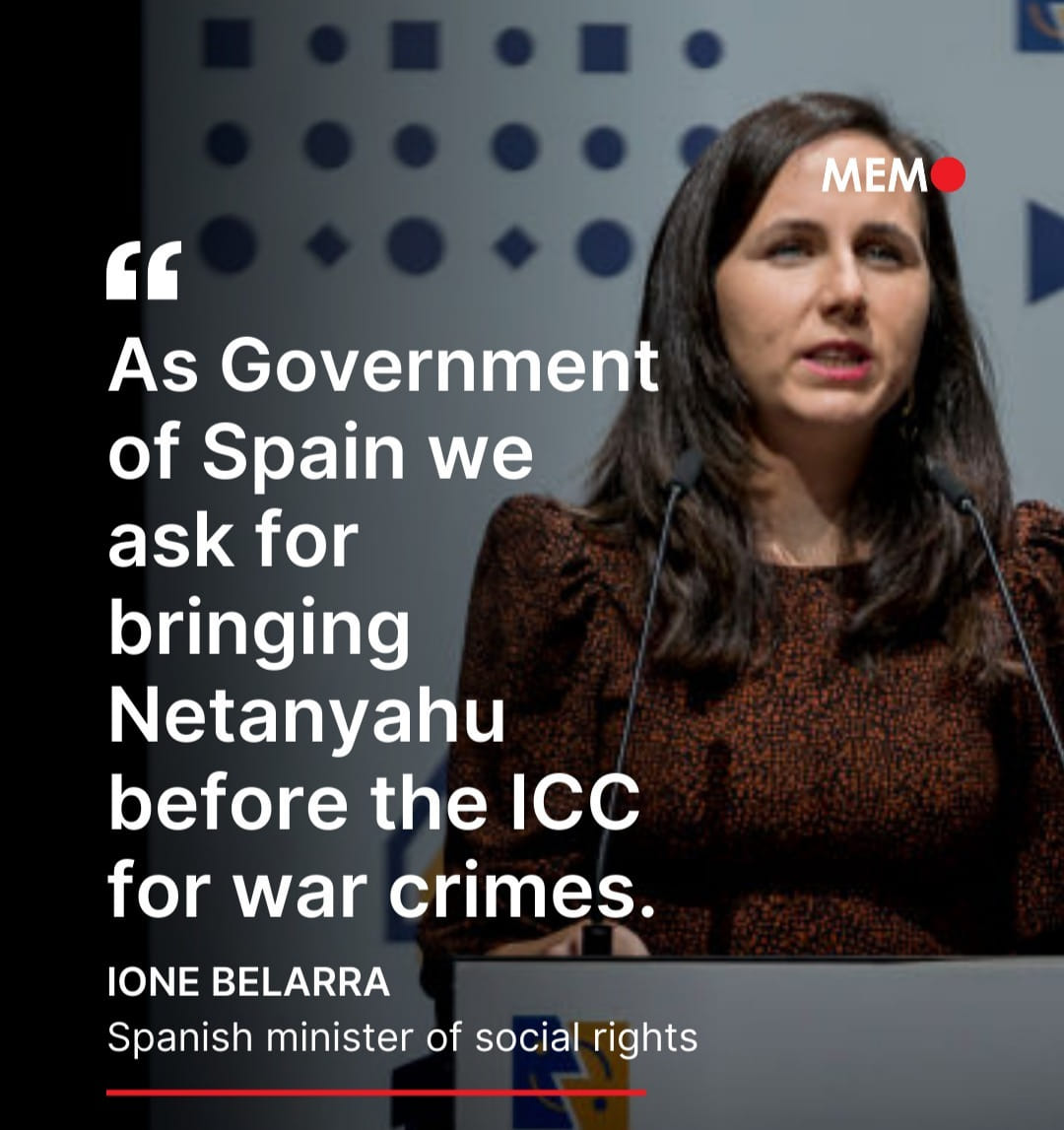
The image is a cropped photograph of Ione Belarra, the Spanish Minister of Social Rights, speaking at a podium. She is a fair-skinned woman with dark hair, wearing a dark blazer. Her expression is serious and direct, as if delivering a strong statement. Behind her is a blue wall with a pattern of circles. A small graphic with “MEM” and a red circle is in the upper right corner. Text superimposed onto the image presents a direct quote from Belarra: "As Government of Spain we ask for bringing Netanyahu before the ICC for war crimes." Beneath the quote is her name and title. The image is lit to highlight Belarra’s face and emphasize the importance of her statement.
Foucauldian Genealogical Discourse Analysis
This image is a perfect starting point for a Foucauldian analysis. The quote itself represents a discourse—a system of thought, ideas and language that constructs a subject or topic.
- Power/Knowledge: Belarra’s statement isn’t simply an assertion of fact; it’s an exercise of power. By naming Netanyahu and demanding his prosecution at the International Criminal Court (ICC), she’s attempting to construct him as a criminal subject within the discourse of international law. The power lies in the ability to define, categorize, and subject someone to legal consequences. Knowledge and power are inextricably linked here; the “knowledge” of international law is the power to judge and condemn.
- Genealogy: A genealogical approach would examine the history of the discourse around “war crimes” and the ICC. When and how did the concept of “war crimes” emerge? What power structures shaped the development of international law and the ICC? The analysis would trace how the language of “war crimes” has been used to justify certain actions and condemn others. This would likely reveal a history of colonial power dynamics and asymmetrical application of justice.
- Disciplinary Power: While not explicitly seen in the image, the demand for prosecution represents a form of disciplinary power. The ICC functions as a disciplinary mechanism within the international system, aiming to regulate the behavior of states and individuals.
- Subjectivation: Belarra’s statement is also part of a process of subjectivation. She positions herself and the Spanish government as upholders of international law and justice. She is framing herself as a moral actor acting in accordance with a supposed universal standard.
Critical Theory
Critical Theory focuses on power structures and social domination. The image aligns strongly with this lens.
- Ideology: The statement can be read as challenging the dominant ideology that often shields powerful nations and leaders (like Netanyahu) from accountability for their actions. By calling for prosecution, Belarra is disrupting the ‘naturalized’ acceptance of impunity.
- Hegemony: The statement suggests a critique of the existing geopolitical hegemony, particularly the influence of the United States and its allies in shaping international law and justice. It is a challenging of the status quo and an attempt to create counter-hegemonic discourse.
- Emancipation: The ultimate goal of the statement, from a Critical Theory perspective, is emancipation—the liberation of Palestinians from oppression and injustice. Holding Netanyahu accountable is seen as a step towards achieving this goal.
- Reason and Instrumental Rationality: From a Frankfurt School perspective, one could analyze how the rhetoric of international law is used as a tool for political action, potentially masking or justifying underlying power dynamics and interests.
Marxist Conflict Theory
A Marxist lens focuses on class struggle and material interests. It's somewhat less directly applicable than the others, but still present:
- Power Dynamics: While the statement appears to focus on legal accountability, a Marxist analysis would ask who benefits from this statement, and who is harmed. What material interests are at play in the demand for Netanyahu’s prosecution?
- Imperialism & Neocolonialism: One could argue that the conflict in Palestine is rooted in imperialist and neocolonial dynamics, and that the demand for accountability is part of a broader struggle against these forces.
- Ideological Struggle: The statement can be seen as part of an ideological struggle over the narrative of the conflict, with Spain positioning itself as a champion of justice and human rights.
Postmodernism
The postmodern lens is less prominent here but still present.
- Deconstruction of Truth: A postmodern reading would question the very notion of “truth” and “justice”. It would highlight the subjective and constructed nature of these concepts, and the fact that they are always embedded in specific power relations. The claim of "war crimes" is not necessarily a neutral objective truth, but a labeling enacted from a particular perspective.
- Challenge to Grand Narratives: The statement could be seen as a rejection of the grand narrative of Western exceptionalism and the idea that international law is universally applied.
- Relativism: A more extreme postmodern interpretation could potentially question the legitimacy of any claim to universal justice, leading to a more relativistic understanding of the conflict. However, this would likely be controversial.
Queer Feminist Intersectional Analysis
This is the least applicable lens, but could still offer some insights.
- Intersectionality: Intersectionality analyzes how various forms of oppression (based on gender, race, class, etc.) intersect and reinforce each other. In this context, one could analyze how the conflict in Palestine affects Palestinian women and LGBTQ+ individuals, who often face multiple forms of discrimination and violence.
- Critique of Power: A queer feminist analysis would focus on the patriarchal and colonial dimensions of the conflict, and the ways in which power operates to marginalize and silence certain voices.
- Solidarity: The statement could be seen as an act of solidarity with Palestinian women and LGBTQ+ individuals who are resisting oppression.
I've tried to provide a comprehensive analysis of the image through multiple theoretical lenses. Let me know if you'd like me to expand on any particular section or explore a different perspective.
simple-description (llama3.2-vision)
The meme is an image of a woman, likely a politician or celebrity, with a quote overlayed on top of her. The quote is from Israeli politician Benjamin Netanyahu, saying "It's true, I did visit the Holocaust museum in Washington, D.C. It is a museum. I am not a museum visitor." However, the actual quote in the meme is "I want to tell you something that's very important. When I visited the Holocaust museum in Washington, D.C. it is a museum. I am not a museum visitor." The image is accompanied by the text "It's true, I did visit the Holocaust museum in Washington, D.C. It is a museum. I am not a museum visitor."
tesseract-ocr
= 6 . rT 4 s As Government \ of Spain we ~ N Sy ask for 3 Ne bringing ae x Netanyahu to a beforetheICC for war ta IONE BELARRA a Spanish minister of social rights