First Seen
2023-11-21T05:45:07+00:00
simple-description (qwen3.5_2b-q8_0)
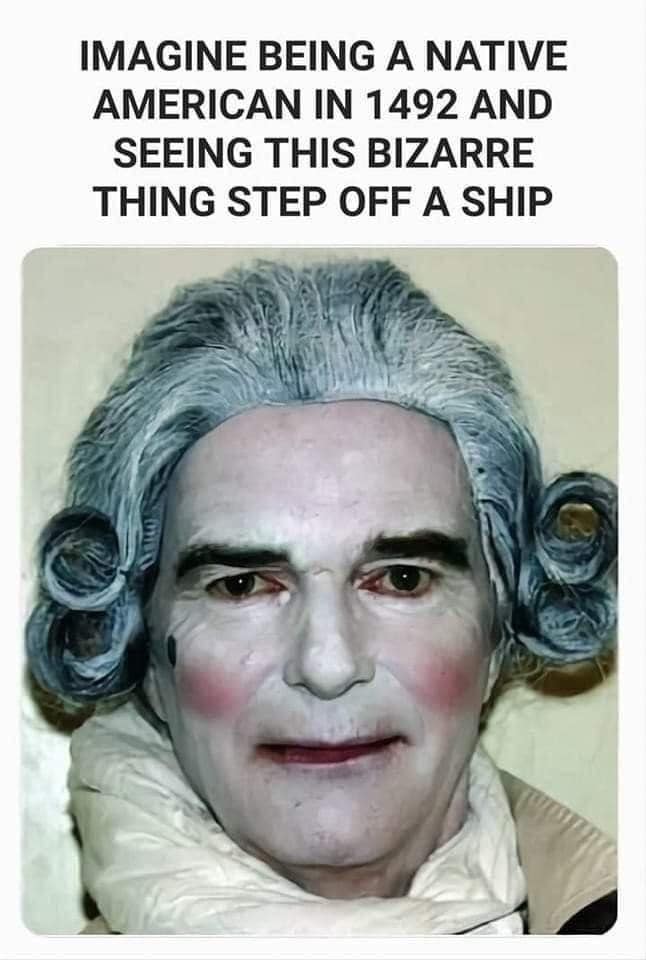
The image asks you to imagine a Native American in 1492 seeing a strange gentleman in an 18th-century wig step off a ship. It mocks the dehumanizing power dynamic by presenting the colonizers as a bizarre, foreign caricature rather than human beings. This anti-colonial critique suggests that the world's perception of Native Americans as exotic curiosities is ridiculous and disconnected from their reality.
simple-description (llama3.2-vision_11b)
This meme is a humorous commentary on the historical and cultural context of European colonization of the Americas. The image depicts a 18th-century European colonizer, dressed in colonial attire, with a caption that pokes fun at the idea of a European colonizer in 1492, when the Americas were already inhabited by indigenous peoples. The text "Imagine being a European colonizer in 1492 and seeing this" is a tongue-in-cheek commentary on the absurdity of European colonization and the cultural appropriation that often accompanies it.
detailed-analysis (gemma3-27b-vision)
Okay, let's break down this image and its implied meme using the requested critical lenses. It's a complex image loaded with layers of historical and cultural implications.
Please Note: This analysis is based on the image and the meme text "Imagine being a Native American in 1492 and seeing this bizarre thing step off a ship." The text is crucial for framing the interpretation.
1. Visual Description
The image is a headshot of a person seemingly in cosplay or theatrical makeup mimicking an 18th-century European aristocratic style. Key visual elements include:
- Wig: A large, powdered wig, characteristic of the 18th-century European upper class. The color is a striking blue.
- Makeup: Heavy rouge is applied to the cheeks, creating a pronounced, almost clownish appearance. There's also apparent lipstick or coloration of the lips.
- Clothing: The person is wearing a pale-colored ruffled garment, likely a shirt or jabot, typical of the period's fashion.
- Expression: The facial expression is somewhat ambiguous, a slight smile or smirk that could be interpreted as arrogance, theatricality, or unsettling composure.
- Image Quality: The image appears to be digitally manipulated or a screenshot. It has a slightly grainy quality, which adds to the surreal feel.
2. Foucauldian Genealogical Discourse Analysis
This image lends itself powerfully to Foucault's ideas.
- Power/Knowledge: The image is not simply about a person in a wig; it’s about the representation of power. The wig, the clothing, the makeup – these are historically constructed signifiers of European aristocratic authority. Foucault would argue that these elements are not neutral; they produce a particular kind of knowledge – a knowledge of dominance, entitlement, and colonial power.
- Discourse & Regulation: The 18th-century European aesthetic, as represented here, is a discourse that regulated bodies and identities. It prescribed ways of dressing, behaving, and presenting oneself to signify social status. This is particularly poignant when juxtaposed with the implied gaze of a Native American viewer in 1492.
- Genealogy of Power: By framing this image in the context of 1492, the meme asks us to consider the genealogy of colonial power. How did these European symbols of authority come to be associated with conquest, subjugation, and the dismantling of Indigenous cultures? The image presents a ludicrous exaggeration of European fashion to emphasize its absurd and ultimately violent implications.
- Disruptive Spectacle: The 'bizarre' nature of the person stepping off the ship is a disrupting spectacle for the Indigenous observer, signaling the arrival of a radically different (and threatening) way of life.
3. Critical Theory
Framed as a "bizarre thing stepping off a ship," the image engages deeply with Critical Theory concepts:
- Othering: The image visually emphasizes the extreme "otherness" of the European colonizer to the Indigenous person. Everything about the figure—the wig, makeup, clothing—is designed to signal a radically different world. This othering is a crucial step in justifying domination.
- Representation & Ideology: The image is a representation of European power, and that representation is ideological. It reinforces a specific worldview – one that sees European culture as superior and entitled to expansion.
- The Gaze: The meme explicitly frames the image through the eyes of the Native American observer. This is a critical move. It subverts the traditional colonial gaze (Europeans looking at the colonized) and forces us to consider how the colonizer appears to those being colonized. What would it feel like to encounter such a spectacle?
- Commodification of culture: The costume is performative, signaling that colonialism is an act.
4. Postmodernism
The image displays several postmodern characteristics:
- Pastiche & Hyperreality: The image is a blend of historical references (18th-century European fashion) and contemporary aesthetics (the digital manipulation, the meme format). This creates a kind of pastiche—a collage of signs that lacks a clear original meaning. It is a simulation of European authority, rather than a genuine representation.
- Deconstruction of Grand Narratives: The meme challenges the traditional “grand narrative” of European progress and civilization. By presenting a ludicrous, almost cartoonish version of European power, it exposes the absurdity and violence inherent in the colonial project.
- Irony & Parody: The image is heavily ironic. It parodies the pompousness and self-importance of European aristocracy, while simultaneously highlighting its destructive consequences.
- Emphasis on Subjectivity: By framing the image through the perspective of the Native American observer, the meme emphasizes the subjective experience of colonialism.
5. Queer Feminist Intersectional Analysis
While subtle, this lens can still illuminate aspects of the image:
- Disruption of Gender Norms: The extreme makeup and exaggerated attire can be read as a disruption of traditional gender norms. While the figure is likely male presenting, the heavy makeup blurs the lines and introduces a degree of camp and performativity. This challenges the rigid gender roles that were often imposed by European colonialism.
- Intersection of Oppressions: The meme powerfully highlights the intersection of colonialism and Indigenous dispossession. It suggests that the arrival of this bizarre figure is not merely a cultural encounter, but the beginning of a process of violence, oppression, and cultural erasure.
- Reclaiming the Gaze: By centering the Native American perspective, the meme subverts the traditional colonial gaze and allows for a reclaiming of Indigenous agency. It is a refusal to accept the colonizer’s version of reality.
- Camp & Spectacle: The image's "bizarreness" can be interpreted through a queer lens, as an instance of camp—a mode of aesthetic exaggeration and irony that challenges conventional norms.
In conclusion, the image and accompanying text are a complex and provocative statement on colonialism, power, and representation. It invites us to critically examine the historical and cultural forces that have shaped our world and to consider the perspectives of those who have been marginalized and oppressed. It’s a meme that, beneath the humor, packs a powerful punch.
tesseract-ocr
IMAGINE BEING A NATIVE AMERICAN IN 1492 AND SEEING THIS BIZARRE THING STEP OFF A SHIP a we 4 2 7 | a oe \ S | : ale iy t ey,
simple-description (llama3.2-vision)
This meme is a humorous image of a person who looks like a colonial-era American, but with a twist: they're dressed in a Native American headdress and a "I can't believe I'm still wearing this" expression. The text above the image reads "Imagine being a Native American in 1492 and seeing this". The meme is poking fun at the idea of European explorers discovering America, but with a humorous twist by imagining a Native American's reaction to encountering a European.