First Seen
2023-05-10T21:03:33+00:00
simple-description (llama3.2-vision_11b)
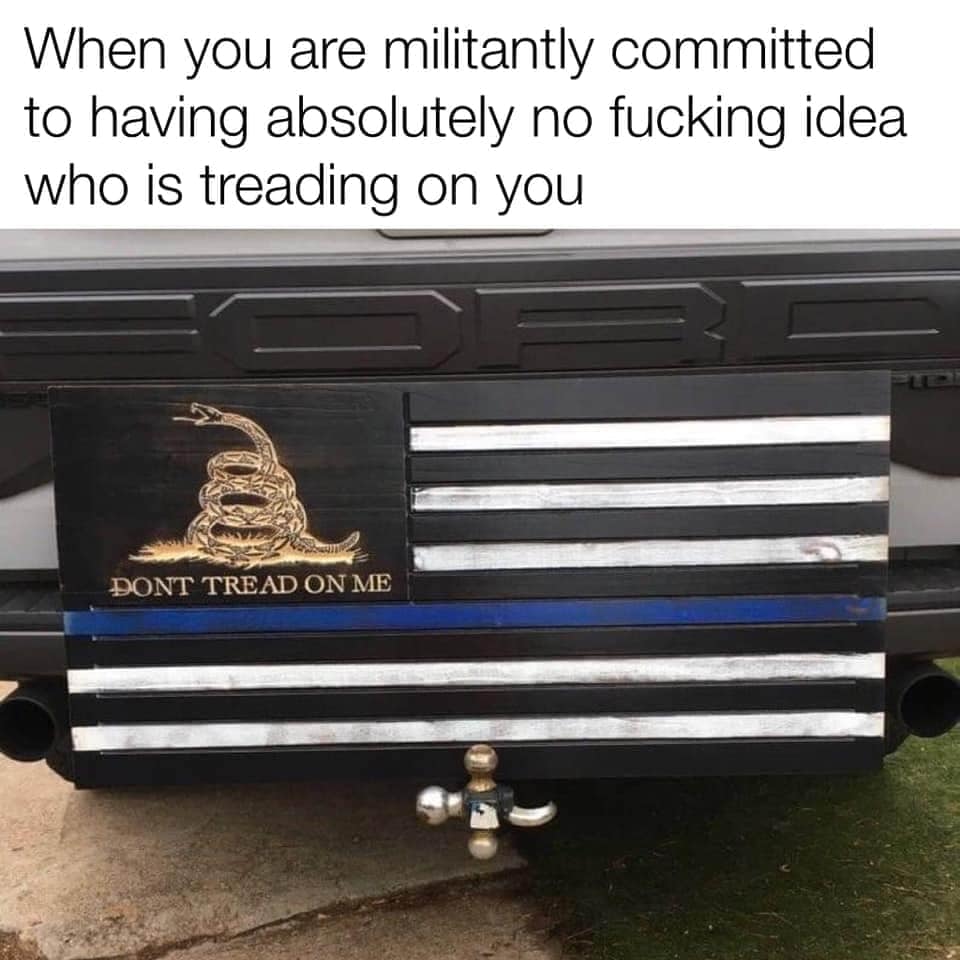
The meme is a sarcastic comment about someone's commitment to being anti-conservative, implying that they're so committed to being anti-conservative that they're willing to overlook or ignore any information that might be beneficial to their anti-conservative stance. The image is a picture of a truck with a "Don't Tread on Me" flag on the back, but the flag is modified to say "Don't Tread on Me, Unless You're a Cop" and has a blue line (a symbol of police support) added to it. The text above the image reads: "When you are militantly committed to having absolutely no idea who is 'treading on you'".
detailed-analysis (gemma3-27b-vision)
Okay, here's an analysis of the image, broken down by the requested theoretical lenses, with headings only for sections where the lens is applicable. I will attempt to provide nuanced analysis, acknowledging complexities.
Visual Description
The image depicts the rear of a silver pickup truck. A modified American flag decal or painted image is prominently displayed on the tailgate. This is not a standard US flag. It features:
- The "Don't Tread on Me" Gadsden flag design: A coiled rattlesnake is positioned in the upper left corner, the phrase “Don’t Tread on Me” below it.
- Thin Blue Line Integration: The thirteen stripes of the flag are replaced with alternating white and black stripes, representing the "thin blue line" - a symbol of support for law enforcement.
- Darkened Red Stripes: Two stripes on the bottom have been colored a darker shade of red.
- Hitch cover: A chrome hitch cover with a depiction of a skull and crossbones is attached to the trailer hitch.
The overall effect is a blend of Revolutionary War-era symbolism (the Gadsden flag) and contemporary pro-law enforcement messaging. The image is accompanied by text saying "When you are militantly committed to having absolutely no fucking idea who is treading on you."
Foucauldian Genealogical Discourse Analysis
This image lends itself powerfully to a Foucauldian analysis. We can trace the discourse around "freedom," "liberty," and "oppression" through the historical deployment of these symbols and how they've shifted in meaning.
- The Gadsden Flag’s History: Initially, the Gadsden flag represented colonial resistance to British tyranny. It was about resisting centralized, distant power. However, in recent years, it has been adopted by various movements, including some with decidedly different aims (libertarians, tea party, far-right groups). The genealogy shows how a symbol of resistance to external power can become a symbol of a specific power structure (those who identify with a specific vision of "freedom" and "individual liberty").
- The Thin Blue Line's Genealogy: Initially meant as a show of support for police, it has become deeply entangled in debates surrounding police brutality, systemic racism, and the relationship between law enforcement and marginalized communities. It represents a specific power/knowledge relation – a framing of police as protectors against chaos, which obscures or legitimizes potential abuses of power.
- The Combination is Key: The juxtaposition of these two symbols creates a powerful, but often unexamined, discourse. The message suggests that anyone challenging the perceived authority of law enforcement is "treading" on the truck owner’s “freedom.” This framing ignores the historical context of the Gadsden flag and simplifies complex issues of power and justice. The hitch cover skull and crossbones symbol further cements a "us vs them" dynamic.
The analysis reveals how these symbols aren’t neutral representations of “freedom” or “support for law enforcement,” but are actively constructed within specific power relations to produce certain meanings and legitimize certain actions.
Marxist Conflict Theory
The image is strongly indicative of class and power dynamics.
- The "Little Guy" Myth: The Gadsden flag and the rhetoric of "don't tread on me" often appeals to a sense of individual liberty and resistance against perceived overreach of authority. However, this framing can mask the underlying class interests at play. The rhetoric of freedom can be used to oppose regulations that protect workers, the environment, or marginalized groups, ultimately benefiting a specific class or group.
- State Apparatus & Legitimacy: The "thin blue line" symbol shows support for the state’s enforcement apparatus. In Marxist terms, the state is an instrument of class rule. Supporting the police, especially in the face of criticism of police brutality and systemic racism, reinforces the existing power structures.
- Ideological Function: The image functions as ideology. It constructs a narrative of victimhood (being "trod upon") and justifies a defensive posture, while obscuring the actual sources of oppression and inequality.
- False Consciousness: The image and its accompanying text reflect a “false consciousness”, where individuals are unaware of their true class interests or are persuaded to support systems that actively harm them.
Critical Theory
A critical theoretical lens allows us to examine the image's contribution to broader systems of domination.
- Instrumental Reason: The image reflects a reliance on instrumental reason – a focus on means-ends rationality. The truck owner sees the police as a tool to maintain order and protect their interests, without necessarily questioning the broader social consequences of that enforcement.
- Authoritarian Personality: This image could be interpreted as a visual manifestation of an authoritarian personality, characterized by a rigid adherence to authority, a fear of difference, and a tendency to see the world in simplistic, black-and-white terms.
- Repressive Tolerance: The image implies a form of repressive tolerance, where the display of symbols supporting authority is permitted, while dissent or criticism of law enforcement is implicitly suppressed.
- The Spectacle: As informed by Debord, this image can be seen as part of a spectacle, where the image itself becomes more important than the underlying realities. The truck owner is projecting an image of defiance and strength, but that image may obscure deeper social issues.
Queer Feminist Intersectional Analysis (Less directly applicable, but present)
While not immediately obvious, this image has implications for queer/feminist/intersectional analysis.
- Reinforcement of Dominant Masculinity: The image strongly projects a sense of rugged individualism and assertiveness—often associated with traditional forms of masculinity. This reinforces patriarchal norms and can contribute to hostile environments for marginalized genders.
- Exclusionary "Freedom": The "don't tread on me" rhetoric often ignores the specific oppressions faced by marginalized groups. A notion of "freedom" that prioritizes individual liberty without addressing systemic inequalities is inherently exclusionary.
- Increased Vulnerability: The strong alignment with law enforcement (thin blue line) could increase the vulnerability of marginalized groups who are disproportionately targeted by police violence and harassment.
- Interlocking Systems of Oppression: The image illustrates how systems of domination (patriarchy, racism, classism) are often intertwined. The truck owner’s defense of authority may be rooted in a desire to maintain their own privilege and power, at the expense of others.
Important Considerations:
- Context is Crucial: The meaning of this image depends on the specific context in which it is displayed.
- Oversimplification: This analysis is necessarily complex, and it's important to avoid simplistic interpretations.
- Agency: While we can analyze the image’s ideological implications, we must also acknowledge the agency of the truck owner and the potential for multiple interpretations.
I hope this detailed response is helpful. Let me know if you'd like me to elaborate on any of these points, or apply different theoretical frameworks.
simple-description (llama3.2-vision)
This meme is a humorous image of a truck's rear bumper, which has been modified to resemble the American flag, but with a twist. The image shows a black and white striped flag with a blue stripe in the middle, but instead of stars and stripes, it features a gold snake coiled around a stick, with the phrase "Don't Tread on Me" written below it. The text at the top of the image reads, "When you are militantly committed to having absolutely no idea who is treading on you."
tesseract-ocr
When you are militantly committed to having absolutely no fucking idea who is treading on you Ee ata FS ; DONT TREAD ON ME —— — 2 a i =_ oe ee ee 4 3