First Seen
2023-05-10T21:03:33+00:00
simple-description (llama3.2-vision_11b)
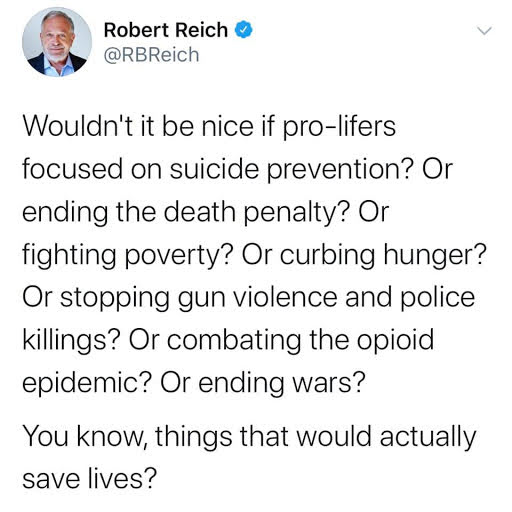
This meme is a satirical commentary on the conservative movement's focus on issues like abortion, gun control, and poverty, while ignoring the impact of these issues on the lives of people. The meme is a tongue-in-cheek response to the idea that pro-lifers would prioritize these issues over others, such as ending the death penalty, fighting poverty, and stopping gun violence. The text "Wouldn't it be nice if pro-lifers focused on..." is a sarcastic commentary on the priorities of the pro-life movement.
detailed-analysis (gemma3-27b-vision)
Okay, here's an analysis of the tweet from Robert Reich, broken down into the sections you requested, focusing on applicable theoretical frameworks. Note that some frameworks will be more relevant than others, and not all will apply strongly.
Visual Description
The image shows a screenshot of a tweet from Robert Reich (@RBReich) on X (formerly Twitter). The profile picture displays Reich in a suit, looking directly at the viewer. The tweet is a text-based post, a rhetorical question addressed to "pro-lifers," listing a series of social issues—suicide prevention, the death penalty, poverty, hunger, gun violence, police killings, the opioid epidemic, and war—as areas where they could focus their efforts to "actually save lives." The overall aesthetic is straightforward and direct, leveraging the concise nature of Twitter for a pointed political message.
Foucauldian Genealogical Discourse Analysis
This tweet can be analyzed through a Foucauldian lens by examining the discourse of "life" and how it’s constructed. The tweet challenges the dominant discourse around pro-life stances, which traditionally focuses solely on preventing abortion. Reich isn’t necessarily arguing against protecting fetal life, but rather questions how the "pro-life" label is operationalized in practice.
- Power/Knowledge: Reich implies that the "pro-life" position is exercising power through knowledge by defining "life" narrowly, centering it around conception. This narrow definition allows them to focus on abortion while ignoring other instances of life-threatening conditions and systemic issues. He challenges this by broadening the definition of what it means to “save life.”
- Genealogy: One could trace the genealogy of the "pro-life" movement to understand how it developed its particular focus. This would involve examining the historical, social, and political conditions that led to abortion becoming the central battleground for this particular notion of valuing life.
- Discursive Practices: The tweet performs a discursive practice – it reframes the debate around "life" by including other social problems. It attempts to disrupt the established association between "pro-life" and only anti-abortion activism.
Critical Theory
The tweet exemplifies a core tenet of Critical Theory – the critique of dominant ideologies.
- Ideology Critique: The tweet performs an ideology critique by highlighting what is seen as a contradiction in the “pro-life” position. It suggests that focusing solely on preventing abortion, while ignoring broader systemic issues that lead to death and suffering, represents a selective and potentially hypocritical application of a supposed value system.
- Reason as Domination: A Critical Theory perspective might interpret the “pro-life” obsession with abortion as a manifestation of instrumental reason – a form of rationality focused on control and achieving specific ends (in this case, preventing abortion) without considering broader ethical or social implications.
- Emancipatory Potential: The tweet attempts to create an emancipatory moment by suggesting alternative ways in which "pro-life" advocates could apply their values to address more pressing and widespread causes of death. It proposes a broader definition of valuing life that could lead to social change.
Marxist Conflict Theory
While not the primary theoretical lens, a Marxist analysis can shed some light on the tweet.
- Material Conditions: The list of issues Reich raises (poverty, hunger, opioid epidemic, war) are all deeply rooted in material conditions and class structures. The tweet implicitly suggests that a truly consistent "pro-life" position would require addressing the economic and social inequalities that contribute to these conditions.
- False Consciousness: One could argue that the exclusive focus on abortion distracts from the real sources of death and suffering, which are often tied to capitalist exploitation and systemic oppression. This distraction could be seen as a form of false consciousness.
- Class Struggle: The issues listed all have implications for class struggle, as marginalized and working-class populations are disproportionately affected by these problems.
Postmodernism
Postmodern analysis would focus on the deconstruction of the term "life" itself.
- Deconstruction of Grand Narratives: The tweet challenges the "grand narrative" of the "pro-life" movement, which assumes a universal and objective definition of "life." It suggests that this definition is socially constructed and contingent.
- Relativism: A postmodern perspective might emphasize that there are multiple, equally valid ways to value life. The tweet implicitly suggests that the "pro-life" position is just one among many possible value systems.
- Language as Power: The tweet's power lies in its rhetorical framing, which uses language to challenge established meanings and create new associations. The juxtaposition of “pro-life” with concerns like poverty and war aims to disrupt the traditional meaning of the term.
Queer Feminist Intersectional Analysis
This framework is somewhat less directly applicable but offers a unique lens.
- Intersectionality: This tweet highlights how different forms of oppression (economic injustice, systemic violence, lack of access to healthcare) intersect to impact people’s lives, especially marginalized communities. A queer feminist analysis would emphasize that these issues disproportionately affect LGBTQ+ individuals and women.
- Devaluation of Life: Feminist theory often examines how patriarchal systems devalue women’s lives, leading to higher rates of violence, poverty, and healthcare disparities. The tweet's concern with issues like gun violence, police killings, and the opioid epidemic connects to this line of thought.
- Reproductive Justice: While the tweet challenges the "pro-life" movement, a reproductive justice perspective would emphasize that true pro-life advocacy goes beyond preventing abortion and includes ensuring access to comprehensive healthcare, economic security, and social justice for all, including LGBTQ+ individuals and people of color.
I hope this detailed analysis, broken down by theoretical framework, is helpful! Let me know if you'd like me to elaborate on any particular point.
simple-description (llama3.2-vision)
This meme is a humorous and satirical commentary on the debate between pro-lifers and pro-choicers. The image shows a series of questions, such as "Wouldn't it be nice if pro-lifers focused on suicide prevention?" and "Wouldn't it be nice if they focused on ending the death penalty?" The text also asks "Wouldn't it be nice if they focused on ending poverty?" and "Wouldn't it be nice if they focused on stopping gun violence and police killings?" and finally, "You know, things that would actually save lives?"
tesseract-ocr
A Robert Reich @ 8 @RBReich Wouldn't it be nice if pro-lifers focused on suicide prevention? Or ending the death penalty? Or fighting poverty? Or curbing hunger? Or stopping gun violence and police killings? Or combating the opioid epidemic? Or ending wars? You know, things that would actually save lives?