First Seen
2023-05-10T21:03:33+00:00
simple-description (llama3.2-vision_11b)
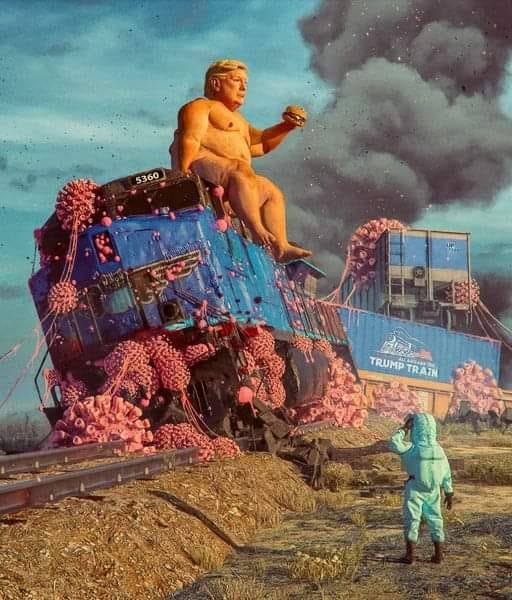
This meme depicts a scene from the 2019 film "Cats," where the character of Jel
detailed-analysis (gemma3-27b-vision)
Okay, here's a multi-faceted analysis of the image, broken down into the requested theoretical frameworks. This is a complex piece, so each section will be relatively in-depth.
Visual Description
The image depicts a bizarre and unsettling scene. A colossal, classical-style statue of Donald Trump, nude and holding a chicken leg, sits atop a blue locomotive engine. The engine itself is covered in a disturbing abundance of pink, fleshy protrusions – resembling masses of cancerous growths or disembodied organs. The train is labeled “Trump Train,” and it’s steaming and seemingly derailed, laying across a dry, yellowish landscape. Thick, dark smoke billows into a cloudy sky. A lone figure in a full-body hazmat suit stands in the foreground, appearing to photograph the wreckage with a camera. The lighting is stark, and the overall palette is a mix of bright, almost garish colors alongside the sickly pink and gray tones. There's a general sense of decay, grotesqueness, and implied disaster. The background is blurred, suggesting a desolate and damaged environment.
Foucauldian Genealogical Discourse Analysis
This image can be read as a powerful illustration of how power operates through discourse and the construction of knowledge. Foucault would focus on the genealogy of how Trump became a figure of authority and how that authority is displayed in the image.
- The Statue as Monument and Discipline: The use of classical statuary immediately connects Trump to historical figures of power, suggesting a deliberate attempt to legitimize him through visual association. But this is inverted – the nudity and the chicken leg undermine the traditional dignity and authority associated with such imagery. It's a parody of power, but also a demonstration of how power is projected – through symbolic representation. The statue disciplines the gaze by demanding attention, but the grotesque elements introduce disruption and challenge to that control.
- "Trump Train" as Discursive Formation: The term "Trump Train" itself is a discursive formation - a way of constructing and circulating ideas about momentum, control, and direction. The derailed train and the imagery of disease on the train signifies a breakdown of that supposed momentum and a corruption from within.
- The Hazmat Suit and Biopower: The figure in the hazmat suit embodies Foucault's concept of biopower – the ways in which power operates over the biological aspects of life. The suit suggests a need for protection from contamination, implying that the "Trump Train" has unleashed something dangerous – a metaphorical plague on the body politic. The figure's act of photographing is itself an act of surveillance and documentation, contributing to the construction of a narrative around the disaster.
- Power/Knowledge: The entire image operates as a manifestation of power/knowledge. The way Trump is represented (as both powerful and grotesque) is not neutral; it’s a construction that reinforces or challenges existing power structures.
Critical Theory (Frankfurt School)
The image aligns strongly with themes explored by the Frankfurt School, particularly regarding the culture industry and the alienation of modern life.
- The Culture Industry and Spectacle: The image can be seen as a commentary on the spectacle of politics in the age of mass media. Trump, as a figure constantly constructed through media representation, becomes a spectacle unto himself. The statue, in its exaggerated and absurd form, emphasizes the artificiality and constructedness of this spectacle. The image is a meta-commentary on how images create our understanding of reality, not the other way around.
- Commodification of Authority: The image hints at the commodification of authority. Trump’s image is being ‘sold’ as a symbol of power, even as it is visibly decaying and corrupted. This reflects the Frankfurt School's critique of how everything, including political leadership, is reduced to a commodity in capitalist society.
- Loss of Authenticity and Reason: The grotesque nature of the imagery suggests a loss of authenticity and reason in political discourse. The image isn’t about reasoned argument or genuine leadership; it’s about sensationalism, spectacle, and the manipulation of emotions.
- Alienation: The desolate landscape and the lone figure in the hazmat suit evoke a sense of alienation and isolation. The image suggests that the "Trump Train" has left a trail of destruction, leaving individuals feeling disconnected and powerless.
Marxist Conflict Theory
Through a Marxist lens, the image can be interpreted as a representation of class struggle and the inherent contradictions of capitalism.
- The Ruling Class and Symbolic Representation: The statue of Trump, as a symbol of power, represents the ruling class and its control over resources and ideology. The image can be seen as a critique of the concentration of wealth and power in the hands of a few.
- Exploitation and Decay: The fleshy growths covering the train might symbolize the exploitation of labor and the environmental damage caused by unchecked capitalism. The decay and disease suggest that this system is inherently unsustainable and will eventually collapse under its own weight.
- False Consciousness: The image can be seen as a metaphor for “false consciousness” – the idea that the ruling class manipulates ideology to convince the working class to accept their own exploitation. The spectacle of the “Trump Train” distracts from the underlying injustices of the system.
- The Hazmat Suit and the Proletariat: The figure in the hazmat suit could be seen as a member of the proletariat, forced to confront the toxic consequences of the ruling class’s actions and attempt to document the disaster.
Postmodernism
The image is deeply infused with postmodern sensibilities.
- Pastiche and Intertextuality: The image is a clear example of pastiche – a combination of different styles and references (classical sculpture, train imagery, biopunk aesthetics). The image references power, spectacle, and decay, but doesn’t offer a coherent or original vision.
- Deconstruction of Grand Narratives: The image rejects any grand, overarching narrative about progress, authority, or national identity. It challenges the idea that there is a single truth or meaning, instead presenting a fragmented, chaotic, and ambiguous scene.
- Simulation and Hyperreality: The image blurs the line between reality and simulation. The grotesque elements and the artificiality of the spectacle create a sense of hyperreality – a world that is more real than real.
- Irony and Parody: The image relies heavily on irony and parody. The statue of Trump is both a celebration and a mockery of power, and the spectacle of the “Trump Train” is both alluring and repulsive.
Queer Feminist Intersectional Analysis
This is a slightly more nuanced application, but relevant.
- Toxic Masculinity and Deformed Power: The naked, grandiose statue of Trump embodies a hyper-masculine ideal, but the grotesqueness of the image deforms and exposes the toxicity of that ideal. The "decay" could be interpreted as the unraveling of patriarchal structures.
- Environmental Justice & Bodily Autonomy: The environmental decay symbolized by the landscape and the "disease" on the train can be linked to feminist concerns about environmental justice—how marginalized communities disproportionately bear the brunt of environmental damage. The image suggests that this damage is linked to power structures. The grotesque imagery can also be read as a violation of bodily autonomy and the body politic.
- The Marginalized Observer: The figure in the hazmat suit (potentially coded as marginalized through its isolation and protective gear) represents the burden of witnessing and documenting the harm caused by those in power. This connects to the experiences of activists and those fighting for social justice.
- Disrupting Binary Oppositions: The image actively disrupts binary oppositions (strength/weakness, health/sickness, power/vulnerability) and challenges conventional notions of beauty and authority.
I hope this detailed analysis provides a comprehensive understanding of the image from multiple theoretical perspectives. Let me know if you'd like me to elaborate on any of these points.
simple-description (llama3.2-vision)
The meme features a photo of a train crash with a large, destroyed train car in the foreground. In the center of the wreckage is a statue of Donald Trump, naked and injured, with a broken leg and a bloody face. The text "TRUMP TRAIN" is written on the side of the train car, and a smaller sign on the statue reads "ALL ABOARD THE TRAIN OF DEATH".
tesseract-ocr
f z E *] G e ’ Se Rice : — : ges a oe ia = hae = fre NC WB bss 1 iG : a ts aa we ane a Pr Fo a eG wy Wi ae Mi \: = te SS A Fat TN ¢ a5, oy 2) Car we ee |) ee ‘ fe % PRD ee v7 epee eal a on a Be Sa LS cs Wg ree se AS: Pie REMIT ee aa eee ce