First Seen
2023-05-10T21:03:33+00:00
simple-description (llama3.2-vision_11b)
This meme is a satirical take on the "room for" phrase, often used in real estate or advertising, but here it's applied to a sci-fi setting, referencing the "room" for a specific type of person. The image likely shows a scene from a sci-fi movie or TV show, with characters in a space or space ship. The meme is saying that the "room" for a specific type of person, such as a "room" for a conservative, is not available, and the "room" for a specific type of person, such as a "room" for a conservative, is not available.
detailed-analysis (gemma3-27b-vision)
Okay, let's break down this image through several theoretical lenses.
Visual Description
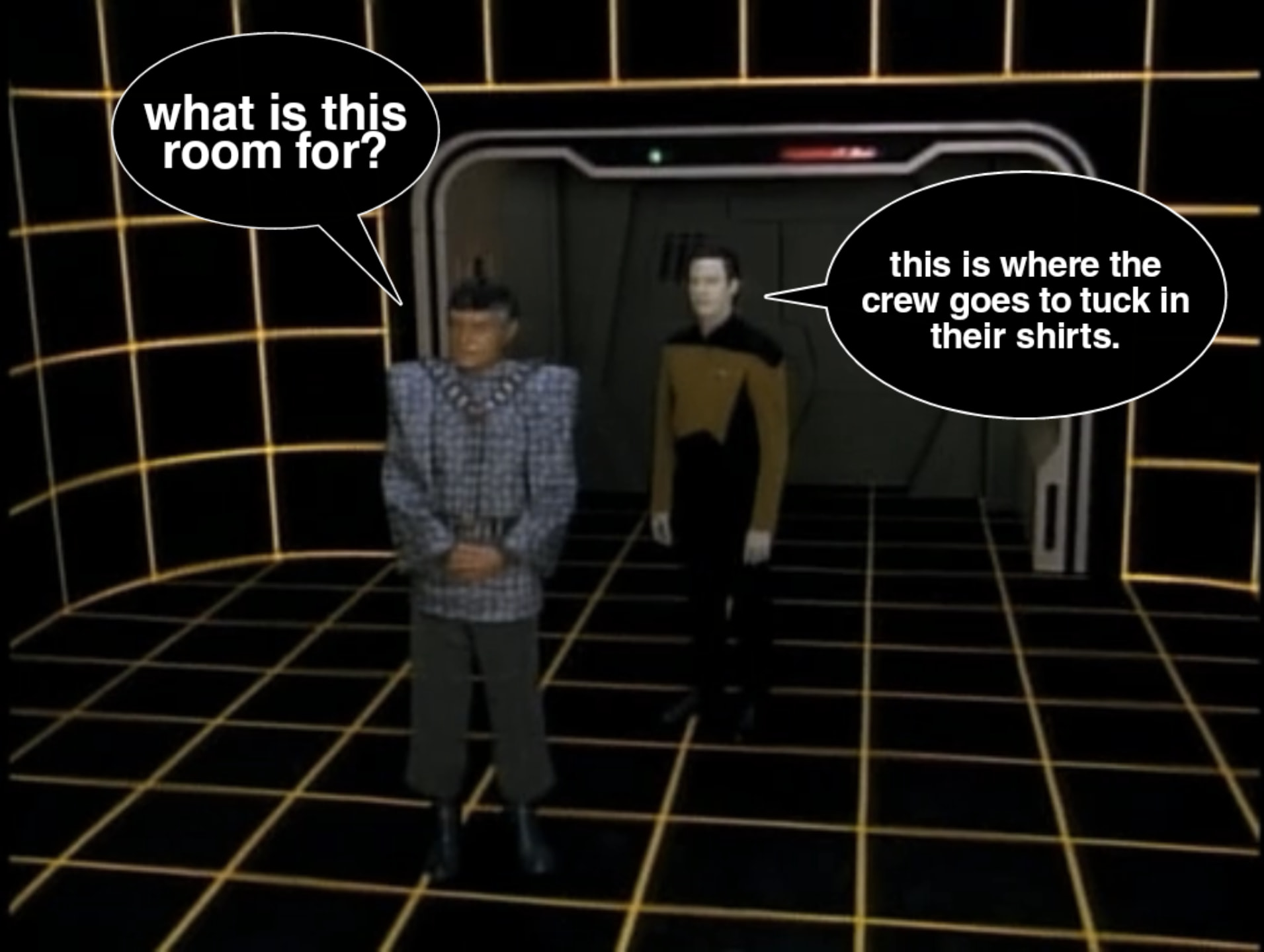
The image appears to be a screenshot from an early Star Trek video game or CGI cutscene, likely from the Star Trek: Voyager era due to the uniform style. Two male figures, presumably Starfleet officers, stand in a stark, minimalist room. The room is constructed of black lines creating a grid pattern over a lighter grey surface, giving the impression of a digitally constructed space. There’s a slight, distant glow from what might be a doorway or corridor further back in the room. The image is somewhat grainy, consistent with the early 3D graphics of the time. The image's humor is derived from the speech bubbles: one character asks, “what is this room for?” and the other responds, “This is where the crew goes to tuck in their shirts.” This is in reference to the Star Trek universe's uniform standards.
Foucauldian Genealogical Discourse Analysis
This image offers fertile ground for a Foucauldian analysis centered on discipline and normalization. The “shirt-tucking room” is a particularly apt example.
- Discipline & Panopticism: The room, while seemingly innocuous, operates as a subtle disciplinary mechanism. The expectation of “correct” uniform presentation, epitomized by the act of tucking in one's shirt, is a micro-level demonstration of power dynamics within the Starfleet hierarchy. The very existence of a designated room for this task suggests a hyper-focus on appearance and adherence to protocol. Even if no one is actively watching, the possibility of being observed (a panoptic effect) encourages self-regulation.
- Genealogy of Uniformity: A genealogical approach could explore how the idea of a rigidly defined uniform evolved within Starfleet. What historical or ideological conditions led to this emphasis on uniformity? Was it rooted in military tradition, a desire to erase individuality in the pursuit of collective goals, or a means of asserting control? The shirt-tucking room becomes a physical manifestation of this historical trajectory.
- Normalization & Deviation: Any officer not properly tucking in their shirt would be marked as "deviant" - a disruption to the expected norm. This demonstrates the power of discourse to define what is considered "normal" and to marginalize those who fall outside of it.
Critical Theory
The image, viewed through a critical lens, reveals the ways in which seemingly benign social norms can serve to uphold systems of power.
- Ideology and the Everyday: The insistence on tucked-in shirts, presented as something requiring a dedicated room, is a perfect example of how ideology operates in the everyday. It presents a rule, seemingly practical, that in reality reinforces a structure of obedience and control.
- False Consciousness: The officers, potentially unaware of the deeper implications of this practice, could be seen as embodying “false consciousness”. They accept the norm without questioning its underlying purpose or the power dynamics it supports.
- Repression and Sublimation: The act of tucking in a shirt might be seen as a small act of self-regulation, but it symbolizes a broader pattern of repression within the Starfleet structure. Individuality is subtly discouraged in favor of collective conformity.
Marxist Conflict Theory
While subtle, a Marxist reading can be applied to this image:
- Hierarchy and Control: Starfleet, as a military-like organization, inherently embodies a class structure, even if not explicitly economic. The shirt-tucking room represents a symbolic manifestation of this hierarchy. The expectation of adhering to dress code is a way for those in power to exert control over those below them.
- Labor of Conformity: The act of tucking in a shirt, repeated countless times by Starfleet officers, can be seen as a form of symbolic labor. It's a small, seemingly insignificant task that contributes to the maintenance of the existing power structure.
- Commodification of Identity: In a broader sense, the uniform itself is a form of commodification of identity. Individual expression is suppressed in favor of a standardized appearance that serves the interests of the organization.
Postmodernism
The image's humor and the absurdity of a dedicated "shirt-tucking room" lend themselves to a postmodern interpretation.
- Parody and Irony: The image operates as a parody of bureaucratic excess and the hyper-rationalization of modern institutions. The sheer dedication of an entire room to something so trivial is inherently ironic.
- Deconstruction of Meaning: A postmodern reading might deconstruct the “meaning” of the uniform itself. What does it signify? Is it a symbol of unity, discipline, or control? By highlighting the absurdity of the shirt-tucking ritual, the image challenges the taken-for-granted assumptions underlying the uniform.
- Simulacrum and Simulation: The room, as a digitally constructed space, can be seen as a “simulacrum” – a representation of something that lacks a real counterpart. It's a simulation of a task that could be performed anywhere, emphasizing the artificiality of the entire system.
Queer Feminist Intersectional Analysis
While less overtly present, a queer feminist intersectional analysis can be brought to bear:
- Gendered Expectations & Policing of Bodies: The emphasis on uniform presentation—particularly the tucking in of shirts—can be understood as a form of policing of bodies and a reinforcement of traditional gender norms. While not exclusively gendered, an obsession with a neat, orderly appearance can often be linked to patriarchal expectations.
- Regulation and Conformity: The image highlights the broader societal pressure to conform to norms, which can be particularly oppressive for those who fall outside of mainstream categories. This image touches on the way social norms can marginalize those who don't fit in.
Let me know if you'd like me to expand on any of these analyses or explore other theoretical frameworks!
simple-description (llama3.2-vision)
This meme is a play on the classic "Where's the [insert word here]?" joke, but with a Star Trek: The Next Generation twist. The image shows a scene from the show where a character is asking where something is, but instead of asking "where" the question is "where is the [insert word here]?" and the answer is "this is where the [insert word here] goes to tuck in their shirts."
tesseract-ocr
AV iriacei Neal for? a \ Se | > r amet cm al) 3 crew goes to tuck in e imal ate | a SV a fo