First Seen
2023-05-10T21:03:33+00:00
simple-description (llama3.2-vision_11b)
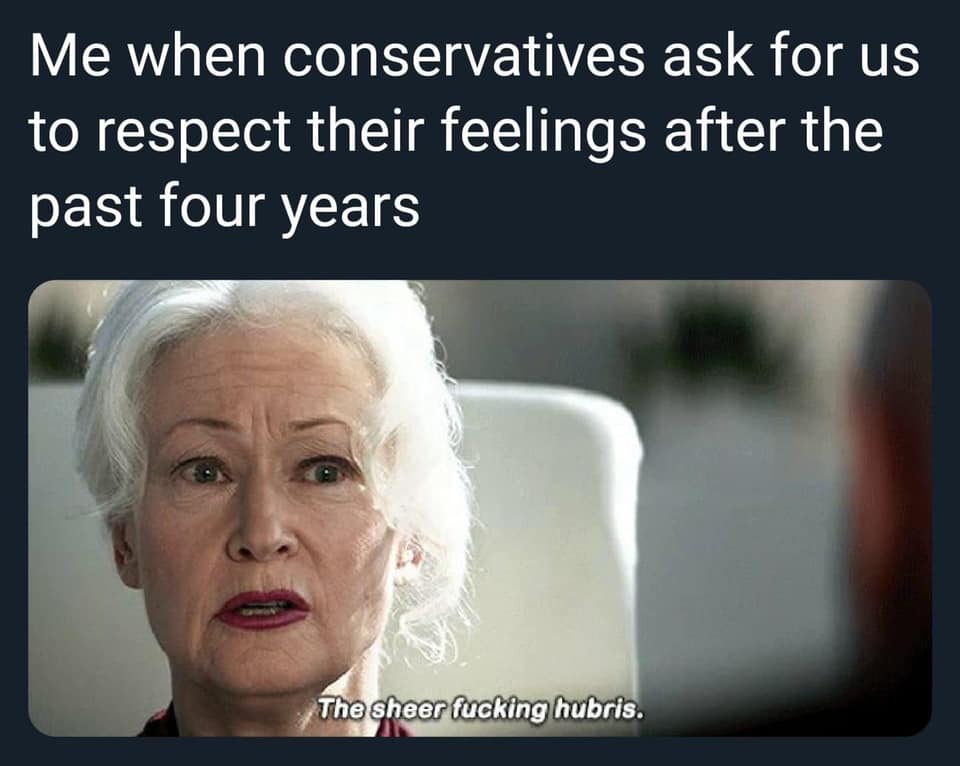
This meme is a humorous take on the idea of a conservative person asking for respect after years of being a part of a community that has been hostile to them. The image features a character from the TV show "The Hand of God" with a shocked expression, captioned "The sheer f***ing hubris" - a phrase that is often used to express outrage or disgust at someone's arrogance or sense of self-importance. The meme is poking fun at the idea that someone would expect to be treated with respect after years of being part of a community that has been hostile to them.
detailed-analysis (gemma3-27b-vision)
Okay, let's break down this meme through several theoretical lenses. It's important to note that memes are complex cultural artifacts, and often resonate on multiple levels.
Visual Description
The image depicts a close-up shot of actress Glenn Close, in character as Mallory Kane from the film Fatal Attraction. She's looking directly at the camera with a deeply skeptical and somewhat enraged expression. The lighting is dramatic, emphasizing her face and the intensity of her gaze. Superimposed at the bottom of the image is the text "The sheer fucking hubris." The meme's text above the image sets the scene: "Me when conservatives ask for us to respect their feelings after the past four years."
Foucauldian Genealogical Discourse Analysis
Foucault’s work emphasizes how power operates through discourse – language and knowledge systems. This meme engages in a counter-discourse. For years, conservatives often framed their own feelings and beliefs as universal, legitimate, and requiring respect. The “past four years” allude to the Trump era, characterized by perceived attacks on marginalized groups, divisive rhetoric, and a disregard for factual truth.
The meme re-articulates the demand for respect by turning it back onto conservatives. The image of Glenn Close, portraying a character known for her intensity and, frankly, dangerous behavior, visually suggests that the demand for respect from conservatives after those years is perceived as preposterous. The language “sheer fucking hubris” is key. Hubris, in classical terms, is excessive pride or arrogance – a transgression against the natural order. Framing the request for respect as hubris positions conservatives as exceeding acceptable bounds, and thus deserving of derision rather than accommodation.
The power dynamic is shifting—the meme attempts to deconstruct the previous framing of "respect" and re-assert a power dynamic where the demand is seen as unwarranted. It's an act of resistance through language.
Critical Theory
From a Critical Theory perspective (drawing from the Frankfurt School, like Adorno and Horkheimer), the meme can be seen as a critique of ideological hegemony. For years, certain conservative ideologies have dominated public discourse. The meme functions as a dissenting voice against that dominant narrative.
It implicitly argues that conservatives have not been sufficiently empathetic or respectful toward other groups during periods of perceived societal upheaval or injustice. The meme acts as a form of counter-cultural critique, dismantling the assumption that conservative feelings are equally valid or deserving of accommodation when they have actively contributed to harm or oppression.
Marxist Conflict Theory
While less directly applicable, we can view the meme through a Marxist lens as a manifestation of class and ideological struggle. "Conservatives," as a general category, are often associated with maintaining existing power structures and economic inequalities. The "past four years" saw a deepening of these inequalities and the rise of explicitly divisive policies.
The meme expresses the frustration of those who perceive themselves as marginalized or oppressed by these policies. It reveals a conflict between differing ideologies and material interests. The meme is not about feelings per se, but rather about power, dominance, and the resentment that builds up when one group perceives itself as consistently disadvantaged or ignored.
Postmodernism
Postmodernism challenges grand narratives and emphasizes the subjective nature of truth. The meme embodies this by deconstructing the universal notion of "respect." It is implicitly arguing that respect is not given automatically, but rather earned and contingent on behavior and context.
The use of a pop culture reference (Glenn Close in Fatal Attraction) is characteristically postmodern. It disrupts any attempt to create a coherent or 'serious' argument, relying instead on irony, parody, and intertextuality to convey its message. The meme doesn’t offer a reasoned explanation; it evokes a feeling of exasperation and disbelief through the visual and textual combination.
Queer Feminist Intersectional Analysis
The meme resonates particularly strongly within Queer and Feminist circles because the request for respect from conservatives often occurs after those same conservatives have actively worked to undermine LGBTQ+ rights, reproductive freedoms, and other vital protections.
The meme articulates a frustration born from the experience of consistently being asked to extend empathy or understanding to those who refuse to reciprocate. It highlights the asymmetrical power dynamics inherent in social and political interactions. The text and image combination express a sense of “enough is enough”—a refusal to continue accommodating views that are seen as harmful or oppressive. An intersectional analysis would recognize how this frustration is amplified for individuals holding multiple marginalized identities.
Let me know if you’d like me to elaborate on any of these points, or explore another theoretical framework!
simple-description (llama3.2-vision)
The meme is a humorous take on the idea of being asked to respect someone's feelings after being a conservative for four years. The image features a still from the TV show "The Handmaid's Tale" where a character says "The sheer fucking hubris" in a dramatic and intense tone. The text above the image reads "Me when conservatives ask for us to respect their feelings after the past four years."
tesseract-ocr
Me when conservatives ask for us to respect their feelings after the past four years al 4 nw : , as = : q é. { ite = > ’ $ ? yihe) € cr fucking/hubris.