First Seen
2023-05-10T21:03:33+00:00
simple-description (llama3.2-vision_11b)
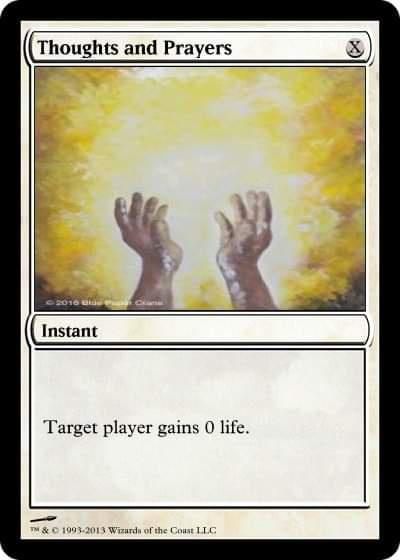
The meme is a picture of a person's hands raised in prayer, with the text "Thoughts and Prayers" above it. The image is likely being used to mock or satirize the idea of sending "thoughts and prayers" as a response to a tragedy or disaster, implying that it's a hollow and insincere gesture.
detailed-analysis (gemma3-27b-vision)
Okay, let's break down this "Magic: The Gathering" card, "Thoughts and Prayers," through the lenses you've requested. It's a particularly provocative card, as it quickly became a meme highlighting the perceived performative inadequacy of certain responses to tragedies.
1. Visual Description
The card depicts a blurred, golden-yellow background, likely representing light or a divine presence. Two hands are raised in a gesture that could be interpreted as prayer, supplication, or even surrender. The hands appear distressed; they have cuts and scrapes on them, suggesting suffering, struggle, or self-harm. The lighting is high-key, creating a dramatic and slightly unsettling mood. The image is deliberately ambiguous, leaving room for multiple interpretations. The card's color scheme is predominantly gold and white, suggesting purity, holiness, or perhaps even emptiness.
2. Foucauldian Genealogical Discourse Analysis
Foucault's genealogical method looks at how power operates through discourse—the ways we talk and think about things. "Thoughts and Prayers" as a card exposes the discursive formation around responses to crisis. This card speaks to a specific historical and cultural moment where simply offering "thoughts and prayers" became a widely recognized, often criticized, response to tragedies (mass shootings, natural disasters, etc.).
- Power/Knowledge: The card exposes how the discourse of "thoughts and prayers" functions to exert a certain kind of control. It’s a way of appearing to respond without actually doing anything. This aligns with Foucault’s concept of power/knowledge - the language we use constructs and maintains existing power structures. Offering thoughts and prayers might be seen as a way to avoid engaging with systemic problems.
- Archaeology of Knowledge: The history of offering sentiments as a substitute for action is complex. From religious rituals to empty political promises, the card points to a lineage of performative gestures.
- Discontinuity: The card ruptures the expected "healing" function of empathy. It exposes it as potentially empty, even harmful if not accompanied by tangible aid.
3. Critical Theory
From a Critical Theory perspective (drawing from the Frankfurt School, like Adorno and Horkheimer), the card exemplifies the culture industry at work.
- Commodification of Sentiment: The card takes a deeply human response (empathy, grief) and commodifies it, turning it into a game mechanic. This reflects a broader cultural tendency to package and sell even the most intimate feelings.
- False Consciousness: The card could be seen as a commentary on false consciousness. It suggests that simply feeling bad about a situation does not address the underlying social or political causes. The "instant" nature of the card—a quick, easy "play"—mirrors the superficiality of the response it critiques.
- Instrumental Reason: The card’s function within the game (as a card with no benefit) suggests the dominance of instrumental reason. It's a card that appears to offer something, but it's ultimately useless. This aligns with the Critical Theory critique of a society that prioritizes efficiency and utility over genuine human connection.
4. Marxist Conflict Theory
Through a Marxist lens, the card speaks to the material conditions that generate suffering and the ways in which symbolic gestures can function as a means of maintaining the status quo.
- Ideology: The card can be read as a critique of ideology. "Thoughts and prayers" can function as an ideological tool, distracting from the systemic issues (inequality, lack of access to resources, etc.) that contribute to tragedy.
- Class Conflict: The card implicitly highlights the disparity between those who offer "thoughts and prayers" (often those in positions of power) and those who are directly affected by the crisis. It points to the ways in which empathy can be used to deflect responsibility for addressing the root causes of suffering.
- Alienation: The card’s emptiness reflects the alienation of modern life. It suggests that individuals are disconnected from each other and from the material conditions that shape their lives. The card's function, or lack thereof, reinforces the sense of meaninglessness and powerlessness.
5. Postmodernism
From a Postmodern perspective, the card deconstructs the very notion of sincerity and authentic emotion.
- Simulacra and Simulation: The card can be seen as a simulacrum – a copy without an original. It's a representation of empathy that lacks genuine feeling. It emphasizes the hyperreality of modern life, where representations become more real than the things they represent.
- Deconstruction of Meaning: The card intentionally undermines the traditional meaning of "thoughts and prayers." It exposes the ambiguity and potential emptiness of the phrase.
- Playfulness and Irony: The card's inclusion in a game inherently introduces an element of playfulness and irony. It challenges the seriousness and reverence traditionally associated with expressions of sympathy.
6. Queer Feminist Intersectional Analysis
This is the most nuanced lens for understanding the card, as it connects the critique of "thoughts and prayers" to broader systems of oppression.
- Emotional Labor: "Thoughts and prayers" often disproportionately falls on marginalized groups (women, people of color, LGBTQ+ individuals) to manage the emotional fallout of crises. This card critiques the expectation that these groups must provide emotional support without receiving adequate support themselves.
- Interlocking Systems of Oppression: The card implicitly acknowledges that suffering is often rooted in interlocking systems of oppression (racism, sexism, classism, homophobia, etc.). "Thoughts and prayers" can function as a way to avoid addressing these systemic issues.
- Silence and Erasure: The card’s emptiness can be read as a metaphor for the silence and erasure of marginalized voices. It highlights the ways in which certain groups are often excluded from discussions about tragedy and loss. The lack of effect on the card highlights the lack of actual help or support provided.
- Performative Activism: The card critiques performative activism—the act of publicly expressing support for a cause without actually taking meaningful action. This is especially relevant in the context of social media, where it is easy to signal virtue without making a tangible difference.
It’s important to note that these analyses aren't mutually exclusive. The card’s power lies in its ability to be interpreted through multiple theoretical lenses, highlighting the complex relationship between language, power, and social action. It’s a provocative, and ultimately cynical, commentary on the human condition.
simple-description (llama3.2-vision)
The meme is a picture of a Magic: The Gathering card with a humorous twist on the typical fantasy setting. The card's name is "Thoughts and Prayers" and the text at the bottom reads "Target player gains 0 life." The image itself is likely a satirical take on the common phrase "thoughts and prayers" being offered in response to a tragedy or disaster, implying that the player's thoughts and prayers are the only thing they can offer to help.
tesseract-ocr
Thoughts and Prayers & £ . i f \ Py Ya Target player gains 0 life.