First Seen
2023-05-10T21:03:33+00:00
simple-description (llama3.2-vision_11b)
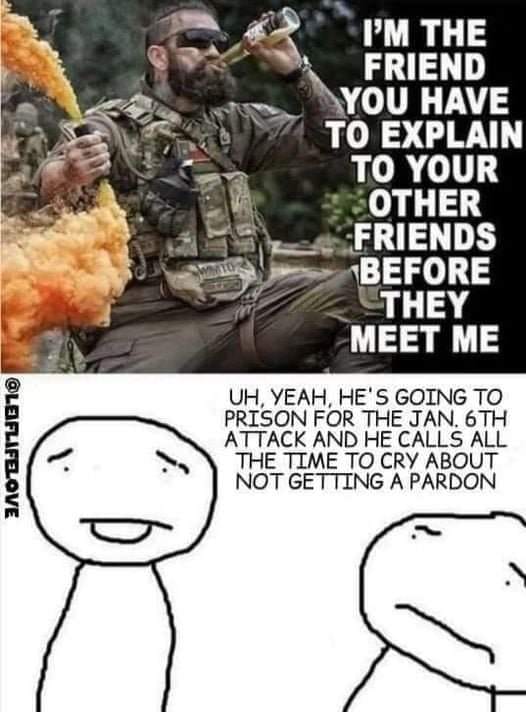
This meme is a humorous take on the idea of a friend trying to explain to someone why they're going to prison for the January 6th attack on the US Capitol. The image shows a person in a military uniform, holding a drink, with a caption that reads: "I'm the friend you have to explain to your other friends before they meet me." The text below the image reads: "Uh, yeah, he's going to prison for the Jan. 6th attack and he calls all the time to cry about not getting a pardon." The meme is poking fun at the idea that someone who is a friend to you, but also has a serious crime record, is going to be a bit of a conversation starter.
detailed-analysis (gemma3-27b-vision)
Okay, let's break down this meme using the frameworks you requested. It's a complex image laden with cultural and political signaling, so we'll have a lot to unpack.
Please note: This is an interpretation. The meme's meaning can be debated, and these analyses are frameworks applied to the content. I will prioritize the most applicable analyses given the content.
1. Visual Description
The meme is a two-panel image.
- Top Panel: Depicts a heavily tattooed, bearded man in military/tactical gear, holding a corn dog in one hand and a bottle up to his lips as if drinking. There's a blurry, orange explosion in the background. The text overlaid reads: "I'M THE FRIEND YOU HAVE TO EXPLAIN BEFORE THEY MEET ME."
- Bottom Panel: Shows a simplistic cartoon drawing of two stick figures. One figure, with exaggerated raised eyebrows and a wide smile, is saying "UH, YEAH, HE'S GOING TO PRISON FOR THE JAN. 6TH ATTACK AND HE CALLS ALL THE TIME TO CRY ABOUT NOT GETTING A PARDON." The other figure appears sad or irritated. The image is watermarked "@LEFTFLLOVE."
The imagery creates a clear contrast: a hyper-masculine, potentially intimidating figure paired with a flippant, gossipy confession.
2. Foucauldian Genealogical Discourse Analysis
This meme can be analyzed through a Foucauldian lens focusing on the power dynamics and discourses surrounding January 6th and the construction of identity.
- Discourse of "The Patriot": The man in the top panel actively performs a particular “patriot” identity. His military-style attire, tattoos, and seemingly defiant pose all contribute to a construction of rugged individualism and a specific vision of American exceptionalism. This is not a naturally occurring identity; it’s produced through a network of discourses and practices (e.g., gun culture, conservative media, online communities).
- The "Criminal" vs. "Victim": The confession in the second panel introduces a complex dynamic. He is going to prison for the January 6th attack, which implicates him in a violent act, but the emphasis on him "crying about not getting a pardon" attempts to shift the narrative toward him as a victim of a perceived injustice.
- Power/Knowledge: The stick figures are positioned as "knowing" the details of this man’s situation and, therefore, possessing a degree of power over the narrative. This power is expressed through gossip and the revealing of potentially damaging information.
- Genealogy of Right-Wing Extremism: This meme reflects a genealogy of right-wing extremism, tracing a historical lineage of grievances, ideologies, and aesthetic presentations that culminated in the January 6th attack. The man’s image acts as a visual marker within this historical trajectory.
3. Critical Theory
The meme lends itself to a Critical Theory analysis, particularly through the lens of the culture industry and ideology.
- Spectacle and Performance: The heavily constructed image of the man in the top panel is a performance of an identity. It's designed to be visually arresting and, arguably, to evoke a certain response from viewers (fear, respect, alignment). This is reminiscent of the "spectacle" described by Guy Debord, where images become more real than reality.
- Ideological Function: The meme can be seen as subtly reinforcing a particular ideology. While seemingly critical of the man's self-pity, it simultaneously presents his image in a way that may appeal to certain audiences and normalize a specific form of masculine aggression.
- Commodification of Identity: The man’s image has become a commodified symbol. It is circulated online, shared, and used to signify certain beliefs and attitudes. This commodification reduces a complex individual to a one-dimensional symbol.
- Critique of Victimhood: The meme subtly mocks the man’s self-pity and desire for a pardon, functioning as a critique of the entitlement and perceived victimhood within certain political circles.
4. Marxist Conflict Theory
Although less prominent, a Marxist lens can reveal underlying class dynamics.
- Class and Political Disaffection: The man's imagery hints at potential frustrations stemming from economic hardship and a sense of alienation from mainstream society, a common narrative within some right-wing extremist groups.
- False Consciousness: The focus on a pardon rather than addressing systemic issues could be interpreted as an example of “false consciousness” – a focus on individual grievances rather than recognizing larger structures of oppression.
- Contradiction of Victim and Aggressor: The image of a physically imposing man “crying about a pardon” creates a contradiction that highlights the complex interplay of power and vulnerability within the context of the January 6th attack.
5. Queer Feminist Intersectional Analysis (Less Applicable, but possible)
This is the least applicable analysis, but there are threads:
- Hypermasculinity & Violence: The man's hypermasculine presentation is linked to a culture of violence and aggression. Feminist analysis can critique how such performances of masculinity contribute to harmful social norms.
- Exclusion & Belonging: The meme implies that this man is an "outsider" or someone you'd need to "explain" before others meet him. This raises questions about who is considered "normal" or acceptable within social circles and who is marginalized.
- Intersection of Identity: While not explicit, the meme points to the way different aspects of identity (masculinity, political affiliation, criminal status) intersect to create a complex individual.
Overall Interpretation
The meme is a darkly humorous and cynical commentary on the January 6th attack and the individuals involved. It satirizes the self-pity and entitlement of someone facing consequences for their actions while simultaneously presenting a visually imposing figure that may appeal to certain audiences. It reveals anxieties surrounding identity, belonging, and the normalization of extremist ideologies.
Let me know if you'd like me to expand on any of these analyses or explore other frameworks!
simple-description (llama3.2-vision)
The meme is a humorous image of a man in a military uniform, holding a grenade and a beer, with a quote in bold white text: "I'm the friend you have to explain to your other friends before they meet me." The text below the image reads: "Uh, yeah, he's going to prison for the Jan. 6th attack and he calls all the time to cry about not getting a pardon." The image is a satirical commentary on the January 6th US Capitol attack and the subsequent pardon of the attacker.
tesseract-ocr
er LL ie We 211-11) be en ET \ 7 P= eee 7) sao oe elt op S| es 4) SE Say eee gas IN m= e UH, YEAH, HE'S GOING TO PRISON FOR THE JAN, 6TH ATTACK AND HE CALLS ALL THE TIME TO CRY ABOUT NOT GETTING A PARDON . a = | S