First Seen
2023-05-10T21:03:33+00:00
simple-description (llama3.2-vision_11b)
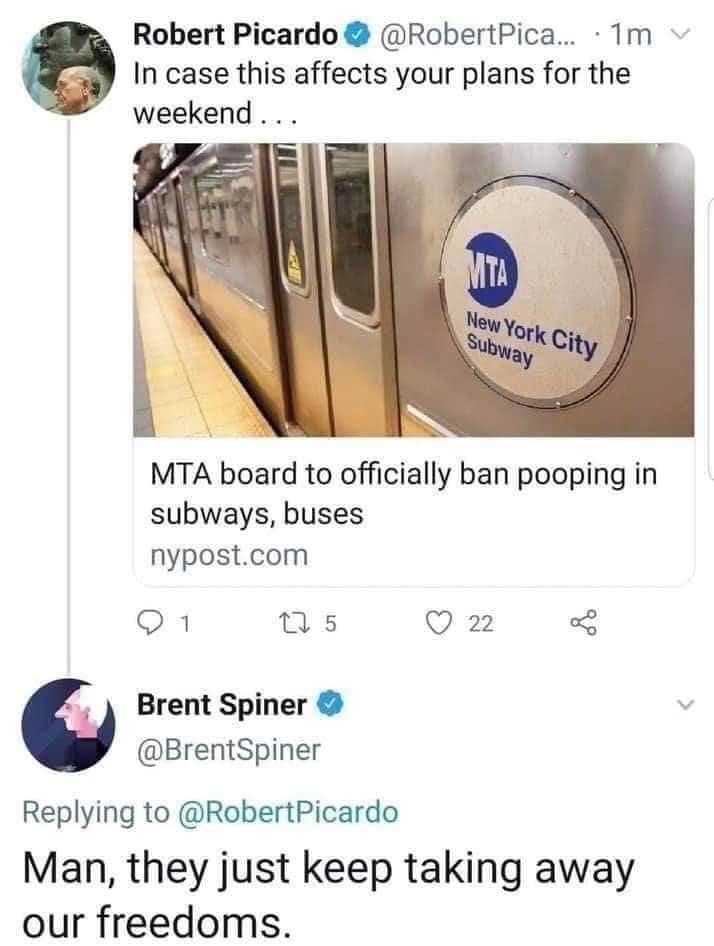
The meme is a satirical take on the New York City Metropolitan Transportation Authority (MTA) board's decision to ban "pooping" in subway cars. The image shows a New York City subway car with a sign that reads "No Pooping" and a photo of a person on the toilet. The text accompanying the image reads "MTA board to officially ban pooping in subways" and "In case this affects your plans for the weekend...". The meme is humorous and ironic, poking fun at the idea that the MTA would need to ban something as mundane as pooping in a public place.
detailed-analysis (gemma3-27b-vision)
Okay, let's break down this fascinating (and frankly, absurd) Twitter exchange through the lenses you've requested. It's a prime example of how seemingly mundane events can be loaded with deeper socio-political implications.
I. Visual Description
The tweet features a photo of a New York City subway car. The photo is a medium shot focusing on the interior of the subway car, specifically a row of seats. A circular emblem of the MTA (Metropolitan Transportation Authority) with the words "New York City Subway" is prominently displayed. The image sets the scene for the announcement of the ban on defecating in public transit. The color scheme is dominated by shades of beige and brown, creating a fairly utilitarian and unremarkable visual. Below the image is the tweet from Robert Picardo announcing a ban on public defecation and linking to a news article. Below that is Brent Spiner's reply, responding to the ban with "Man, they just keep taking our freedoms."
II. Foucauldian Genealogical Discourse Analysis
This is where it gets interesting. Michel Foucault’s work on power and discourse is highly relevant. The seemingly simple act of banning defecation in public transit isn’t about hygiene; it’s about the exercise of power and the construction of norms.
- Discipline & Biopower: Foucault argued that modern power operates not just through repression (explicit "no" rules) but through disciplinary practices (shaping behavior through surveillance, normalization, and examination). The ban is an exercise of biopower – control over the bodies and populations. The state is defining what is acceptable bodily function in a public space. The implication is that "proper" bodily function is contained, private, and controlled.
- Genealogy: To understand this ban, we need a genealogy of the concept of "public decency." Historically, what constitutes "indecency" is not natural or universal but socially constructed. This ban builds on a history of social norms about bodily functions, privacy, and public space. We can trace this through evolving sanitation practices, Victorian-era concerns about public order, and modern concepts of public health.
- Discourse & Subjectivation: The ban creates the "transgressor" – the person who would defecate in the subway. By defining this act as unacceptable, the ban constructs a specific subject position. The subject, in turn, internalizes this norm, potentially leading to self-regulation (and anxiety about accidentally transgressing).
III. Critical Theory
Critical Theory, largely stemming from the Frankfurt School, focuses on the examination of power structures and their influence on society.
- Rationalization & Bureaucracy: The ban is a symptom of increasing rationalization and bureaucratic control in modern life. It represents an attempt to impose order and predictability onto a complex social system. The very act of needing to issue a ban suggests a breakdown of social norms and an increasing reliance on formal rules and regulations.
- Culture Industry: (A stretch, but still possible) This event could be seen as part of the "culture industry" – a system that produces mass-produced cultural artifacts (like news articles about subway bans) that serve to reinforce dominant ideologies. The news coverage sensationalizes the problem and normalizes the imposition of control.
- Alienation: The ban highlights a potential alienation from the body and natural processes. Modern life often requires suppressing bodily functions or containing them in private spaces. This can lead to a disconnect from our physical selves.
IV. Marxist Conflict Theory
While not directly central, conflict theory can be applied.
- Social Control & Inequality: The ban can be viewed as a mechanism of social control. It's likely that those engaging in this behavior are marginalized individuals facing socioeconomic hardship (mental health issues, homelessness, lack of access to facilities). The ban doesn’t address the root causes of the problem but rather criminalizes a symptom. This reinforces existing power imbalances.
- Repression of the Underclass: The ban can be seen as another instance of the state regulating the behavior of the less powerful. It's a disproportionate response to a problem that likely stems from systemic inequality.
V. Postmodernism
Postmodernism emphasizes the fragmentation of meaning, the rejection of grand narratives, and the instability of truth.
- Hyperreality & Simulation: The ban, as mediated through social media and news coverage, can be seen as a form of simulation. The event itself is less important than its representation. The outrage and humor surrounding the ban create a hyperreal experience that obscures the underlying issues.
- Deconstruction of Norms: The absurdity of having to issue a ban on this behavior invites a deconstruction of the norms that led to this situation. Why is this even a problem? What social conditions have contributed to this?
- Rejection of Universal Truth: Postmodernism would reject the notion that this ban is a universally "good" or "necessary" thing. It would emphasize the context-dependent nature of morality and the subjective experience of "decency."
VI. Queer Feminist Intersectional Analysis
While not immediately obvious, this lens can provide an interesting perspective.
- Bodily Autonomy & Control: The ban, at its core, is about controlling bodies and bodily functions. Queer and feminist theory challenge the idea that the state has the right to dictate what people do with their bodies, particularly when those bodies are already marginalized.
- Disproportionate Impact: It's likely that the ban will disproportionately impact vulnerable populations, including homeless individuals, people with disabilities, and people experiencing mental health challenges. Intersectionality highlights how these intersecting identities can create unique forms of oppression.
- Challenge to Normative Assumptions: The ban reinforces normative assumptions about bodies, privacy, and public space. Queer and feminist theory would challenge these assumptions and ask who benefits from maintaining these norms.
In conclusion:
This seemingly simple Twitter exchange is loaded with socio-political implications. By applying these critical lenses, we can see how the ban on defecation in the subway is not just about hygiene but about power, control, social norms, and the construction of identity. The Twitter reply – "Man, they just keep taking our freedoms" – perfectly encapsulates the sense of alienation and resentment that can arise from the increasing rationalization and control of modern life. It’s a darkly humorous illustration of how even the most mundane events can be understood as part of larger systems of power and oppression.
simple-description (llama3.2-vision)
The meme is a screenshot of a Twitter conversation between two users, Robert Picardo and Brent Spiner, who are discussing the New York City subway's ban on eating on trains. The image shows a New York Post article headline "MTA board to officially ban pooping in subways" with a photo of a subway train. Robert Picardo responds to a news article saying "In case this affects your plans for the weekend..." and Brent Spiner replies with "Man, they just keep taking away our freedoms".
tesseract-ocr
7 Robert Picardo @ @RobertPica... - 1m In case this affects your plans for the weekend... Ay Me a 4 \\ ah, \ ‘ Dd ij he MTA board to officially ban pooping in subways, buses nypost.com 01 5 © 22 C4 F. ) Brent Spiner @ v @BrentSpiner Replying to @RobertPicardo Man, they just keep taking away our freedoms.