First Seen
2023-05-10T21:03:33+00:00
simple-description (llama3.2-vision_11b)
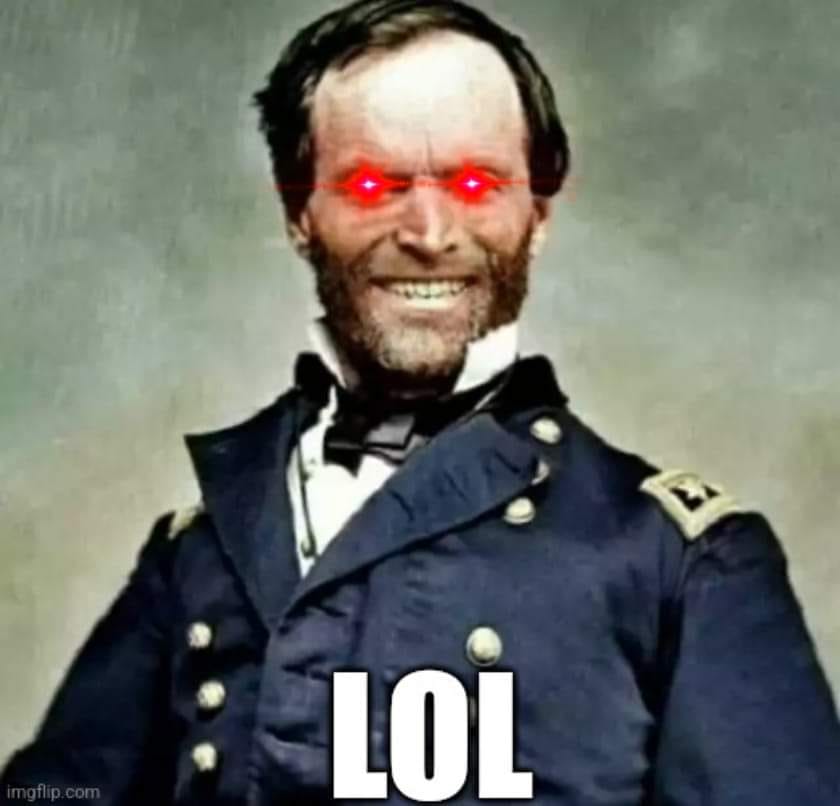
The meme is a humorous image of General William Tecumseh "U.S. Grant" with glowing red eyes, implying that he's possessed by a malevolent spirit. The image is captioned "LOL" (short for "laugh out loud") with a "U.S. Grant" face with a maniacal grin, implying that the general is laughing maniacally. The meme is likely used to express a humorous or sarcastic response to a situation, implying that someone is being ridiculous or absurd.
detailed-analysis (gemma3-27b-vision)
Okay, let's break down this image using the requested theoretical lenses. It's a fascinating, and unsettling, meme, so there’s quite a bit to unpack.
Visual Description
The image is a digitally altered portrait of a man in 19th-century attire, clearly evoking a historical figure, likely a military officer from the American Civil War era. He’s wearing a dark blue military uniform with brass buttons, a white shirt, and a black bow tie. The most striking feature is the alteration: his eyes have been digitally replaced with glowing red circles, giving him a demonic or sinister appearance. Below the portrait, in large, bold, white letters, is the internet slang term “LOL” ("laugh out loud"). The image has a watermark “imgflip.com” at the bottom, indicating it was created on a meme generator platform. The background is a faded, nondescript gray. The overall effect is intentionally jarring – a juxtaposition of a historical, dignified figure with a modern, flippant expression of amusement, and an implied menacing nature.
Foucauldian Genealogical Discourse Analysis
This image is ripe for a Foucauldian analysis. The image constructs a discourse around power, history, and the expression of "humor."
- Historical Power/Knowledge: The figure's 19th-century military uniform evokes an era steeped in authority, dominance, and the exercise of power. The image taps into the historical archive of power dynamics associated with war, command, and social hierarchy. The choice of a military figure is significant because it's inherently tied to organized violence and control.
- Disciplinary Power: Though not explicitly shown, the uniform implicitly connects to the systems of disciplinary power that operated in that era - the control of bodies, surveillance, and the enforcement of norms.
- The “LOL” as a Disruptive Force: The insertion of "LOL" disrupts this historical discourse. It represents a contemporary mode of expression that intentionally trivializes or subverts the seriousness usually associated with historical authority. It's a form of ironic detachment.
- Genealogy of "Humor": A genealogical approach would investigate how the very concept of "humor" has evolved over time, and how this specific use of "LOL" functions as a particular power/knowledge articulation. Is it a way to disarm authority through mockery? A nihilistic expression of indifference? The genealogy would trace the historical roots of this ironic "humor" and the conditions that give rise to it.
- Power/Knowledge Relation: The image shows a power/knowledge relation in the act of being overturned. The red eyes suggest a power unleashed, a disruption of the “normal” authoritative figure, and the “LOL” reinforces the subversion of the expected seriousness.
Critical Theory
From a Critical Theory perspective (drawing on thinkers like Adorno and Horkheimer), the image can be seen as a manifestation of several key themes:
- Culture Industry & Reification: The meme format itself is a product of the "culture industry" – a system of mass-produced cultural commodities. This image is a decontextualized fragment of history, repackaged for immediate consumption. This contributes to reification – the process by which complex social relationships are reduced to superficial objects.
- Loss of Aura: Walter Benjamin’s concept of “aura” – the unique authenticity of an artwork or historical artifact – is eroded. The image is a digital copy, stripped of its original historical context and imbued with a new, ironic meaning.
- Irony as a Form of Political Disengagement: The “LOL” can be interpreted as a cynical response to social and political issues. Irony, in this context, might serve as a way to distance oneself from meaningful engagement, avoiding genuine critique or action. It's a way of saying "everything is absurd" and thus avoiding responsibility.
- Commodification of History: The meme essentially commodifies history. It transforms a potentially significant historical figure into a fleeting source of amusement, ignoring the complex realities of his time.
Marxist Conflict Theory
From a Marxist perspective, this image can be interpreted as a subtle expression of class struggle and power dynamics.
- Subversion of Authority: The image represents a subtle form of rebellion against established authority. The figure in the uniform symbolizes power and control, while the "LOL" can be seen as a mocking, irreverent response from those historically oppressed or marginalized.
- Ideology and False Consciousness: The image’s seemingly harmless irony could be seen as a mechanism of false consciousness. By trivializing history and authority, it deflects attention from underlying economic and social inequalities. It's a form of entertainment that discourages critical thought about systemic problems.
- Class Consciousness: The potential for disrupting norms with irony could point to a budding class consciousness. The image's subversive nature implies a dissatisfaction with established power structures.
- Commodity Fetishism: The image can be seen as another commodity within the digital capitalist sphere. It's a piece of content designed to be shared and consumed, contributing to the endless cycle of production and consumption.
Postmodernism
The image is almost quintessentially Postmodern:
- Pastiche & Intertextuality: The image is a blend of historical imagery and contemporary internet slang. It's a pastiche – a playful, often ironic imitation of styles. The use of “LOL” inserts a new layer of meaning onto the historical portrait, creating intertextuality between the past and the present.
- Deconstruction of Meaning: The image actively deconstructs the traditional meaning of authority and historical representation. The red eyes and "LOL" create a jarring dissonance that undermines any sense of seriousness or reverence.
- Simulacra & Hyperreality: The image can be seen as a simulacrum – a copy without an original. It's a digital representation of a historical figure, divorced from its original context, and existing primarily as a signifier. This contributes to the hyperreality – a state where the boundary between reality and simulation becomes blurred.
- Irony & Playfulness: The image is steeped in irony and playfulness. It’s a deliberate attempt to disrupt conventional modes of representation and challenge established norms.
Queer Feminist Intersectional Analysis
This is the most complex area to apply, but potential interpretations exist.
- Subversion of Masculine Power: The image can be seen as a subversion of traditional masculine power. The figure is a historical representation of authority and military strength, but the red eyes and “LOL” destabilize that power. It can be read as a playful dismantling of patriarchal norms.
- Reclaiming Historical Narratives: While not explicit, the disruption of the image can be seen as a queer feminist tactic of reclaiming and rewriting historical narratives. The figure is detached from the power he represents, and that power is mocked.
- Irony as a Survival Strategy: For marginalized groups, irony and humor can be used as a survival strategy, a way to cope with oppression and maintain agency. The "LOL" could be interpreted as a form of defiant resilience.
- Intersectionality & Power Dynamics: An intersectional approach would consider how the image’s meaning might be different depending on the viewer’s identity. The power dynamics represented in the image might resonate differently for people of different genders, races, classes, or sexual orientations.
- Critique of the Military-Industrial Complex: The image’s subversion of a military figure can be seen as a critique of the military-industrial complex and its impact on marginalized communities. The mocking “LOL” can be read as a rejection of violence and oppression.
Important Note: These are interpretations. The meaning of any image, especially a meme, is subjective and open to debate. The lens through which you analyze it will shape your understanding. Also, a meme’s interpretation can shift over time and in different contexts.
simple-description (llama3.2-vision)
This meme is an image of a historical figure, likely General William Tecumseh Sherman, with a twisted and evil grin. The image has been edited to make his eyes glow red with an otherworldly energy, giving him a menacing and supernatural appearance. The text "LOL" appears below the image, implying that the figure is finding the situation humorous, but the tone is actually sinister and unsettling.
tesseract-ocr
ay —— 4 in i. ~ er a e e P . e ~EH