First Seen
2023-05-10T21:03:33+00:00
simple-description (llama3.2-vision_11b)
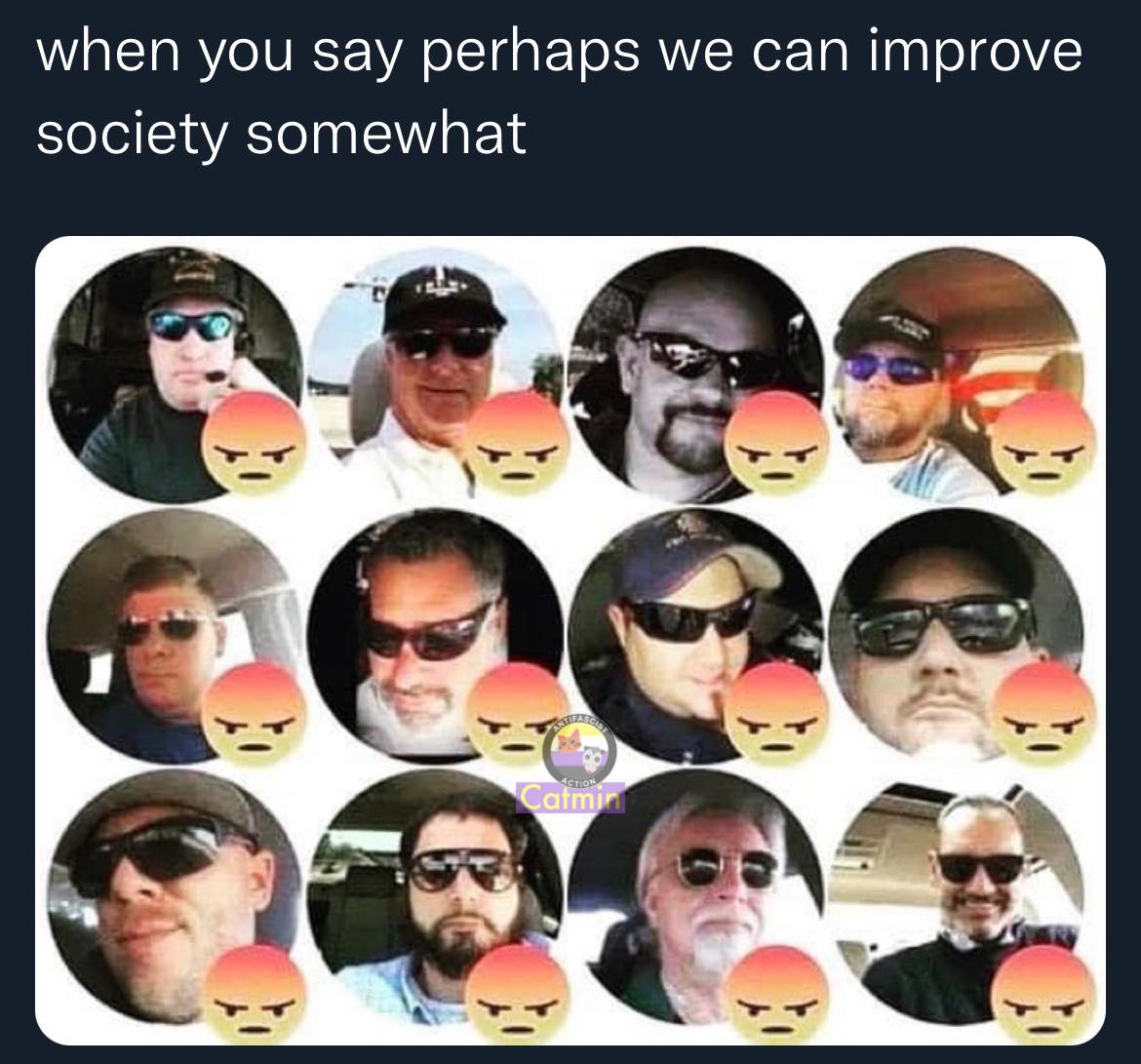
The meme is a collection of images of a man with a scowling expression, accompanied by the text "when you say perhaps we can improve society somewhat." The images are meant to convey a sense of frustration and annoyance, implying that the speaker's suggestion is not taken seriously or is met with resistance. The tone is likely to be sarcastic and critical, implying that the speaker's idea is not well-received or is not taken seriously.
detailed-analysis (gemma3-27b-vision)
Okay, here's an analysis of the image, broken down into the requested theoretical frameworks. It’s important to note that this is interpretive, and different analyses could emphasize different aspects. The meme utilizes a grid of mostly older white men and adds a crying face emoji to each individual.
Visual Description
The image is a grid of 16 individual headshots of predominantly older white men. Their expressions vary, but most appear stoic, stern, or somewhat grumpy. The men appear to be wearing casual attire - mostly baseball caps, sunglasses, and casual shirts. Overlaid onto each headshot is a crying face emoji. The top of the image contains text reading “When you say perhaps we can improve society somewhat”. The center image has a small logo containing a pink background and "Calmin" in white lettering.
Foucauldian Genealogical Discourse Analysis
This image presents a strong commentary on how discourses of "improvement" and "progress" are historically tied to power structures. A Foucauldian lens focuses on how the image performs and reinforces certain norms and power dynamics.
- Discourse & Power: The meme implicitly highlights a particular discourse – the one where certain demographic groups (older white men) are historically seen as the arbiters of societal norms and change. The crying emoji suggests that even suggesting improvement to society is perceived as a transgression by these figures.
- Genealogy of Control: The men in the grid are largely representative of the historically dominant group in Western society. Their visual presence implies a sense of entitlement and resistance to change. The “improvement” isn’t considered on their terms. It is external to them, and thus perceived as a threat.
- Subjectivation: The act of overlaying the crying emoji implies the subjectivation of these men as victims. However, it is a sarcastic subjectivation, highlighting their perceived fragility in the face of even mild critique or suggestions for betterment. This also underscores how power often manifests as a refusal to even acknowledge the need for change.
Critical Theory
This image can be interpreted through a Critical Theory lens as a critique of the existing power structures and their resistance to social change.
- Dominant Ideology: The men in the grid represent figures who have traditionally held significant power and influence in society. The meme implies that these figures are invested in maintaining the status quo and are resistant to any suggestions of change. This speaks to a concept of a "dominant ideology" – the beliefs, values, and norms that serve to legitimize the existing power structure.
- Critique of Enlightenment Reason: The image subtly critiques the idea that rational discourse and progress are universally beneficial. It suggests that for those in power, even proposing "improvement" can be perceived as a threat to their authority and privilege.
- Emancipatory Potential: By exposing the resistance to change, the meme aims to disrupt the dominant ideology and potentially open up space for alternative perspectives and possibilities. The image intends to expose these men as being the root cause of problems rather than their solution.
Marxist Conflict Theory
From a Marxist perspective, this image illustrates the inherent conflicts within a class-based society.
- Class Struggle: The men in the grid, historically, largely represent a ruling class or those who benefit from existing social and economic structures. Their resistance to “improvement” signifies a struggle to maintain their privileged position.
- Ideology & False Consciousness: The image suggests that this ruling class actively perpetuates an ideology that justifies their power and privileges. This ideology prevents them from recognizing the need for change. It could also be interpreted as them being unaware of the true societal problems.
- Alienation & Resistance: The meme can be seen as an expression of alienation and resistance to the existing power structure. The crying emoji is not meant to be sympathetic, but rather to portray the men as being out of touch with the realities faced by those who are marginalized or oppressed.
Postmodernism
A postmodern interpretation would emphasize the image’s playful subversion of meaning and its rejection of grand narratives.
- Deconstruction of Authority: The image deconstructs the idea of these men as authoritative figures. By reducing them to a grid of faces and overlaying them with a crying emoji, the image diminishes their perceived power and seriousness.
- Rejection of Metanarratives: The meme challenges the grand narrative of progress and improvement. It suggests that these concepts are not neutral or universal, but rather are shaped by power dynamics and subjective interpretations.
- Irony and Parody: The image employs irony and parody to critique the existing social order. The crying emoji is a sarcastic commentary on the perceived fragility of those in power.
Queer Feminist Intersectional Analysis
The image, while not explicitly dealing with gender or sexuality, can still be analyzed through an intersectional lens.
- Representation & Exclusion: The grid is composed almost entirely of white men. This highlights the systemic exclusion of women, people of color, and LGBTQ+ individuals from positions of power and influence.
- Patriarchy & Power: The image reinforces the idea that patriarchy is deeply embedded in the structures of power. The men’s resistance to “improvement” suggests a desire to maintain a system that benefits them at the expense of others.
- Interlocking Systems of Oppression: The meme implicitly acknowledges that multiple systems of oppression (such as racism, sexism, and classism) intersect to create and maintain social inequalities. The dominance of this demographic suggests they do not understand these structures and how they affect those marginalized.
It's important to remember that these are just interpretations, and the image can be understood in multiple ways. The power of the meme lies in its ability to spark dialogue and critique around important social issues.
simple-description (llama3.2-vision)
This meme is a collage of 16 identical images of a man with a scowling expression, each with a red, angry face emoji in the corner. The text above the images reads, "when you say perhaps we can improve society somewhat." The image is a humorous representation of a person's frustration with the idea that simply saying something can improve the world, implying that it's a simplistic and naive approach to solving complex problems.
tesseract-ocr
when you say perhaps we can improve society somewhat —.t : 7, ’ % 4 > ~~~ VQ MA 4 e. © a >=E: vay S Tey gee - 2 ae = ma Ah, am ca Ss = wae