First Seen
2023-07-22T01:35:30+00:00
simple-description (qwen3.5_2b-q8_0)
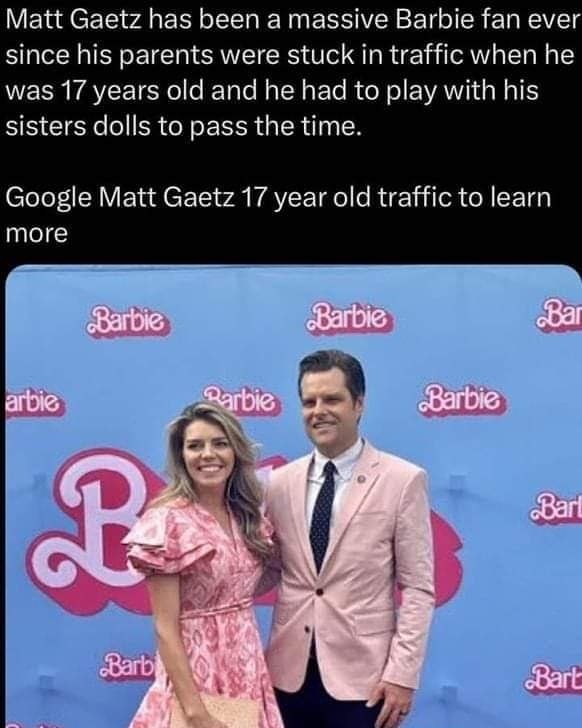
This "anti-conservative" meme mocks conservative figures like Matt Gaetz by jokingly claiming they have a secret past of being huge Barbie fans. The text satirically implies that these politicians are the actual fans, suggesting they are only in politics because they discuss the toys themselves. It plays on the idea that they are the real fans while making it seem like a hidden, embarrassing backstory.
simple-description (llama3.2-vision_11b)
The meme is a photo of a 17-year-old Matt Gaetz, a Republican congressman, with a caption that implies he's a fan of Barbie dolls, which is ironic given his anti-conservative stance. The text above the image reads, "Matt Gaetz: 17, still playing with dolls." The meme is poking fun at Gaetz's hypocrisy, suggesting that his conservative views don't align with his personal life.
detailed-analysis (gemma3-27b-vision)
Okay, here's an analysis of the image and its accompanying text, broken down into the requested theoretical frameworks, with sections only appearing where relevant.
Image Description:
The image depicts Matt Gaetz (a US Congressman known for his controversial political positions) and a woman (identified as his girlfriend) posing in front of a promotional backdrop completely covered in the "Barbie" logo. They are both dressed in pastel pink outfits – she in a frilly dress, and he in a pastel pink suit with a dark tie. The overall impression is an intentionally ironic and provocative image, juxtaposing a hyper-masculine political figure with the traditionally feminine world of Barbie.
Foucauldian Genealogical Discourse Analysis
This image and its accompanying text invites a Foucauldian analysis by revealing how notions of childhood, gender, and masculinity are constructed through discourse.
- Discourse & Power: The claim that Gaetz became a "Barbie fan" at 17 while stuck in traffic isn't presented as neutral fact, but as a statement designed to produce a specific understanding. It attempts to reframe his public image, and perhaps humanize or “soften” it. It seeks to associate Gaetz with a particular set of associations— childhood, femininity, play—to counteract or deflect from his public persona.
- Genealogy: Examining the historical development of childhood, gender roles, and the Barbie doll itself unveils the shifting power relations that have shaped our understanding of these concepts. Barbie, initially marketed as a fashion doll allowing girls to imagine future possibilities, has also been critiqued for promoting unrealistic beauty standards and reinforcing traditional gender roles. The fact that the image links a conservative, male politician with this doll is noteworthy.
- Power/Knowledge: The connection made suggests a claim that something about Gaetz's early childhood experiences with the doll shaped him, subtly implying a challenge to normative ideas about masculinity and how it is formed.
Critical Theory
The image lends itself well to a critical analysis focused on the interplay of power, ideology, and representation.
- Ideology: The image challenges the dominant ideology around masculinity and politics. It presents a deliberate disruption of expectation. The suit and pastel colors are deliberately incongruous with the typical presentation of a conservative politician, and the Barbie backdrop forces viewers to consider how seemingly “innocent” cultural objects (like a doll) can be deployed for political purposes.
- Culture Industry: The Barbie movie and associated promotional materials are a product of the culture industry—a system of mass production and consumption of cultural commodities. Gaetz’s appropriation of this aesthetic is a form of signaling and a way to insert himself into a pre-existing cultural narrative, potentially to garner attention or rehabilitate his image.
- Spectacle: The image is fundamentally spectacular. It relies on shock value and the incongruity of the scene to attract attention. The political figure has become a media spectacle, and this image is a deliberate attempt to contribute to that spectacle, albeit in an ironic or subversive manner.
Marxist Conflict Theory
While the image doesn't directly address class struggle, a Marxist reading can consider how it reflects the dynamics of cultural capital and the commodification of identity.
- Cultural Capital: The image plays on the association of "Barbie" with a particular social class and consumer culture. By aligning himself with Barbie, Gaetz is attempting to cultivate a certain image or aesthetic, appealing to a specific audience and potentially attempting to broaden his appeal.
- Commodification: The Barbie brand is, fundamentally, a commodity. The image participates in this system of commodification, using Barbie as a symbol to create a narrative around Gaetz.
- False Consciousness: One could argue that the image is an attempt to manipulate public perception and create a "false consciousness," presenting a superficial or misleading image of Gaetz and obscuring his political positions.
Queer Feminist Intersectional Analysis
This image is rich with potential for Queer Feminist and Intersectional readings, particularly due to the performative aspects of gender and the tension between normative expectations and the image presented.
- Gender Performance: Gaetz’s choice of a pastel pink suit, traditionally associated with femininity, challenges conventional notions of masculinity. It is a deliberate performance of gender, and asks us to consider the social construction of gender roles.
- Subversion & Reappropriation: While the image may appear to subvert gender norms, it's important to consider who is doing the subversion. Gaetz is a conservative politician, and his embrace of a traditionally feminine aesthetic may be a tactic to disarm critics or appeal to a broader audience, rather than a genuine expression of queer or feminist politics.
- Intersectionality: The image implicitly touches on the intersection of gender, political power, and public image. Gaetz, as a powerful male politician, is leveraging a traditionally feminine symbol to construct a narrative about himself. This highlights the ways in which gender and power are intertwined, and how individuals can strategically deploy gender to advance their own interests.
Postmodernism
The image is highly postmodern in its approach to representation and meaning.
- Pastiche & Irony: The image is an example of pastiche—the imitation of a style or genre—and is laced with irony. It combines elements from seemingly disparate worlds—conservative politics and the world of Barbie—to create a jarring and unsettling effect.
- Hyperreality & Simulacra: The image can be seen as an example of hyperreality, where the representation of reality becomes more real than reality itself. The image isn't necessarily about Gaetz's genuine interest in Barbie; it's about the image of Gaetz as a Barbie fan, and how that image circulates in the media and shapes public perception.
- Deconstruction of Meaning: The image challenges our assumptions about masculinity, politics, and the meaning of cultural symbols. It resists easy interpretation and forces us to question the ways in which we construct meaning in a media-saturated world.
Disclaimer: These are interpretations based on the theoretical frameworks and can be subject to different readings. Analyzing images involves subjective elements.
simple-description (llama3.2-vision)
This meme is a joke about Matt Gaetz, a US politician, and his relationship with his sister. The image shows a photo of Matt Gaetz and his sister, with the text "Matt Gaetz's sister" and "Matt Gaetz's sister is a 17-year-old girl who he's been accused of having sex with." The meme is a joke about the fact that Matt Gaetz's sister is a 17-year-old girl, implying that he has been accused of having sex with her, which is a serious accusation of a crime.
tesseract-ocr
Matt Gaetz has been a massive Barbie fan ever since his parents were stuck in traffic when he was 17 years old and he had to play with his sisters dolls to pass the time. Google Matt Gaetz 17 year old traffic to learn more CG > 1 4 A if e