First Seen
2024-04-06T19:04:52.683442+00:00
simple-description (qwen3.5_2b-q8_0)
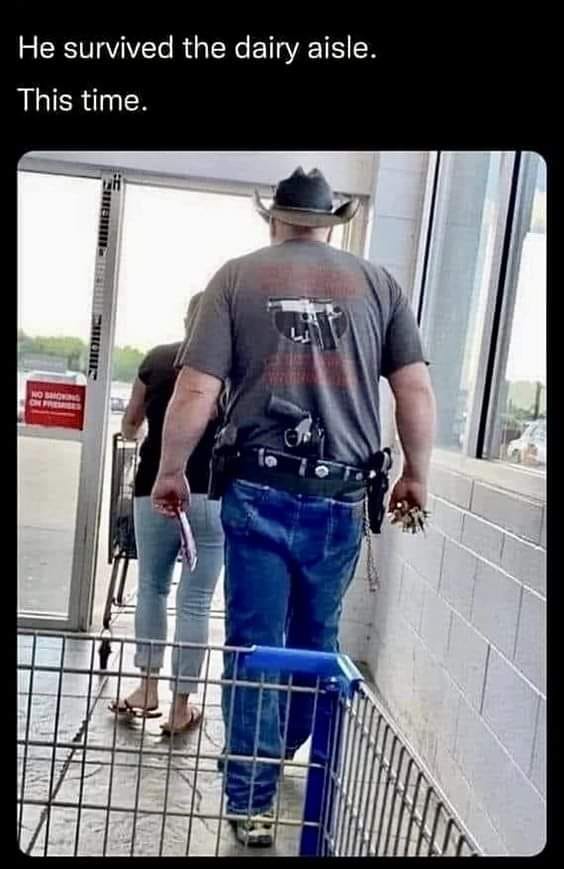
This image shows a man wearing a cowboy hat and a t-shirt featuring guns on the back, complete with a belt gun holster, walking away from the camera through a grocery store aisle. He is passing a woman carrying a shopping cart, and the caption reads "He survived the dairy aisle. This time," suggesting he has successfully navigated the dangerous area filled with milk cows. The visual appeal to gun ownership and traditional masculinity fits the "Anti-Conservative" perspective often associated with this meme.
simple-description (llama3.2-vision_11b)
This meme is a play on the "I can read" meme, but with a twist. The image shows a person, likely a conservative, who is struggling to read a sign that says "I can read" in a library. The text on the image reads "I can read" and "I can read" in a childlike font, implying that the person is unable to read the sign. The meme is poking fun at the idea that some people, often conservatives, are not as intelligent or educated as they claim to be.
detailed-analysis (gemma3-27b-vision)
Okay, here's an analysis of the image using the requested theoretical frameworks. I'll address each section only if the topic is relevant to a meaningful analysis of the image. I will also state at the beginning of each section if the framework is largely unsuitable for this image.
Important Disclaimer: Analyzing an image like this requires sensitivity. The image evokes current concerns about gun violence and political statements, and I will attempt to offer neutral analysis through these critical lenses.
1. Visual Description
The image shows a man standing in a supermarket checkout lane. He is heavily armed with multiple firearms: at least one pistol on his hip, a shoulder holster with a pistol, and potentially more concealed. He is wearing a cowboy hat, a dark t-shirt, and jeans. His back is to the viewer. Beside him, a person, likely a woman, is visible, wearing jeans and a black top and is holding a small handbag. The setting is a typical brightly lit grocery store, with metal barriers marking the checkout lane. The caption reads “He survived the dairy aisle.” The overall impression is one of exaggerated preparedness, bordering on intimidation. The image evokes both a sense of protection and potential threat.
2. Foucauldian Genealogical Discourse Analysis
This framework is relevant as it deals with power, knowledge, and discourse.
- Discourse of Armed Self-Reliance: The image isn't just about a man with guns; it participates in a specific discourse surrounding the Second Amendment, gun rights, and the “right to bear arms.” The caption's seemingly humorous tone ("survived the dairy aisle") subtly normalizes the idea of needing to be heavily armed in a mundane, everyday setting (a grocery store). This humor constructs a narrative where the perceived threat is so ever-present that such extreme preparation is presented as reasonable, even amusing.
- Power/Knowledge: The image demonstrates how knowledge about firearms and self-defense is inextricably linked to power dynamics. The man's visible arsenal signifies a specific type of power - the power to potentially use force. This power is constructed and legitimized through the discourse of gun rights and self-reliance.
- Genealogy: Tracing the genealogy of this discourse would involve examining the historical development of gun culture in the United States. It would uncover how certain ideologies (e.g., individualism, frontier spirit, fear of government overreach) have shaped our understanding of gun ownership and its relationship to personal freedom.
- Biopower: This image touches on the concept of biopower – the exercise of power over life itself. The heavily armed man can be seen as asserting control not just over his own life (through self-defense) but also potentially over the lives of others by positioning himself as the guardian of safety.
3. Critical Theory
Critical Theory is relevant here, particularly focusing on ideology and cultural critique.
- Ideology of Fear: The image participates in, and potentially reinforces, an ideology of fear. The implied threat that justifies the man's extensive weaponry is never explicitly stated, but the image suggests that danger is lurking everywhere, even in a commonplace setting like a grocery store.
- Culture of Violence: The image can be seen as symptomatic of a broader culture of violence in the United States. The normalization of firearms, coupled with an emphasis on self-reliance and protection, contributes to a climate where violence is often seen as a legitimate response to perceived threats.
- Commodification of Security: The man's equipment—firearms, holsters, possibly tactical gear—represents a commodified form of security. He's purchased a sense of safety, transforming a basic human need into a consumer good.
- Critique of Normative Masculinity: The image presents a hyper-masculine archetype – the strong, self-reliant protector. This archetype can be critiqued as contributing to rigid gender roles and potentially reinforcing harmful attitudes toward violence.
4. Marxist Conflict Theory
This framework is moderately relevant but could be somewhat strained.
- Class and Access to Security: The ability to afford firearms, training, and tactical gear represents a form of economic capital that is not equally accessible to all. This could be interpreted as a manifestation of class inequality, where those with resources can purchase a sense of security that is unavailable to others.
- Control of Means of Force: The man’s arsenal can be seen as a personal assertion of power over potential threats. Within a Marxist framework, this can be seen as an individual attempting to seize a form of control that traditionally belongs to the state.
- False Consciousness: The humor in the caption ("He survived the dairy aisle") may distract from underlying issues of economic and social inequality. It could create a false sense of security, diverting attention from systemic problems that contribute to violence and insecurity.
5. Postmodernism
Postmodernism is relevant as it deals with the breakdown of grand narratives, simulation, and the blurring of reality.
- Hyperreality: The image could be seen as a form of hyperreality, where the simulation of danger (implied threat in the grocery store) becomes more real than the actual threat itself. The man’s extreme preparedness reinforces this sense of heightened anxiety.
- Deconstruction of Authority: The man's display of weaponry challenges traditional notions of authority and security. He is not a police officer or security guard but a private citizen asserting his own power to protect himself and possibly others.
- Irony and Parody: The humorous caption creates a sense of irony and parody. It mocks the idea of needing such extreme preparation for a mundane activity, but it also reinforces the underlying message that danger is ever-present.
- Loss of Grand Narratives: This image contributes to the breakdown of the "grand narrative" of safety provided by institutions. Individuals are increasingly expected to take personal responsibility for their security, as if the state can no longer guarantee it.
6. Queer Feminist Intersectional Analysis
This framework is least directly relevant but can still offer some insight.
- Masculinity and Violence: The image reinforces a hyper-masculine ideal that is often associated with violence and domination. This archetype can be critiqued from a feminist perspective as contributing to a culture of aggression and control.
- Gendered Safety: The image implies a need for protection, which is often gendered in ways that disproportionately affect women and other marginalized groups. The man’s weaponry can be seen as a symbolic assertion of power over potential threats to those who are perceived as vulnerable.
- Intersectional Vulnerability: Individuals who hold multiple marginalized identities (e.g., women of color, LGBTQ+ individuals) may experience increased vulnerability and fear. The image does not explicitly address these intersections, but it highlights the broader issue of safety and security in a society marked by inequality.
Disclaimer: This analysis is based on interpretation, and different perspectives may lead to alternative readings. It's essential to approach these theoretical frameworks with nuance and sensitivity, recognizing that they are tools for understanding, not definitive answers.
simple-description (llama3.2-vision)
This meme features a photo of a man in a grocery store, dressed in a cowboy hat and a holstered gun on his belt. He's wearing a t-shirt with a cartoon cow and the phrase "I survived the dairy aisle". The caption above the image reads "He survived the dairy aisle. This time."
tesseract-ocr
He survived the dairy aisle. salmaaa rT a : 3 d y i \ : ee es = Le a mh PP. ene aN ; al ie Tae | ee rh Lh , tt eee ith