First Seen
2024-04-03T21:41:09.479037+00:00
simple-description (qwen3.5_2b-q8_0)
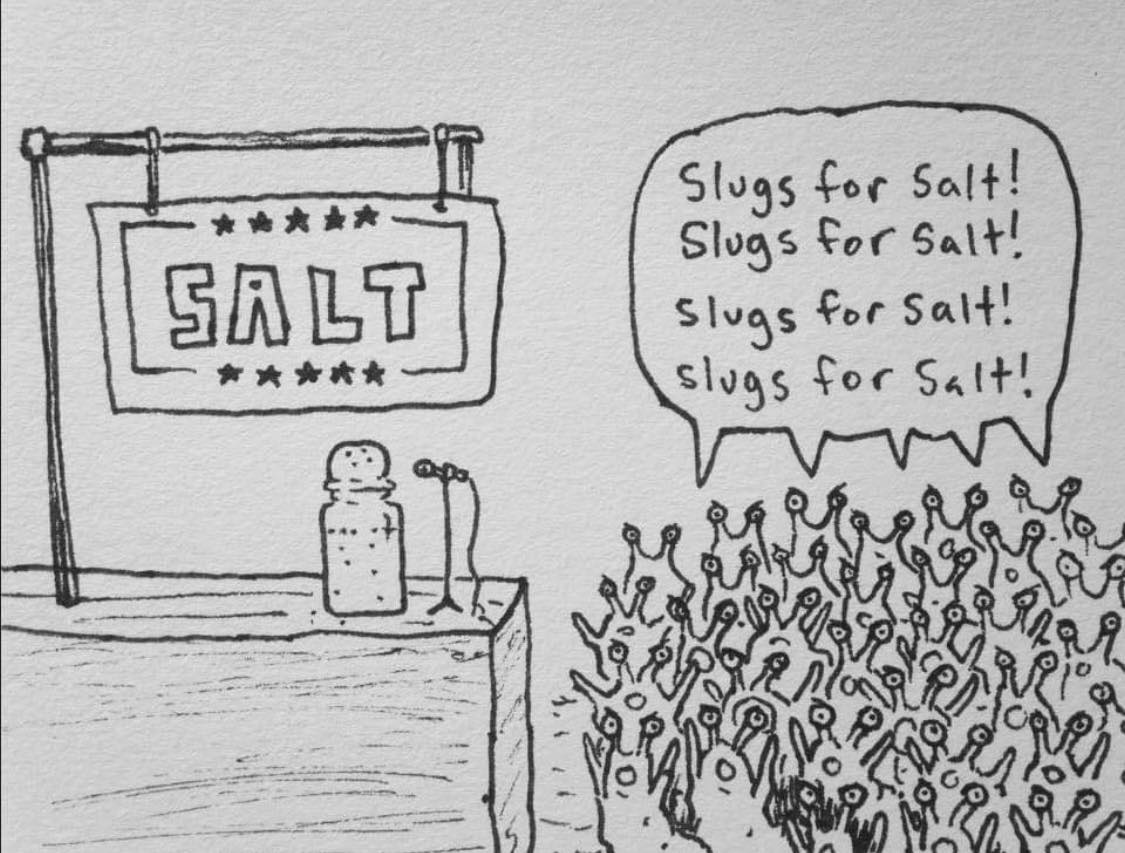
This image references the viral internet meme "Salty," which is a political expression often associated with anti-Labor and anti-establishment views. It depicts a chaotic scene where a crowd of "slugs" (creatures with mouths and eyes) are screaming "Slugs for Salt!" with intense, repetitive passion. This visual humor is used to represent a loud, vocal, and rebellious stance against the mainstream establishment, specifically aligning with the "Salty" movement which frequently opposes Conservative policies.
simple-description (llama3.2-vision_11b)
The meme features a drawing of a salt shaker with a sign that says "Salt" and a crowd of people in the background. The text in the image reads "Slugs for Salt!" and "Slugs for Salt!" in a repetitive and mocking tone, implying that the crowd is being manipulated or deceived by the salt shaker's label. The meme is likely being used to criticize or mock a situation where people are being misled or manipulated, with the salt shaker serving as a symbol of deceit or corruption.
detailed-analysis (gemma3-27b-vision)
Okay, let's break down this intriguing little sketch with the lenses you've requested. It's a surprisingly rich image despite its simplicity.
Visual Description
The image is a hand-drawn sketch, likely done with a pen. It depicts a simple, almost cartoonish scene. On the left is a small stand or counter, reminiscent of a market stall or a stand for demonstrations. A sign above it, decorated with star-like symbols, boldly declares "SALT". A salt shaker is placed on the counter.
To the right of the stand is a large, densely packed mass of slugs. They are drawn in a repetitive, almost overwhelming way. Above them are speech bubbles repeating the phrase "Slugs for Salt!". The style is simple, conveying a sense of urgency and perhaps desperation. The drawing employs a high-contrast black and white aesthetic.
Foucauldian Genealogical Discourse Analysis
This image lends itself well to a Foucauldian reading. The “SALT” sign isn't just a sign for a commodity; it’s a point of power/knowledge. Michel Foucault argued that power isn't simply repressive, but productive – it creates discourses and categories that shape our understanding of the world.
Here, "Salt" has become a central point around which a discourse is forming. This discourse isn’t about salt in a literal sense; it's about exchange, about a desperate need, and about the constitution of a subject (the slugs) defined by its relation to that need. The repetitive slogan "Slugs for Salt!" isn’t a rational transaction, but an utterance that reinforces a specific power dynamic.
The genealogy (tracing the history of the idea) would ask: how did "Salt" come to have this power? What historical circumstances led to this desperate exchange? Who benefits from the definition of the slug as one that requires salt? The image suggests that the very category of "slug" is constructed through this demand, defining them by their lack and dependence. It’s not about the slugs’ inherent nature, but about the power structures that position them as needing something.
Critical Theory
Applying a general Critical Theory lens (drawing on the Frankfurt School, for example), we can see the image as a miniature allegory for broader systems of exploitation. The "Salt" can be seen as symbolic of any essential resource—wealth, power, knowledge, or even basic necessities—that is unevenly distributed.
The slugs, massed together and desperately chanting their demand, represent the exploited masses. Their seemingly irrational plea—giving themselves for salt—highlights the ways in which ideology can mask exploitation and even lead people to participate in their own subjugation. The absurdity of the exchange – of slugs giving themselves for something they need to survive – forces us to question the “naturalness” of existing power structures. Is this a representation of systemic inequality? Does the exchange reinforce a cycle of dependency?
Marxist Conflict Theory
From a Marxist perspective, this image encapsulates the core of class conflict. "Salt" represents the means of production or a vital resource controlled by a dominant group (who are absent from the image but implied). The slugs, a homogeneous mass, are the proletariat, the working class, who are entirely dependent on the owners of “Salt” for survival.
The chant “Slugs for Salt!” represents the alienation of labor—the slugs have nothing to offer except themselves, and this self-offering is presented as a necessary condition for their existence. It suggests a deeply exploitative relationship where the slugs are reduced to mere instruments of exchange, with no agency or control over their own lives. The absence of any negotiating power or alternative solutions further highlights the stark power imbalance.
Postmodernism
A postmodern reading would focus on the deconstruction of meaning and the instability of the sign. “Salt” isn’t simply a substance; it's a signifier whose meaning is contingent and unstable. What does "salt" really mean in this context? It could represent anything – security, status, life itself.
The absurdity of the exchange (slugs offering themselves for salt) deconstructs the idea of rational economic exchange. It highlights the constructedness of value and the arbitrariness of the symbols we use to represent it. The repetitive chant, lacking any logical basis, emphasizes the performativity of language—the way in which language creates reality rather than reflecting it. The image questions grand narratives of progress and rationality, revealing the underlying chaos and instability of meaning.
Queer Feminist Intersectional Analysis
This is the most complex lens to apply here, but potentially a very fruitful one. The mass of slugs can be read as a metaphor for marginalized groups—those historically denied access to resources and power. Their collective demand for “Salt” represents the struggle for basic rights and recognition.
The image could be interpreted as a critique of heteronormative systems of exchange that prioritize certain identities and needs over others. The slugs’ vulnerability and desperation highlight the ways in which marginalized bodies are often subjected to exploitation and control. The self-offering aspect of the exchange resonates with experiences of self-sacrifice and the pressure to conform to dominant norms in order to survive.
The homogeneity of the slug mass can also be read as a challenge to essentialist notions of identity—the slugs are not defined by their individual differences but by their shared need for “Salt.” Intersectional analysis would further complicate this by considering how different factors (e.g., size, color, speed) might contribute to disparities within the slug mass and affect their access to “Salt.”
Let me know if you'd like me to expand on any of these interpretations or explore other theoretical frameworks!
simple-description (llama3.2-vision)
This meme is a simple, hand-drawn image of a salt stand, with a sign reading "SALT" and a jar of salt on a table. The image is accompanied by a speech bubble with the text "Slugs for Salt! Slugs for Salt! Slugs for Salt!" and a crowd of slugs in the foreground. The humor comes from the absurdity of a crowd of slugs enthusiastically chanting a slogan for a salt stand.
tesseract-ocr
(Kooi) meen i} . fi Slugs for Salt! —earar Sloss ae Salt! | SA LT | Slvqs for Salt! ta wKK Slugs for Salt! | AT) ue RAR eARR PAE gee ey Ve RPI B IE 4aF So enews, zt PIR) REAR a . ~ = = A, eae Ne} Se en fe 2 Ke LAS os {| Vet pee een