First Seen
2024-06-11T18:12:27.149366+00:00
simple-description (qwen3.5_2b-q8_0)
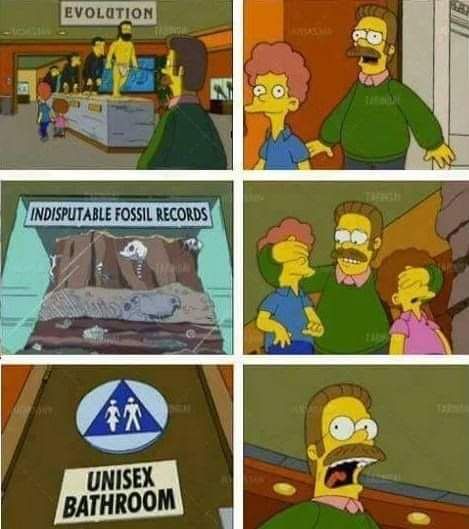
This meme satirizes the tension between secular scientific discovery and traditional religious beliefs. It references The Simpsons episode "Fossil Records," highlighting the conflict between finding real dinosaur fossils and the opposition to evolution often held by conservatives. The final panel humorously suggests that once a 'truth' is found, even trivial rules like the sign for the Unisex Bathroom are easily ignored.
simple-description (llama3.2-vision_11b)
The meme is an image of a "Banned in the U.S.A." sign from The Simpsons, but with the words "Anti-Conservative" instead. The image is a play on the classic sign, but with a new and humorous twist. The text on the sign reads "Anti-Conservative" in bold, black letters, poking fun at the idea of being "banned" in a humorous way.
detailed-analysis (gemma3-27b-vision)
Okay, let's break down this image from The Simpsons using the requested theoretical frameworks. It’s a rich little segment, ripe for analysis.
Visual Description
The image consists of three panels, each a still from an episode of The Simpsons.
- Panel 1 & 2: The Simpson family (Homer, Marge, Lisa, and Maggie) are at a natural history museum. The first two panels showcase displays - first, a bust representing a human in evolutionary progress, and then a wall showcasing fossilized remains. The family appears to be passively viewing the exhibits.
- Panel 3: The final panel shows a sign with an icon depicting a man and a woman and the text "UNISEX BATHROOM" below. Homer is shown in a state of obvious shock and distress, mouth open in a scream.
Foucauldian Genealogical Discourse Analysis
This scene is highly amenable to a Foucault-inspired analysis. We can trace the discourse of knowledge/power around bodies, evolution, and gender.
- Museum as a Disciplinary Institution: The museum itself is a disciplinary institution, constructing and normalizing particular forms of knowledge. The exhibits on evolution and fossils create a lineage of "acceptable" human development, setting parameters for what is considered "natural" or "normal".
- Evolutionary Discourse: The exhibits themselves contribute to a discourse surrounding the "human" body as evolving towards a certain form. This form implicitly carries with it expectations about gender roles and acceptable physicality. It’s a historical construction of what being human means.
- Gendered Spaces and the "Unisex" Bathroom: The core of the joke hinges on the "unisex" bathroom. Historically, bathrooms have been rigidly gendered, reflecting and reinforcing societal notions of binary gender and the proper separation of the sexes. The introduction of a unisex bathroom disrupts this norm.
- Homer's Reaction as an Embodied Resistance: Homer's shock isn't just comedic; it's an embodiment of the deeply ingrained power/knowledge relationship surrounding gender. His reaction reveals how strongly he believes in the need for gender separation and finds the idea of a combined bathroom threatening to his established worldview. He doesn't understand the possibility of something outside the normative.
Critical Theory
This scene provides a strong illustration of the central tenets of critical theory.
- Ideology & Hegemony: The museum displays present a particular worldview – a scientific narrative about human origins. However, the seemingly neutral presentation of this “objective” knowledge masks underlying ideological assumptions. The way evolution is presented can reinforce existing power structures.
- Domination & Subjugation: The museum, as a cultural institution, participates in the process of shaping how we understand ourselves and the world. This seemingly harmless act of presenting knowledge can contribute to the normalization of certain power dynamics and the marginalization of alternative perspectives.
- Critique of Reason & Enlightenment: The scene subtly critiques the idea that scientific progress (like the understanding of evolution) automatically leads to enlightenment or liberation. The shock surrounding the unisex bathroom reveals that even “rational” individuals (like Homer) can be deeply resistant to changes that challenge established norms.
- Hegemony & The Challenge to It: The shock Homer experiences in front of the unisex bathroom reveals he’s entrenched in established norms that enforce control. The disruption of a simple act like using the same bathroom is threatening to the status quo.
Marxist Conflict Theory
While the scene isn't explicitly about class conflict, a Marxist reading can still reveal underlying power dynamics:
- Cultural Hegemony: The museum, as a state-sponsored or elite-controlled institution, contributes to the dominant culture that upholds the interests of the ruling class. The "objective" knowledge presented in the museum serves to naturalize existing power relations.
- Ideological Control: The presentation of evolution and fossils can be seen as a way to legitimize existing social hierarchies. The museum subtly reinforces the idea that certain ways of being are "natural" or "superior" to others.
- Homer as a "False Consciousness": Homer's shock at the unisex bathroom can be interpreted as a manifestation of “false consciousness” - a lack of awareness of the true nature of his own social and economic situation. He's unable to recognize that the strict gender separation in bathrooms is a social construct that serves to reinforce existing power structures.
Postmodernism
This image is very postmodern. It embodies several core tenets of the theory.
- Deconstruction of Binary Oppositions: The scene directly challenges the binary opposition of male/female, embodied in the traditional separation of bathrooms. The unisex bathroom disrupts this rigid categorization and suggests a fluidity of gender.
- Rejection of Grand Narratives: The scene subtly questions the "grand narrative" of evolutionary progress, suggesting that human development isn't a linear march towards a predetermined goal.
- Irony & Parody: The scene is deeply ironic. The juxtaposition of the scientific exhibits on evolution with Homer's absurd reaction to the unisex bathroom highlights the contradictions and absurdities of modern life.
- Simulacra & Simulation: The museum itself can be seen as a simulacrum – a representation of reality that has become divorced from the “real” thing. The exhibits are not the actual fossils or evolutionary processes, but rather representations of them.
Queer Feminist Intersectional Analysis
This is perhaps the most potent lens for interpreting the image.
- Challenging Gender Norms: The unisex bathroom is a direct challenge to traditional gender norms and the rigid categorization of bodies. It disrupts the expectation that spaces should be segregated by gender.
- Intersectionality of Gender, Space, and Power: The scene reveals how gender is intertwined with power dynamics and spatial organization. The segregation of bathrooms is not just about convenience; it's about maintaining social control and reinforcing hierarchies.
- Trans and Non-Binary Inclusion: While not explicitly stated, the scene implicitly raises questions about the inclusivity of gendered spaces. A unisex bathroom is more accommodating to trans and non-binary individuals who may not fit neatly into the male/female binary.
- Homer's Reaction as Microaggression: Homer’s shock can be seen as a microaggression – a subtle, often unintentional expression of prejudice or discrimination. His reaction reveals a discomfort with anything that challenges his deeply ingrained assumptions about gender.
Let me know if you’d like me to elaborate on any of these analyses, or focus on a particular theoretical framework!
simple-description (llama3.2-vision)
The meme is a split-screen image with a scene from the TV show "The Simpsons" on the left, and a scene from the same show on the right. The left scene shows a store with a sign reading "Indisputable Fossil Records" and a sign in the window reading "We're not just a store, we're a museum". The right scene shows a sign in a bathroom reading "Unisex Bathroom" with a picture of a man and a woman. The meme is likely poking fun at the idea of a store or museum being called "indisputable" and the sign in the bathroom being a joke about the lack of a gender-specific bathroom.
tesseract-ocr
EVOLOTION] ke F = ae §. S ‘a Ae | INDISPUTABLE FOSSIL RECORDS’ AB? .aes { ; wy 5 IRE B.S: de s BATHROOM i (adi Sos