First Seen
2025-06-03T19:17:04.771604+00:00
simple-description (qwen3.5_2b-q8_0)
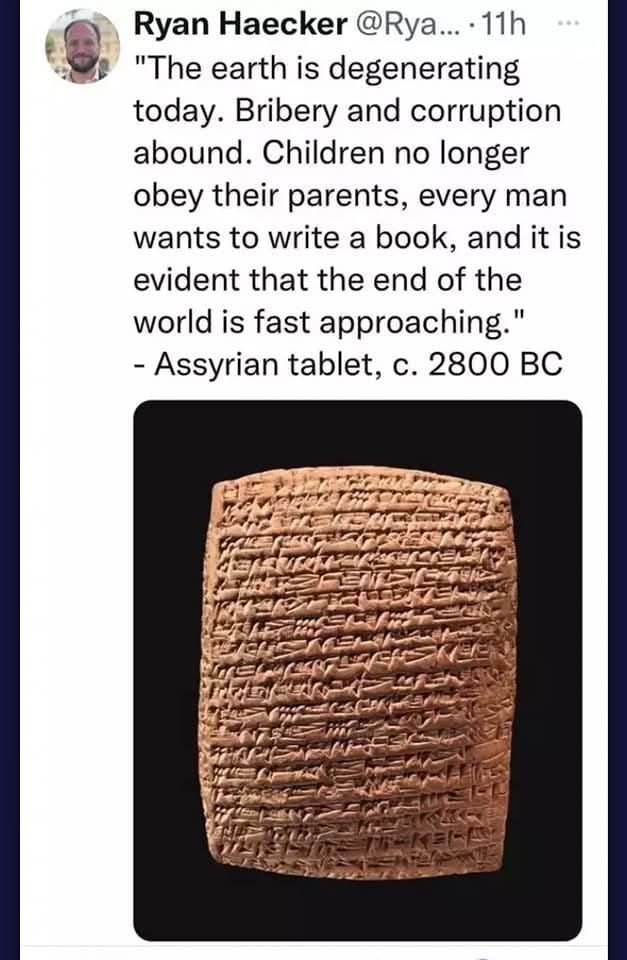
This meme frames the ancient clay tablet as a "propaganda" document warning that civilization is coming to an end. It argues that today's society is failing because people are disobeying parents, writing books instead of following laws, and engaging in bribery, all of which a future, supposedly more mature society claims will lead to the world's rapid destruction.
detailed-analysis (gemma3_27b-it-q8_0)
Okay, let's break down this meme through the lens of an "Anti-Conservative" perspective, utilizing the requested theoretical frameworks where relevant. This will involve dissecting the intentional effect of the meme, as understood by someone who's actively critical of conservative ideologies.
Visual Description
The image features a well-preserved clay cuneiform tablet, dated to approximately 2800 BC (the Early Dynastic period of Mesopotamia). It's a rectangular prism, brown in color, covered in densely packed wedge-shaped characters. The tablet looks weathered but remarkably intact. The aesthetic is one of ancient, authoritative history, and also of obscurity - the writing is unreadable to most.
Foucauldian Genealogical Discourse Analysis
This meme functions through a brilliant disruption of discourse. Conservatives often appeal to "tradition," "ancient wisdom," and a perceived moral high ground rooted in the past. They often frame societal decay as a recent phenomenon, a departure from a "golden age."
This meme directly undercuts that narrative. By attributing a pessimistic, doom-and-gloom sentiment – complaints about societal degeneration, bribery, parental disrespect, and a desire for self-expression (writing books) – to a text from 2800 BC, it demonstrates that these anxieties are not new. They've been present throughout human history.
The power dynamic, per Foucault, isn't about "truth" but about who gets to define reality. Conservatives seek to define "normal" by referencing an idealized past. This meme exposes that the past they idealize wasn’t even particularly happy, or characterized by the obedience and order they claim it had. It's a disruption of the conservative construction of historical narrative and the power embedded within it. It challenges the notion that we’ve somehow fallen from a state of grace.
Critical Theory
From a Critical Theory perspective (specifically the Frankfurt School), the meme targets the conservative tendency toward instrumental reason. Conservatives often frame issues in terms of efficiency, order, and functionality. They prioritize a hierarchical social structure where everyone “knows their place.”
The tablet's lament about children disobeying parents and people seeking self-expression challenges this. It suggests that even in ancient times, there was resistance to rigid social structures, a desire for autonomy, and a recognition of corruption. The meme suggests that these struggles are inherent to the human condition, not recent aberrations.
Furthermore, the very use of an obscure artifact (cuneiform) serves to de-legitimize the conservative appeal to authority. The "wisdom of the ancients" is rendered inaccessible, forcing a reevaluation of what "ancient wisdom" even means. It reveals the arbitrariness of choosing certain historical elements as authoritative while ignoring others.
Marxist Conflict Theory
This meme can also be viewed through a Marxist lens, though it's more subtle here. The complaint about "bribery and corruption" points to inherent class conflict. The unequal distribution of resources and power existed in 2800 BC just as it does today. The anxieties expressed on the tablet are symptoms of those underlying economic and social tensions.
The lament about people writing books also subtly alludes to the rise of intellectual property and the control of knowledge. Even in ancient times, the ability to record and disseminate information was likely tied to social status and power. The tablet’s mention of writing could be interpreted as a complaint about the democratization of information – a threat to the established order.
Postmodernism
The meme’s core operates on postmodern principles. It dismantles the idea of a singular, objective “Truth” about the past. There is no unproblematic access to history. The meme highlights the constructed nature of historical narratives. The conservative appeal to "tradition" is exposed as a selective and strategically curated story.
The juxtaposition of the ancient tablet with the contemporary anxieties presented by the tweet itself is a postmodern gesture of collage and juxtaposition. It questions any attempt to establish a linear, progressive narrative of history. It emphasizes that the past is not a fixed point of reference but a field of interpretations.
In essence, from an anti-conservative viewpoint, this meme is a clever and effective rhetorical weapon. It is designed to debunk the conservative myth of a lost, idyllic past, to expose the historical roots of social tensions, and to de-legitimize the conservative appeal to tradition and authority.
Disclaimer: This analysis is based on the stated categorical perspective ("Anti-Conservative") and the assumptions underlying the relevant theoretical frameworks. Different perspectives might yield different interpretations.
simple-description (llama3.2-vision_11b)
This meme is a commentary on the current state of politics, specifically targeting conservative ideologies. It uses a quote from the ancient Sumerian king, Hammurabi, to criticize the lack of accountability and ethics in modern politics. The meme juxtaposes the ancient law code with a modern-day commentary on the state of politics, implying that the principles of justice and morality have been lost in the current era.
detailed-analysis (gemma3-27b-vision)
Okay, here's an analysis of the image and accompanying text, broken down into the sections you requested, only where those frameworks are applicable. Given the nature of the content, some sections will be more substantial than others.
Please note: This analysis relies on interpreting the combination of the ancient text and its contemporary framing in a social media post. It’s important to remember that projecting modern frameworks onto ancient texts is always fraught with complexity and potential anachronism.
1. Visual Description
The image depicts a rectangular clay cuneiform tablet. It’s a reddish-brown color, typical of fired clay. The surface is covered in wedge-shaped indentations – the characteristic cuneiform script of ancient Mesopotamia. The tablet appears somewhat worn, showing its age, but the writing is still largely legible. The tablet is photographed against a dark background, which emphasizes its form and texture. It appears to be a fragment of a larger tablet, perhaps a section of a larger narrative or legal document. The tablet is a three dimensional object, with what looks like a top and bottom.
2. Foucauldian Genealogical Discourse Analysis
This framework is highly relevant, as the tweet explicitly highlights the ancient origins of the lament. Foucault’s genealogy examines how knowledge and power are intertwined, and how ideas change over time.
- Discourse & Power: The tweet presents an ancient Mesopotamian lament as a historical precedent for contemporary anxieties about societal decline. This positioning constructs a discourse connecting ancient and modern fears, implying a recurring, inherent tendency toward decay. This framing exercises power by suggesting this decline is inevitable and longstanding.
- Archaeology of Knowledge: The tweet extracts a fragment of ancient thought and re-inserts it into the present, severing it from its original context. It's not a scholarly presentation; it’s a selectively chosen snippet meant to bolster a specific contemporary viewpoint. The archaeology of knowledge here is not about uncovering the original meaning of the tablet, but about constructing a narrative that uses the ancient text to justify a current belief.
- Disciplinary Power: The framing is implicitly disciplinary, suggesting there is a ‘correct’ way to interpret the signs of societal decline. By presenting the ancient tablet as evidence, the poster subtly positions themselves as someone with insight into these patterns and therefore implicitly establishing authority and control.
3. Critical Theory
Critical theory, broadly, examines how power structures are embedded within culture and knowledge. This tweet and image can be interpreted through that lens.
- Ideology: The tweet functions as a statement of ideology – an expression of beliefs about social order and decline. It's presented as an almost objective 'truth' (stemming from the ancient source), masking its subjective and value-laden nature.
- Dominant Narratives: The tweet contributes to a dominant narrative of decline, which often reinforces existing power structures. Lamenting the state of the world can be a way to justify maintaining the status quo (e.g., "things were better in the past") or to call for drastic, conservative measures.
- Commodification of Antiquity: The tablet is visually presented as a prop to support a modern opinion. This can be seen as a commodification of antiquity – using ancient sources for contemporary ideological purposes, often stripping them of their original richness and context.
4. Marxist Conflict Theory
This framework is less directly applicable, but connections can be drawn.
- Class & Social Control: The lament about bribery and corruption implicitly points to inequalities and the abuse of power. Within a Marxist framework, this could be seen as a manifestation of class conflict—those in power exploiting their positions for personal gain.
- Hegemony: The tweet can be seen as attempting to establish a hegemonic view of societal decline—presenting it as an unquestionable truth that justifies certain social or political positions. The use of the ancient tablet lends a sense of authority and inevitability to this viewpoint.
5. Postmodernism
Postmodernism challenges grand narratives and emphasizes the subjective nature of truth. This applies to how the tweet utilizes the ancient tablet.
- Deconstruction: The tweet deconstructs the tablet from its original context, stripping it of its historical meaning and re-purposing it as a tool for contemporary argument.
- Simulation & Hyperreality: The image of the ancient tablet can be seen as a simulacrum – a copy without an original. It's not a direct engagement with the ancient world, but a mediated, constructed representation used to support a contemporary idea.
- Skepticism of Metanarratives: Postmodernism is skeptical of grand narratives, such as the idea of societal decline. The tweet, however, embraces this narrative, presenting it as something confirmed by the ancient world.
6. Queer Feminist Intersectional Analysis
This framework is the least applicable, as the image and text do not explicitly address gender, sexuality, or intersectional issues. However, one could make a tenuous connection:
- Silencing of Marginalized Voices: While the lament focuses on broad societal decay, it is important to ask who is included in the diagnosis of decline, and whose voices are silenced. Historically, any lament of a changing world has been more harshly felt by marginalized groups. This context is conspicuously absent in the tweet.
Important Considerations:
- Anachronism: It's crucial to recognize the risk of anachronism – applying modern concepts and values to an ancient context.
- Context Matters: The original context of the cuneiform tablet is essential for a nuanced understanding. Without that context, our interpretation is necessarily limited and subjective.
- Social Media Framing: The tweet's presentation on social media, with its focus on brevity and emotional resonance, shapes how we perceive the image and text.
I hope this analysis is helpful. Let me know if you’d like me to expand on any particular section or explore additional frameworks.
simple-description (llama3.2-vision)
The meme is a humorous comparison between the ancient Babylonian law code (the "Babylonian Code") and the current state of the world. The text on the image reads: "The Babylonian Code, 2000 BC: If you steal a house, you will be put to the house. If you steal a field, you will be put to the field." The meme is poking fun at the idea that the ancient law code is more straightforward and less corruptible than modern society.