First Seen
2023-05-10T21:03:33+00:00
simple-description (llama3.2-vision_11b)
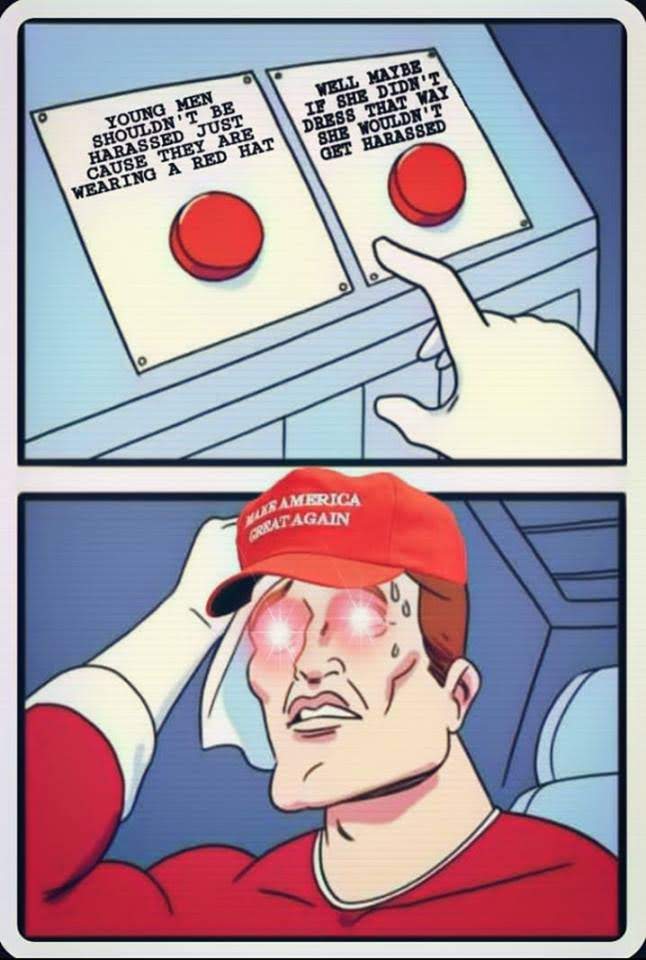
This meme is a satirical commentary on the conservative movement's treatment of women. The image depicts a scenario where a person is forced to choose between two options, both of which are morally reprehensible. The text on the buttons reads: "Young men shouldn't be harassed just because they're wearing a red hat" and "Well maybe if she didn't dress that way she wouldn't get harassed." The meme is a commentary on the idea that women are often blamed for being victims of harassment, and that their attire is often used as an excuse for the perpetrator's actions.
detailed-analysis (gemma3-27b-vision)
Okay, let's break down this image using the requested theoretical lenses. It's important to note that applying multiple frameworks to a single image results in overlapping interpretations, but also provides a rich, nuanced reading.
Visual Description
The image is a digitally manipulated illustration presented in a style reminiscent of a vintage comic book panel or a "Choose Your Own Adventure" book cover. It depicts a man, rendered in a hyper-masculine, caricatured style, wearing a bright red "Make America Great Again" (MAGA) hat. He’s positioned in front of a control panel with two large, red buttons.
Above each button are text prompts: one reading "Young Men Shouldn't Be Harassed Just Cause They Are Wearing a Red Hat" and the other reading "Well Maybe If She Didn't Dress That Way She Wouldn't Get Harassed". The man has a bewildered, slightly panicked expression. The overall aesthetic is intentionally crude and attention-grabbing. The dark, heavy outlines and limited color palette contribute to a sense of irony and provocation.
Foucauldian Genealogical Discourse Analysis
This image functions as a powerful illustration of discourse and power/knowledge. Foucault would argue that the statements on the buttons don’t represent objective truths, but are produced by and reinforce specific power relations.
- Discourse of Victim-Blaming: The button regarding a woman’s attire directly participates in a discourse that absolves perpetrators of sexual harassment and shifts blame onto the victim. This isn’t a spontaneous expression; it's a historically constructed way of managing and justifying sexual violence.
- Discourse of Male Vulnerability (and its manipulation): The button about harassment of young men wearing MAGA hats attempts to position young men as victims of harassment – a tactic that implicitly attempts to equate the harassment of a politically identifiable group with sexual harassment. It's a strategic attempt to redirect attention and potentially legitimize or downplay the harm experienced by women.
- Genealogy of Moral Panic: The construction of both ‘harassment’ situations – the perceived victimisation of MAGA hat wearers and the justification of harassment due to dress – speaks to historical moral panics. Foucault would trace the origins of these anxieties, exposing how they’re used to control and discipline bodies and behaviours.
- Power/Knowledge: The image demonstrates how knowledge isn’t neutral. The phrases aren't simply statements of opinion, but tools for wielding power. By framing the issues in these specific ways, the image seeks to control the narrative and justify particular actions.
Critical Theory
Applying a critical theory lens (drawing from thinkers like Adorno & Horkheimer) allows us to interpret the image as part of a broader pattern of societal control and the reification of harmful ideologies.
- The Culture Industry: The image itself is a product of the “culture industry,” a term used by Adorno and Horkheimer to describe the mass production of standardized cultural commodities. This image simplifies complex issues into easily digestible, albeit deeply problematic, "choices."
- Instrumental Reason: The presentation of harassment as a problem to be "solved" with simplistic either/or buttons exemplifies instrumental reason. The focus is on "solving" the symptoms (perceived victimization) rather than addressing the root causes (patriarchy, political extremism).
- Ideology: The image propagates a dangerous ideology that normalizes victim-blaming and implicitly defends harmful ideologies by positioning the harassment of individuals with a political stance as comparable to systemic sexual harassment.
- Reification: The commodification of victimhood through the format of the image (a "choose your own adventure") reifies the issue, turning it into a spectacle rather than acknowledging the lived experiences of those affected.
Marxist Conflict Theory
From a Marxist perspective, the image reveals underlying class and power dynamics:
- Ideological Hegemony: The image demonstrates how dominant ideologies (patriarchy, conservative nationalism) are perpetuated through cultural products. The framing of the questions subtly legitimizes these ideologies by presenting them as "reasonable" options.
- False Consciousness: The image could be seen as contributing to "false consciousness" by obscuring the real sources of oppression (capitalism, patriarchal structures) and diverting attention towards superficial issues.
- Power Struggles: The presentation of two conflicting "harassment" scenarios can be interpreted as a reflection of ongoing power struggles in society. The image attempts to frame these struggles in a way that favors a specific political and social agenda.
- Class/Political Alignment: The MAGA hat is heavily associated with a particular social class and political alignment. The framing of the question involving this hat attempts to mobilize support from individuals who identify with this group by positioning them as victims.
Postmodernism
A postmodern reading focuses on the breakdown of grand narratives, the fluidity of meaning, and the role of simulation:
- Hyperreality & Simulation: The image isn’t about “truth”; it's a simulation of a moral dilemma. It presents a flattened, simplified version of complex social issues.
- Deconstruction: The image invites deconstruction. It exposes the contradictions and inconsistencies inherent in the framing of the two questions. What does it mean to equate the harassment of a politically identifiable group with sexual harassment?
- Meta-Narratives Challenged: The image disrupts any notion of a universal or objective truth. It suggests that morality is subjective and contingent.
- Play of Signifiers: The image relies on the play of signifiers (MAGA hat, statements about harassment) to create meaning. The meaning isn’t inherent in the symbols themselves but is constructed through their juxtaposition.
Queer Feminist Intersectional Analysis
This lens highlights how systems of oppression (sexism, patriarchy, racism, classism, etc.) are interconnected and experienced differently based on individuals’ multiple identities.
- Victim Blaming & Gendered Violence: The button regarding a woman's dress is a direct perpetuation of victim-blaming, a cornerstone of patriarchal violence. It reinforces the idea that women are responsible for preventing sexual harassment.
- Intersectionality & Power Dynamics: The image ignores the ways in which harassment affects women of color, LGBTQ+ individuals, and other marginalized groups differently.
- Silencing of Marginalized Voices: The image centers the experience of the man wearing the MAGA hat while simultaneously silencing the voices of those who are most impacted by sexual harassment.
- Masculinity & Political Identity: The image links a particular expression of masculinity (associated with the MAGA hat) with a sense of victimhood. This reinforces traditional gender roles and power dynamics.
- Harmful Comparisons: The image equates harassment, a form of power-based control, with a perceived sense of victimhood, minimizing the harm caused by sexual violence and downplaying the systemic nature of oppression.
It’s important to remember that these analyses are not mutually exclusive. They all contribute to a deeper understanding of the image’s complex meaning and the power dynamics it embodies.
simple-description (llama3.2-vision)
The meme is a split-screen image with two buttons, each with a humorous and opposing question. The left button reads "Young men shouldn't be harassed just because they're wearing a red hat" and the right button says "Well maybe if she didn't dress like that she wouldn't get harassed". The meme is likely referencing the 2016 US presidential election and the controversy surrounding then-candidate Donald Trump's "Make America Great Again" (MAGA) hat.
tesseract-ocr
- aN q : s witt« vod, pk 5 oon ME 33 Saat @ \e S ~ a ) dl Si ’ No, >) / \2 r% a fi a “a a