First Seen
2023-05-10T21:03:33+00:00
simple-description (llama3.2-vision_11b)
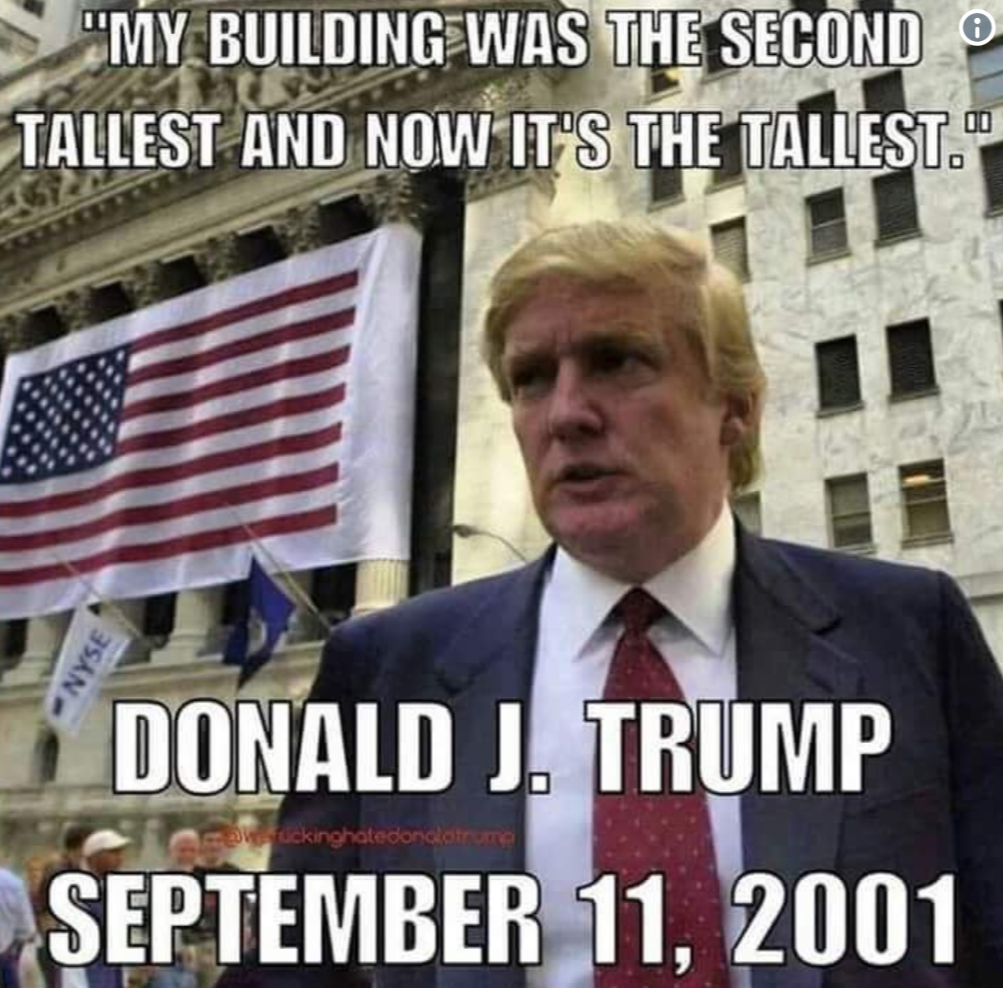
This meme is a commentary on the anti-conservative sentiment of the internet, specifically targeting Donald Trump's infamous quote about his building being the second-tallest in New York City. The meme is a satirical take on Trump's ego and his tendency to exaggerate his achievements, implying that his building is not as impressive as he claims. The image features a photo of Trump with a quote from his 2001 interview, where he claims his building is the second-tallest in New York City, which is a humorous and ironic statement given the actual building's height.
detailed-analysis (gemma3-27b-vision)
Okay, let's break down this image and the quote through the requested theoretical lenses.
Please note: Analyzing a single image with a complex quote is a simplification of these theories, but it allows us to demonstrate how they could be applied. I'll flag where a theoretical lens might not fully fit.
1. Visual Description
The image is a still photograph depicting Donald Trump in a dark suit, looking upward. He is amidst a scene of rubble and debris, likely in the aftermath of the 9/11 attacks. An American flag is prominently displayed billowing to the left, somewhat obscuring a section of the background. The lower portion of the image shows a blurry view of people on the ground. Superimposed over the image is a quote in large white text, “MY BUILDING WAS THE TALLEST AND NOW IT'S THE TALLEST.” Underneath is the text “DONALD J. TRUMP SEPTEMBER 11, 2001”. The quote is juxtaposed with the context of 9/11, immediately raising questions about the intention and interpretation.
2. Foucauldian Genealogical Discourse Analysis
This image and statement are ripe for a Foucauldian analysis. The discourse around "tallest" and "building" isn't simply about architectural achievement; it’s a power/knowledge nexus.
- Genealogy of "Tallest": We can trace the historical development of "tallest" as a marker of status, power, and national pride. In the 20th/21st century, skyscrapers became symbols of capitalist achievement and American exceptionalism. Trump's statement reclaims this symbol immediately after a tragedy, associating his personal success with a national trauma.
- Discourse of Loss and Competition: The statement is not about empathy for the victims, but immediately centers Trump's personal position and triumph within the context of unimaginable loss. It constructs a discourse where competition and individual success remain paramount, even in the face of collective grief.
- Power/Knowledge: Trump's status as a real estate mogul gives him the authority to make this statement, and the media/public acceptance of it demonstrates how certain forms of power shape what is considered "knowledge" or acceptable discourse. It also illustrates the power to redefine the narrative – in this case, from tragedy to personal triumph.
- Panopticism: To a lesser extent, the image has aspects of panopticism, in that the destruction and chaos in the background is witnessed by many, and Trump is presented as a subject of this collective gaze.
3. Critical Theory
This image is a prime example of what Critical Theorists would analyze as the reproduction of ideology.
- Instrumental Reason: The statement exemplifies the prioritization of instrumental reason - focusing on achieving a specific goal (being "tallest") even in a situation where ethical considerations should take precedence. The focus is on how to win, not if one should be winning in such a context.
- Culture Industry: The image, when circulated (e.g., as a meme) becomes part of the "culture industry." It contributes to the normalization of valuing competition and personal gain above empathy or collective mourning. The image serves to reinforce capitalist values.
- Commodification of Tragedy: The statement and subsequent image circulation can be seen as commodifying tragedy, turning a national event into an opportunity for self-promotion. This demonstrates how capitalism can infiltrate and distort even the most profound experiences.
- Reification: Trump’s claim reifies the concept of “tallest” – treating it as an objective and unquestionable value, ignoring the human cost of achieving it.
4. Marxist Conflict Theory
From a Marxist perspective, this image highlights class and power dynamics:
- Class Conflict: Trump, as a representative of the capitalist class, prioritizes his economic interests (his building's prestige) over the suffering of the working class and the broader public affected by the attacks.
- Control of Means of Production: His ownership of the building, and thus his ability to profit from it, symbolizes the capitalist control of the means of production.
- Ideological Hegemony: The image, if accepted without critical analysis, reinforces the ideological hegemony of capitalism – the dominance of capitalist values and beliefs in society.
- Exploitation: The implication is that even in the face of tragedy, the drive for capitalist competition and accumulation continues, essentially exploiting the situation for personal gain.
5. Postmodernism
Postmodern analysis would focus on the breakdown of grand narratives and the fragmentation of meaning.
- Simulacra and Simulation: The image becomes a simulacrum – a copy without an original. It’s not about the actual event (9/11) but a constructed representation used for a specific purpose (self-promotion).
- Deconstruction of Meaning: The juxtaposition of the statement with the tragedy deconstructs the traditional meaning of both. Grief and national mourning are undermined by the focus on material success.
- Loss of Authenticity: The statement lacks authenticity and sincerity, highlighting the postmodern concern with the erosion of genuine feeling and experience.
- Hyperreality: The image and the statement together contribute to a hyperreality – a simulation that becomes more real than the actual event it references.
6. Queer Feminist Intersectional Analysis
This is the lens that has the most difficulty applying to the image in a direct way, but it can still provide insights:
- Power Imbalance: The image exemplifies the concentration of power in the hands of a wealthy, white man, reinforcing patriarchal and capitalist systems.
- Silencing of Marginalized Voices: The focus on Trump’s success obscures the experiences of those who were most affected by 9/11 – particularly marginalized communities who were disproportionately impacted.
- Intersectionality of Trauma: The image ignores the intersectional nature of trauma, failing to acknowledge how factors like race, class, gender, and sexual orientation shape individuals' experiences of loss and grief.
- Toxic Masculinity: The statement demonstrates a form of toxic masculinity, prioritizing competition and dominance over empathy and compassion. The drive to be "the tallest" is a symbol of male ego and aggression.
Disclaimer: These are just potential interpretations. The richness of these theories can’t be fully expressed in a single analysis of an image. The goal is to demonstrate how these lenses can be applied to unpack complex meanings and power dynamics.
simple-description (llama3.2-vision)
This meme is a photo of Donald Trump standing in front of the New York Stock Exchange, with a quote from him. The quote, "My building was the second-tallest, and now it's the tallest," is a reference to the fact that the World Trade Center's Twin Towers were destroyed in the 9/11 attacks, and Trump's building, 7 World Trade Center, survived the collapse of the Twin Towers.
tesseract-ocr
MN. BUILDING? WAS MHE SECOND 4a Vt Se se s SSS ETL SUT TUSS y Lae Y \ * DONALD JSTRUMP eae” ‘SEPTEMBER TWAT