First Seen
2023-05-10T21:03:33+00:00
simple-description (llama3.2-vision_11b)
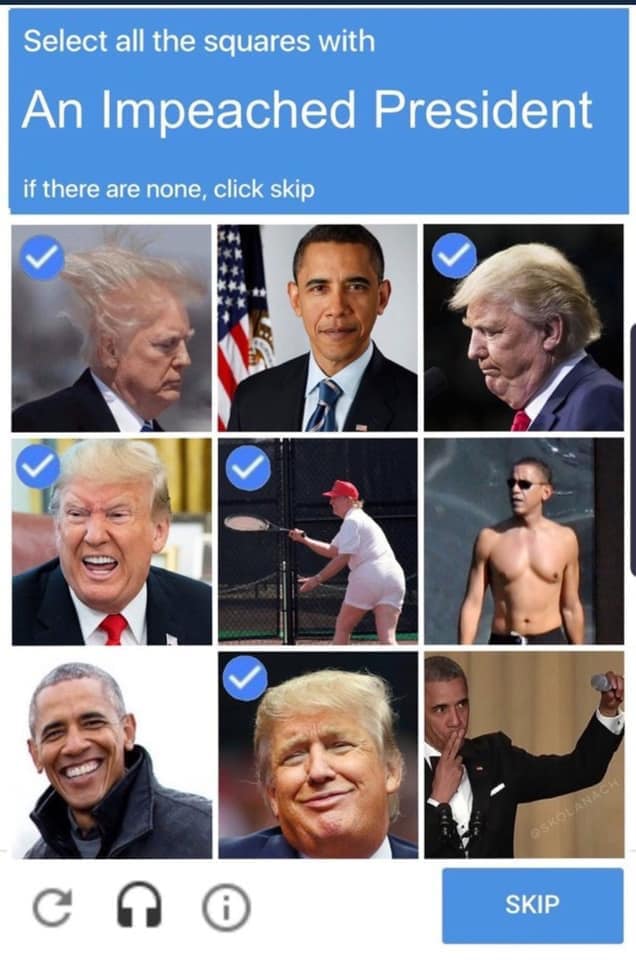
The meme is a "Guess the Character" game where users are shown a series of images with a description of an "Impeached President" and are asked to select the images that fit the description. The images are a mix of the former President's face with various emotions and situations, such as a stormy face, a smirking face, and a face with a "I'm a good guy" expression. The text in the image reads "Select all the squares with an Impeached President" and the "I'm a good guy" face is highlighted.
detailed-analysis (gemma3-27b-vision)
Okay, let's break down this image using the frameworks you've requested. It’s a complex image with many layers, so this will be a fairly in-depth analysis.
Visual Description
The image is a grid of nine squares, each containing a photograph of a former President: Donald Trump or Barack Obama. A selection prompt at the top asks the user to identify the squares depicting an “Impeached President.” Seven of the squares have a checkmark overlaid on them, indicating those are the expected selections. The squares contain various images of Trump and Obama. Trump is depicted in several portraits, a golfing stance, and a shirtless image. Obama is depicted in portraits, and with a serious facial expression. At the bottom of the screen are a "C," "O," and "I" icon, and a "Skip" button.
Foucauldian Genealogical Discourse Analysis
This image is a perfect example for applying a Foucauldian analysis. The very act of framing the question "Impeached President" establishes a discourse. It assumes the impeachment process is a definitional characteristic, a way of knowing the president. The discourse around impeachment isn't just about legality, but about power and the creation of truth.
- Power/Knowledge: The grid demonstrates how power operates through the construction of knowledge. The expectation (indicated by the checkmarks) shapes what counts as true (who is an impeached president). The user is being conditioned to associate impeachment with these particular figures and, thus, to see the question as a matter of fact rather than a political interpretation.
- Genealogy: A genealogical analysis would examine how the concept of impeachment evolved historically, tied to ideas of governance, justice, and abuse of power. It would explore how the discourse around impeachment was utilized in each case.
- Disciplinary Power: The selection format itself is a form of disciplinary power. The image operates as a test, categorizing the viewer as either knowledgeable or ignorant of this particular historical fact. This reinforces a specific understanding of political history.
Critical Theory
From a Critical Theory perspective (drawing from the Frankfurt School, such as Adorno and Horkheimer), the image reflects the culture industry's role in shaping public consciousness.
- Commodification of Politics: The image reduces complex political events (impeachment) to a visual game. It commodifies political history, turning it into something consumable and easily categorized.
- Mass Deception: The image, as part of a larger game or quiz format, potentially contributes to a culture of distraction and superficial understanding. It may prioritize quick recognition over critical thought.
- Ideological Reproduction: By framing impeachment as a defining characteristic, the image reinforces certain ideological assumptions about presidential power and accountability.
Marxist Conflict Theory
Applying Marxist Conflict Theory, the image can be seen as a reflection of the class struggle embedded within the political sphere.
- Dominant Ideology: The framing of the question ("Impeached President") potentially reinforces the dominant ideology—the beliefs and values of the ruling class. This ideology legitimizes the existing power structures.
- Power Dynamics: The image indirectly highlights the power dynamics between the presidents, the electorate, and the institutions of governance. Impeachment represents a conflict within this system.
- Control of Narrative: The selection format suggests a desire to control the narrative around these presidents, framing them within a particular context.
Postmodernism
A Postmodern interpretation focuses on the image's deconstruction of truth, authority, and meaning.
- Simulacra & Simulation: The image can be seen as a simulacrum—a copy without an original. It’s a representation of a representation (a photograph of a political event presented as a test question). It obscures the underlying reality of impeachment and reduces it to a superficial visual game.
- Deconstruction of Grand Narratives: Postmodernism challenges "grand narratives" or overarching explanations of history. The image fragments historical events, isolating impeachment as a single category without acknowledging its broader context.
- Relativism of Truth: The format invites users to "choose" the correct answers, implying that "truth" is not fixed but is constructed through selection and interpretation.
Queer Feminist Intersectional Analysis
This is the trickiest area for a direct analysis, as the image doesn't immediately present overtly gendered or queer content. However, we can apply an intersectional lens to unpack the underlying power dynamics:
- Masculinity and Power: The image prominently features portraits of (primarily) male presidents, reinforcing the association of political leadership with masculinity. The shirtless image of Trump in particular reinforces this, presenting a hypermasculine portrayal.
- Exclusionary Practices: The image implicitly excludes other perspectives—namely, those of women, people of color, and LGBTQ+ individuals—from the narrative of political history. This reflects systemic exclusion within the political sphere.
- Intersection of Power and Representation: Intersectionality highlights how different forms of oppression intersect and create unique experiences of marginalization. The image’s focus on white male leaders contributes to the perpetuation of dominant power structures.
- The Absence of Diverse Voices: The visual representation further marginalizes already marginalized groups.
In conclusion: This seemingly simple image is rich with layers of meaning when analyzed through these theoretical frameworks. It reflects power dynamics, cultural constructions of truth, and the ways in which political history is framed and represented. The image's simplicity belies the complexity of the concepts it subtly embodies.
simple-description (llama3.2-vision)
This meme features a grid of images of former US President Donald Trump, with a "I'm with stupid" pointing gesture superimposed on each one. The meme is likely poking fun at Trump's reputation for making poor decisions and being a symbol of American politics. The text "I'm with stupid" is a common phrase used to point out someone who is acting foolishly.
tesseract-ocr
ats ae) 7 i Y b