First Seen
2023-05-10T21:03:33+00:00
simple-description (llama3.2-vision_11b)
This meme is from the Anti-Cops category, which means it's a humorous or satirical take on a serious topic. The meme is likely a photo of a bear and a salmon, but with a caption that says "Cops: 'We're here to protect you'". The image is a play on the common phrase "bear and salmon" being used in a humorous way to reference police officers, implying that they are not actually protecting anyone, but rather causing harm.
detailed-analysis (gemma3-27b-vision)
Okay, let's break down this image of a bear seemingly "swimming with salmon" through the lenses of various theoretical frameworks as requested. It's important to note that some of these might stretch a bit, as the image is quite simple, but we'll aim for thoughtful application.
Visual Description
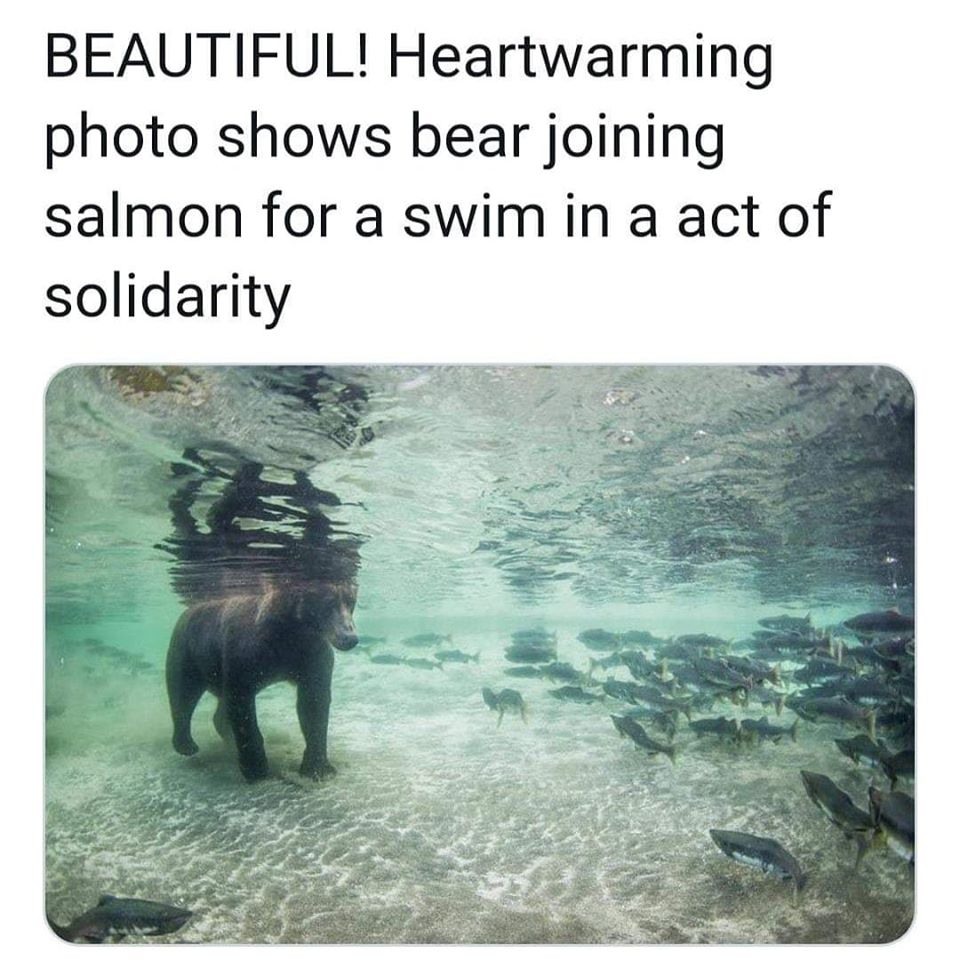
The photograph depicts a brown bear partially submerged in a body of water, likely a river or stream. The bear is viewed from behind, and its head and upper back are visible above the water's surface. The water is a greenish hue, suggesting algae or sediment. Surrounding the bear are numerous salmon, swimming in a clustered group, also visible beneath the water’s surface. The image is taken underwater. The lighting is diffuse, and the composition is fairly centered. The text accompanying the image emphasizes a narrative of "solidarity."
Foucauldian Genealogical Discourse Analysis
The framing of this image as "beautiful" and an "act of solidarity" constructs a specific discourse about human-animal relations. A Foucauldian genealogical approach asks how this discourse came to be and what power relations it reinforces. Historically, representations of bears have shifted. Once viewed as dangerous threats to be conquered, they are increasingly framed as majestic creatures deserving of protection, even empathy.
- Power/Knowledge: The discourse of "solidarity" between bear and salmon participates in a broader power/knowledge regime where the goal is often to manage nature through empathy, thereby solidifying human control. It subtly positions humans as arbiters of what constitutes “good” or “harmonious” interactions in the natural world. We define this as solidarity, imposing a human-centric moral judgment onto animal behavior.
- Discontinuity: Examining the historical depictions of bears reveals a discontinuity. Early narratives emphasized the bear as an "other" to be subdued; now, the image is often a symbol of wild beauty and peaceful co-existence. This shift is not “natural,” but a result of changing social, economic, and political forces.
- The Archive: This image contributes to a growing "archive" of images depicting human-animal bonding, which is then used to promote conservation efforts or specific ideologies around animal rights.
Critical Theory
From a critical theory perspective (drawing heavily from the Frankfurt School and thinkers like Horkheimer and Adorno), this image, while appearing natural, participates in the "culture industry" that reproduces dominant ideologies.
- Commodification of Nature: The image promotes a sanitized, aestheticized view of nature. By portraying a seemingly harmonious scene, it obscures the real ecological violence inherent in human-animal interactions (hunting, habitat destruction, etc.). It’s nature as spectacle rather than a complex, often brutal, ecosystem.
- False Consciousness: The emphasis on "solidarity" can be interpreted as a form of "false consciousness." It encourages the viewer to believe in a harmonious, natural order that doesn't exist, masking the power imbalances inherent in the relationship between humans, bears, and salmon. It lets us feel good about nature without confronting the systems that are destroying it.
- Instrumental Rationality: The framing of this image (e.g., a heartwarming story) can be viewed as an example of instrumental rationality – using images and narratives to achieve a specific goal (e.g., support for conservation, reinforcing a particular worldview).
Marxist Conflict Theory
While perhaps not the most obvious fit, a Marxist lens can analyze this image through the lens of resource control and class relations.
- Control of Natural Resources: The salmon represent a natural resource that historically has been subject to conflict – between humans, and between different groups of humans (e.g., fishing rights, indigenous access to resources). The image downplays this inherent conflict.
- Alienation: The aestheticization of nature can be seen as a form of alienation. It separates us from the actual material conditions of our relationship with the environment – the labor, exploitation, and conflict involved in resource extraction.
- Ideology: The "solidarity" framing serves an ideological function, obscuring the ways in which humans are fundamentally positioned above nature, controlling and exploiting it for their own benefit.
Postmodernism
A postmodern perspective would deconstruct the very notion of a fixed "meaning" in this image, arguing that interpretation is fluid and subjective.
- Simulacra and Simulation: The image itself is a simulation – a representation of a moment in time. It's not the "real" event, but a mediated version of it. The meaning of "solidarity" becomes a simulacrum – a copy of a copy, disconnected from any concrete reality.
- Deconstruction of Narrative: The framing as "heartwarming" imposes a narrative that can be deconstructed. There's no inherent “warmth” in this image; it’s a projection of human emotion onto animal behavior.
- Rejection of Grand Narratives: The idea of "solidarity" as a universal truth is rejected. There's no overarching "story" about human-animal relations, only a multitude of individual interpretations.
Queer Feminist Intersectional Analysis
This is the most challenging application, but can be attempted by considering power dynamics and challenging normative assumptions.
- Challenging Human Exceptionalism: A queer feminist lens challenges the assumption of human exceptionalism – the idea that humans are inherently superior to other animals. This image, if read critically, can expose the ways in which we project our own values and desires onto the animal world.
- Non-Anthropocentric Perspectives: The image can be used to explore non-anthropocentric perspectives – ways of understanding the world that don’t center human experience. What is this moment from the perspective of the salmon, or the bear?
- Intersectionality of Environmental Justice: Environmental damage and habitat loss disproportionately affect marginalized communities. An intersectional analysis would consider how the "harmony" depicted in the image ignores the broader issues of environmental injustice and social inequality.
It is crucial to remember that these are interpretations, and the image can be analyzed from many different perspectives. The goal of these theoretical frameworks is not to arrive at a single "correct" meaning, but to reveal the complex power relations and ideological assumptions that shape our understanding of the world.
simple-description (llama3.2-vision)
This meme is a humorous image that juxtaposes two seemingly unrelated things: a bear and a school of fish. The text at the top of the image reads "BEAUTIFUL! Heartwarming photo shows bear joining salmon for a swim in a act of solidarity" in a sarcastic tone, implying that the bear is actually attacking the fish, not joining them. The image itself shows a bear swimming in a lake or river, surrounded by a school of frightened fish.
tesseract-ocr
BEAUTIFUL! Heartwarming photo shows bear joining salmon for a swim in a act of solidarity = 2 =. — & See «Vr «eee ee eee es a. Sa