First Seen
2023-05-10T21:03:33+00:00
simple-description (llama3.2-vision_11b)
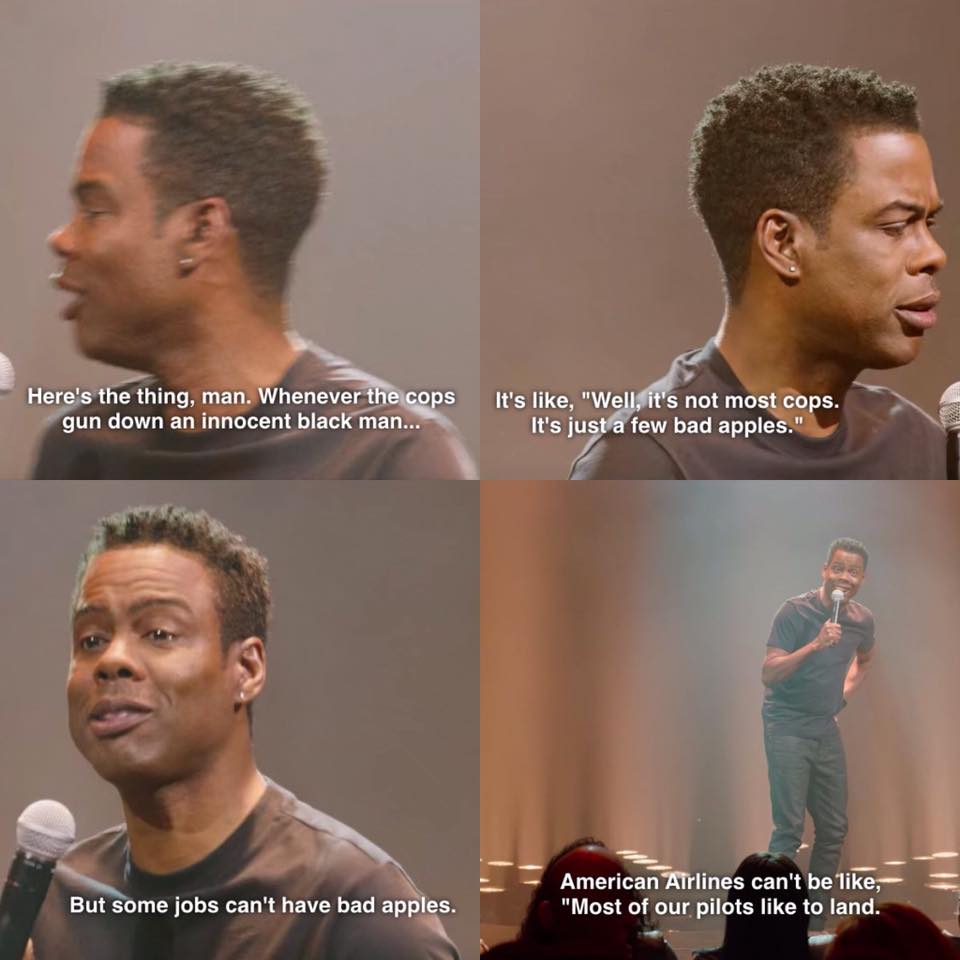
The meme is a humorous commentary on the stereotype that police officers are often perceived as being "bad apples" who are not representative of the entire profession. The image features a quote from Chris Rock's stand-up comedy special, where he jokes that if you're a police officer, you're not a good cop, you're a bad cop. The meme is a humorous way to poke fun at the idea that police officers are not always the most reliable or trustworthy.
detailed-analysis (gemma3-27b-vision)
Okay, here's an analysis of the image, broken down by the requested theoretical frameworks. I'll indicate where a framework doesn't directly apply.
Visual Description
The image is a collage of four different snapshots of comedian Dave Chappelle performing stand-up comedy. He is dressed in various outfits. Each snapshot features a text caption presumably from a bit he's doing.
- Top Left: Chappelle is in a dark blazer with a serious expression. Text reads: "Here's the thing, man. Whenever the cops gun down an innocent black man..."
- Top Right: Chappelle is wearing a teal/green scrub top, holding a microphone, and appears to be making a point with a stern expression. Text: "It's like, 'Well, it's not most cops. It's just a few bad apples.'"
- Bottom Left: Chappelle is wearing a black collared shirt, looking directly at the camera, with a slightly incredulous expression. Text: "But some jobs can't have bad apples."
- Bottom Right: Chappelle is wearing the teal scrub top again and the text reads: "American Airlines can’t be like, 'Most of our pilots like to land.'"
The overall aesthetic is that of a live comedy performance, captured in still images. The contrast between the serious subject matter (police brutality) and the comedic context is immediately apparent. The repetition of the "bad apple" phrase suggests it's a central point of his commentary.
Foucauldian Genealogical Discourse Analysis
This framework is highly relevant. Dave Chappelle’s comedic bit is a potent example of how dominant discourses are constructed and maintained around issues of power, specifically police brutality and systemic racism.
- Discourse: The "bad apple" trope is a discourse – a system of thought, language, and practice that creates a particular understanding of a problem. It’s a way of framing police misconduct as an individual failing rather than a symptom of systemic issues within the police force and broader societal structures.
- Genealogy: A genealogical analysis would trace the historical emergence of this discourse. Where did this phrase come from? How has it been used over time to manage the problem of police misconduct? The phrase aims to deflect attention from the broader issues of police training, culture, accountability, and racial bias. It shifts the focus to individual officers, creating the illusion that fixing a few "bad apples" will solve the problem.
- Power/Knowledge: Foucault argues that power and knowledge are inextricably linked. The discourse of the "bad apple" is a way of exercising power – maintaining the status quo by controlling how the problem is understood and addressed. The authorities (police departments, politicians) produce knowledge that supports this discourse, framing individual instances of misconduct as exceptions to the rule, rather than manifestations of a pattern.
- Chappelle’s Deconstruction: Chappelle, through his humor, deconstructs this discourse. By juxtaposing the "bad apple" excuse with the absurdity of a pilot being allowed to not land a plane ("most of our pilots like to land"), he exposes the illogical and unacceptable nature of applying the same logic to life-and-death situations involving police violence.
Critical Theory
This is very applicable, as Critical Theory seeks to analyze and critique power structures and ideologies.
- Ideology: The "bad apple" trope is an ideological mechanism that serves to legitimize and perpetuate systemic racism. It obscures the structural roots of police brutality and presents it as an isolated incident caused by a few deviant individuals. This allows the system to continue functioning without fundamental change.
- Hegemony: The widespread acceptance of the “bad apple” excuse demonstrates the power of hegemony – the dominance of a particular set of ideas and values that become taken for granted as common sense. It’s not necessarily that people consciously support racism, but that they’ve internalized a worldview that makes it difficult to see the systemic nature of the problem.
- Domination and Oppression: The image highlights the power dynamics between law enforcement and marginalized communities, particularly Black Americans. The phrase "bad apple" serves to minimize the harm inflicted on those communities and deflect responsibility from the system.
- Chappelle as Critique: Chappelle functions as a critical voice, challenging the dominant ideology and forcing audiences to confront the uncomfortable truth about systemic racism. His humor is a form of resistance, disrupting the hegemonic narrative and creating space for alternative understandings.
Marxist Conflict Theory
This framework offers a useful lens, though it's less directly applicable than Critical Theory or Foucauldian analysis.
- Class Struggle: While primarily focused on race, the issue of police brutality is intertwined with class structures. Marginalized communities are often economically disadvantaged and disproportionately targeted by law enforcement. Police violence can be seen as a form of control exerted by the state to maintain the existing power structure.
- Power Dynamics: The image demonstrates the power imbalance between the state (represented by the police) and the oppressed (Black Americans). The "bad apple" excuse is a way of maintaining this imbalance by absolving the system of responsibility.
- Ideology as a Tool of Control: The “bad apple” trope can be seen as part of the ruling class’s (or the state's) ideological apparatus—a means of legitimizing its power and suppressing dissent.
- Chappelle as Social Commentary: Chappelle's commentary can be interpreted as a critique of the capitalist system's inherent inequalities and the ways in which they manifest in policing and criminal justice.
Postmodernism
While potentially relevant, this is the least directly applicable framework.
- Deconstruction of Grand Narratives: Postmodernism challenges universal truths and “grand narratives.” Chappelle, by exposing the absurdity of the “bad apple” trope, is implicitly challenging the dominant narrative that police misconduct is simply the result of a few individual failures.
- Emphasis on Discourse: Postmodernism, like Foucauldian analysis, emphasizes the role of language and discourse in shaping our understanding of reality.
- Questioning Authority: Postmodernism encourages skepticism towards authority and established institutions. Chappelle’s comedy implicitly questions the authority of the police and the justice system.
- However: The image isn't primarily about the instability of meaning or the rejection of all truth. Its power lies in its direct engagement with a very concrete social issue.
Queer Feminist Intersectional Analysis
While the image explicitly centers on race and policing, an intersectional analysis adds valuable nuance.
- Intersectionality: Intersectionality recognizes that systems of oppression (racism, sexism, homophobia, classism, etc.) are interconnected and create unique experiences of discrimination. Black women, Black LGBTQ+ individuals, and other marginalized groups within the Black community face compounded forms of oppression.
- Impact on Black Women: Black women are disproportionately impacted by police violence and often subjected to unique forms of harassment and brutality. The "bad apple" excuse often ignores the gendered dimensions of police misconduct.
- Queer and Trans Experiences: Black LGBTQ+ individuals are particularly vulnerable to police violence and discrimination. Their experiences are often marginalized even within discussions of racial justice.
- Chappelle’s Responsibility: This is where it gets more complex. Chappelle has faced criticism for his jokes about the LGBTQ+ community. An intersectional analysis would require acknowledging this and recognizing the potential harm his humor can inflict, even while acknowledging his critique of systemic racism. The image itself doesn’t explicitly address queer or feminist issues, but the framework reminds us to consider how all forms of oppression are interconnected.
I hope this detailed breakdown provides a comprehensive analysis of the image through the requested theoretical frameworks! Let me know if you'd like me to elaborate on any specific point.
simple-description (llama3.2-vision)
The meme is a screenshot of a TV show where a comedian is talking about a joke about racism. The text "In 2-3 sentences, describe this meme for someone who cannot see it" is at the top, and the comedian says "Here's the thing, man. When you put the word 'racist' in front of 'cops', the first thing that comes out is racist cops. And then you say, 'They're not racist cops.' And then you say, 'They're not racist cops.' And then you say, 'They're not racist cops.'" The text "In 2-3 sentences, describe this meme for someone who cannot see it" is at the top.
tesseract-ocr
e < = = cr aE fr a % = 7 "= — —_ e — = er fa a Here's iit: man. Whenever thejcops It's like, "Wellfit's not most cops. — t Cola fT La locent bla hail Tees: feUbad Je D , we 1 ? -_ “5 es i eS ‘ ah a. ‘ / X “| : -_— es aa : 3 ? ! ‘ Pout) lilt Ta a LUT TES Tale Ua CNT) ~) |code ORCC Lo i ni — _