First Seen
2023-05-10T21:03:33+00:00
simple-description (llama3.2-vision_11b)
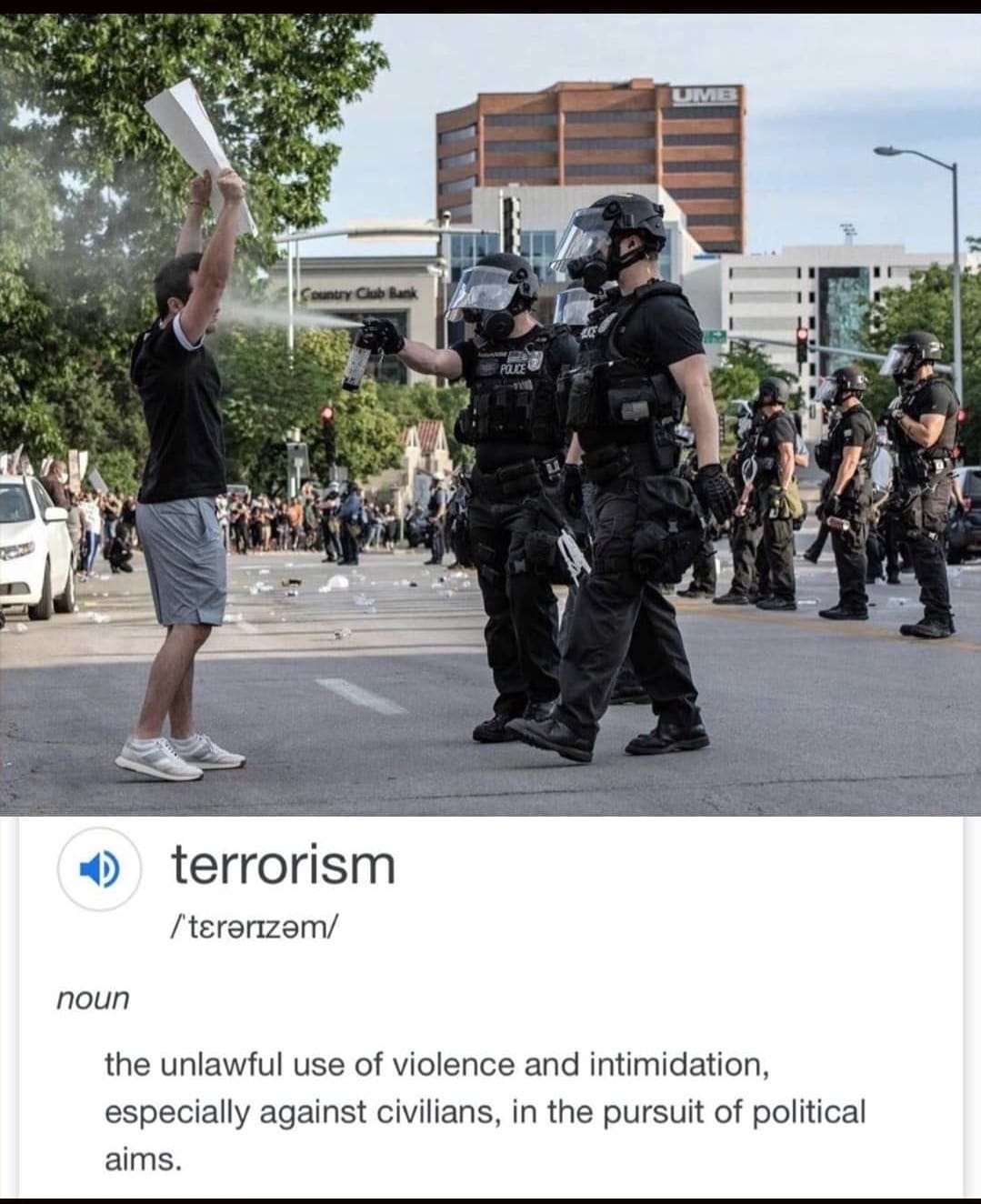
The meme is a screenshot of a protest where a protester is holding up a sign that reads "I Can Explain" in the style of a 19th-century literary figure. The image is captioned "Terrorism" with a definition that reads "the use of violence or intimidation in the pursuit of political goals". The meme is likely referencing the idea that the protester is using their sign to explain their actions, but the definition of terrorism is being used to describe the situation in a humorous and ironic way.
detailed-analysis (gemma3-27b-vision)
Okay, let's break down the image and the provided definition of "terrorism" through various critical lenses. Please note that interpreting images through theory is inherently subjective and can yield multiple readings.
Image Description
The image depicts a line of heavily armed police officers in full riot gear, standing in a street lined with trees and buildings. They are facing away from the camera, creating a wall of authority. In the foreground, a single individual (appears to be male, but not discernible) is standing with their arm raised in a gesture that could be seen as defiance, protest, or surrender. The background reveals the city and buildings, including one labeled "Country Bank."
Foucauldian Genealogical Discourse Analysis
This image is fertile ground for a Foucauldian analysis. Michel Foucault’s work would focus on how “terrorism” as a concept, and its associated practices (police militarization, displays of force), have historically been constructed through discourse.
- Power/Knowledge: The image embodies the relationship between power and knowledge. The police, as representatives of the state, possess the knowledge (and, crucially, the right) to define what constitutes legitimate and illegitimate action. The image performs that power. The heavily armed police, in their gear, are the definition of a force that can use violence. The individual raising their arm is defined by that power - potentially as a threat, a rebel, or even a terrorist.
- Discipline and Control: The riot gear represents a panoptic form of discipline, a visible reminder of potential surveillance and control. The line of officers represents an attempt to normalize a certain order and to suppress any deviation from it. The act of protest, even a solitary gesture, is seen as a transgression requiring forceful response.
- Genealogy of "Terrorism": A genealogical study would trace how the term "terrorism" has evolved over time, how its meaning has shifted, and how it has been deployed to justify specific forms of state power. The way the individual is visually framed as a potential terrorist (even before any action) is part of that genealogy.
Critical Theory
From a Critical Theory perspective, this image reveals the underlying power dynamics and ideological structures that shape society.
- Hegemony: The image illustrates how the state attempts to maintain its hegemonic position – its dominance not just through force, but through the acceptance of its ideology. The image is designed to appear as a natural and necessary response to potential threat.
- Ideology: The image reinforces the idea that order and control are paramount, and that any challenge to the status quo is inherently dangerous. The presentation of the police as protectors, and the protestor as potentially dangerous, reinforces this ideology.
- Commodification: Note the "Country Bank" sign in the background. Critical Theory would analyze how the protection of private property (the bank) is often framed as a primary justification for the use of force.
Marxist Conflict Theory
From a Marxist perspective, this image can be interpreted as a manifestation of class conflict.
- State as Instrument of Class Rule: The police are seen as instruments of the ruling class, protecting its interests (wealth, property) through the suppression of dissent. The bank in the background serves as a visual symbol of those interests.
- Alienation: The individual raising their arm might be interpreted as representing the alienation of the working class or marginalized groups from the dominant power structures. The police response represents the state's attempt to maintain its control over the alienated.
- Exploitation: Depending on the context of the protest, the image could represent a struggle against economic exploitation or social injustice. The police are there to enforce the existing system of exploitation.
Postmodernism
A postmodern interpretation of the image might focus on the instability of meaning and the deconstruction of grand narratives.
- Simulacra and Simulation: The image itself can be seen as a simulacrum – a representation of reality that has become detached from the real. The heavily armed police, the raised arm, the bank – all are signs that have lost their original meaning and are now part of a spectacle of power.
- Deconstruction of "Terrorism": A postmodern approach would challenge the fixed definition of "terrorism" and examine how the term is used to construct particular narratives and legitimize certain actions. The image prompts us to ask: who defines terrorism, and what are their motivations?
- Fragmented Narratives: The image doesn't tell a complete story. It's a fragment of a larger event, and its meaning is open to interpretation.
Queer Feminist Intersectional Analysis
While not immediately apparent, this lens can add nuanced understanding if we assume the context of the protest involves issues of gender, sexuality, and/or race.
- Intersectionality: If the protester is part of a marginalized group (e.g., LGBTQ+, person of color), the police response might be understood as a manifestation of systemic oppression, where multiple forms of discrimination intersect. The state violence can be seen as reinforcing existing power imbalances.
- Gender and Violence: The image could be analyzed in terms of how state violence is often gendered, with marginalized genders disproportionately affected.
- Deconstructing Normativity: The act of protest itself can be seen as a challenge to dominant norms and power structures. If the protest is about LGBTQ+ rights or racial justice, the police response can be seen as an attempt to enforce heteronormative and white supremacist ideologies.
Disclaimer: This is an interpretation. The actual meaning of the image depends on the specific historical and social context in which it was taken.
simple-description (llama3.2-vision)
This meme is a humorous take on the concept of terrorism, using a definition from a dictionary to illustrate the absurdity of using the word to describe a situation where a person is being sprayed with pepper spray by police, while another person is simply holding a sign and protesting. The image shows a police officer in riot gear, with a protester in the background holding a sign, and a caption with the word "terrorism" defined as "the unlawful use of violence and intimidation, especially against civilians, in the pursuit of political aims." The meme is poking fun at the idea that the police are using pepper spray to control the situation, while the protester is simply exercising their right to free speech.
tesseract-ocr
Ae Roe a ah he PP : AR “ il > Ht ey ei ki re 1am ; ae i lie, I : i ae ss = a pr , ) ae | Pee 4 aS if 4 e N ft 3 i nt NAW Pa ed, My , be Mi ee may OMe eae Ck Rie ri Hey ee aes 1 , See eh a v re es Tl a OS —— eremtten crc ee were ce a Pics s ae Bate 5 () terrorism /terertzem/ noun the unlawful use of violence and intimidation, especially against civilians, in the pursuit of political aims.