First Seen
2023-05-10T21:03:33+00:00
simple-description (llama3.2-vision_11b)
The meme is a screenshot of a live stream where a man is sitting on the ground with a sign that reads "I'm not resisting arrest, I'm just not getting up". The meme is likely to be shared in the context of anti-cop sentiment, where individuals are expressing frustration and distrust towards law enforcement. The image is meant to be humorous and satirical, poking fun at the idea of police procedures and the power dynamics between law enforcement and the public.
detailed-analysis (gemma3-27b-vision)
Okay, let's break down this image through the lenses you've requested. I'll note if a specific lens doesn't strongly apply.
Image Description
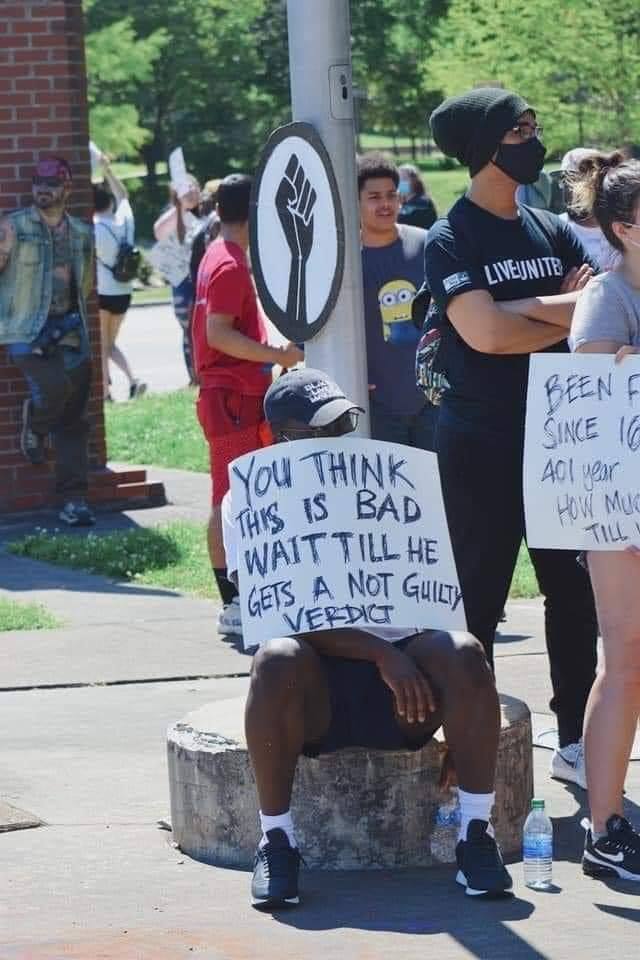
The photo depicts a Black man sitting atop a stone pillar or pedestal, seemingly as part of a protest or demonstration. He’s holding a hand-written sign that reads: "You think this is bad wait till he gets a not guilty verdict." He is wearing a baseball cap and appears to be looking downwards or lost in thought.
Around him is a crowd of people, a mix of races and genders, also holding signs. A pole is present with a sticker of a raised black fist. In the background is a brick building and some greenery. The scene is taking place outdoors in bright sunlight. A water bottle is visible on the ground. The overall mood appears serious and possibly tense, suggesting a politically charged environment.
Foucauldian Genealogical Discourse Analysis
This image is ripe for a Foucauldian reading. The sign's message anticipates a specific outcome in a legal case—a "not guilty" verdict—and implies a future reaction. This future reaction is key. Foucault would be interested in the discourses surrounding criminal justice, race, and power that create the anticipation and the potential for unrest.
- Power/Knowledge: The very notion of "guilt" or "innocence" is a construction of power. The legal system, with its rules, evidence, and processes, produces truth about criminality, but this truth is not neutral. It’s deeply embedded in societal norms and power dynamics. The man’s sign anticipates how that power will be re-negotiated if the verdict defies expectations.
- Genealogy: A genealogical approach would trace the historical origins of these discourses. How did the concept of "criminal justice" develop? How has race been historically linked to criminality and punishment? What are the historical precedents for both legal outcomes and the types of reactions the sign foreshadows? The phrase “wait till” hints at historical patterns of injustice and predictable responses.
- Disciplinary Power: The sign, even before any verdict, functions as a threat – a form of “disciplinary power” in the Foucauldian sense. It attempts to control future behavior not through direct force but through the anticipation of negative consequences if expectations are not met. It subtly aims to shape the behavior of the legal system and the public.
Critical Theory
The image strongly resonates with themes central to Critical Theory, specifically those relating to social justice and power imbalances.
- Ideology: The sign challenges the ideology of the legal system as neutral and objective. It suggests that the system is inherently biased or disconnected from the lived experiences of marginalized communities. The anticipation of a "not guilty" verdict highlights a distrust in the system's ability to deliver just outcomes, especially for those who are already disadvantaged.
- Emancipation: The protest and the sign’s message are attempts at emancipation – a breaking free from structures of oppression. It's a direct challenge to the status quo.
- Hegemony: The protest is a direct challenge to the hegemonic narratives about crime, justice, and racial disparities. Hegemony refers to the ways in which dominant groups maintain power through the consent of the governed. By publicly questioning the legal system, the protestors are disrupting the normal acceptance of its authority.
Marxist Conflict Theory
While not the primary lens, Marxist Conflict Theory can offer some insights.
- Class Struggle: One could argue that the legal system often perpetuates existing class structures, disproportionately punishing individuals from lower socioeconomic backgrounds. The sign hints at a potential for social unrest as a result of perceived injustice, suggesting a tension between different social classes or groups.
- Power Dynamics: The anticipation of a "not guilty" verdict signals a belief that the legal system is controlled by those in power and may not serve the interests of the marginalized.
- Superstructure: The legal system itself can be seen as part of the "superstructure" in Marxist terms – a system designed to uphold the interests of the ruling class.
Postmodernism
Postmodernist interpretations might focus on the deconstruction of grand narratives and the instability of meaning.
- Deconstruction of Truth: The sign directly questions the idea of objective "truth" in the legal system. It implies that the outcome of a trial is not simply a matter of determining facts but is also influenced by social, political, and racial factors.
- Instability of Meaning: The phrase “wait till” introduces a sense of uncertainty and anticipates a future event that may radically alter the situation. This challenges the idea of a fixed or stable meaning.
- Rejection of Metanarratives: The protest and sign reject the notion of a universal, objective legal system as an ideal metanarrative.
Queer Feminist Intersectional Analysis
While the image doesn't explicitly depict queer or feminist themes, an intersectional analysis can still be applied.
- Interlocking Oppressions: An intersectional lens recognizes that individuals experience oppression based on multiple, overlapping identities (race, gender, class, sexuality, etc.). The sign speaks to the experience of racial injustice, which often intersects with other forms of oppression, especially for Black women, Black LGBTQ+ individuals, and other marginalized groups.
- Disrupting Dominant Narratives: The protest challenges the dominant narratives about crime, justice, and race that often exclude or misrepresent the experiences of marginalized communities.
- Centering Marginalized Voices: The sign can be seen as an attempt to center the voices and experiences of those who are most affected by systemic injustice.
Let me know if you'd like me to elaborate on any of these analyses or explore other theoretical frameworks!
simple-description (llama3.2-vision)
This meme is an image of a person sitting on the ground with their back to the camera, wearing a "I Can Read" sign. The sign is being held up by another person standing behind them, who is also wearing a "I Can Read" sign. The text on the sign reads "I can read" but is actually written in a childlike, scribbled handwriting.
tesseract-ocr
= : ice . se Gey. \ iy Ni Be b, + ' 7 a \ : Aa\ | | eo i = Hy cen ef 1 . és AEN + BNO THINK Ae yar ome & Art TILLHE A a ra = ay (es, PNET Gt cs \ a ae __—_———_f , — ‘ eS 4 ! ge ve i [ a ‘es =