First Seen
2023-05-10T21:03:33+00:00
simple-description (llama3.2-vision_11b)
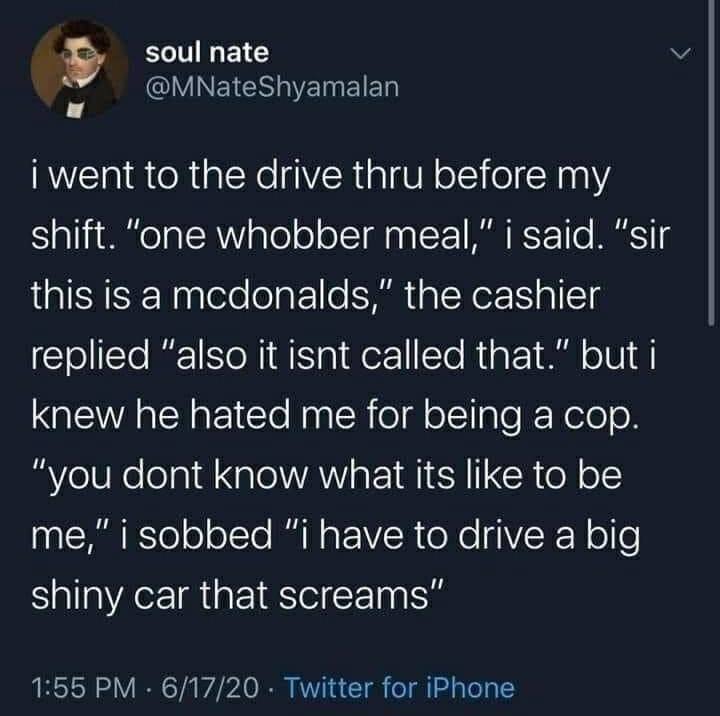
The meme is a humorous example of anti-cop sentiment, where the narrator is expressing their frustration and anger towards a police officer who is trying to eat at the same fast food restaurant. The text reads: "i went to the drive thru and i said 'i'd like to order a whopper' and the cashier said 'i'm sorry, we don't have whoppers' and i said 'what?' and he said 'we don't have whoppers' and i said 'what do you mean you don't have whoppers? this is mcdonalds' and he said 'i'm sorry, we don't have whoppers' and i said 'what? this is mcdonalds!'"
detailed-analysis (gemma3-27b-vision)
Okay, here's an analysis of the Twitter post, broken down into sections as requested, focusing on applicable theoretical lenses. I'll indicate when a section doesn't apply. Note that this is a short text, so the analysis will be concise.
Visual Description
The image is a screenshot of a Twitter post. The post's author is @MNateShyaman, pictured with a black and white portrait. The post itself is text-based, a short exchange purportedly occurring at a drive-thru. Below the text is the timestamp and information that the post was made via Twitter for iPhone. The overall visual impression is one of casual, unfiltered online expression.
Foucauldian Genealogical Discourse Analysis
This exchange is ripe for a Foucauldian reading. The entire scenario plays out as a demonstration of power dynamics enacted through seemingly mundane language.
- Discourse & Knowledge: The confrontation over the "whobber" reveals how power shapes what counts as legitimate knowledge. The cashier asserts the "correct" term ("McDonald's"), implicitly policing the cop's language. This act isn't simply about accuracy; it’s a performance of authority—a claim to define reality.
- Panopticism & Surveillance: The cop's final line ("i have to drive a big shiny car that screams") hints at the panoptic nature of policing. The "big shiny car" acts as a visible marker of power and surveillance, implicitly asserting dominance. It is a mobile structure of disciplinary power. The phrase "screams" suggests the car is an instrument of force, inherently associated with control and potentially violence.
- Genealogy: We could trace the genealogy of the "cop" figure, looking at how their role has been historically constructed through law, media, and societal narratives. The cashier's response could be interpreted as a rejection of that constructed authority.
Critical Theory
This tweet engages with key tenets of Critical Theory, particularly regarding ideology and alienation.
- Ideology: The exchange reveals a clash of ideologies. The cop likely operates within a framework of authority and entitlement, expecting to be accommodated. The cashier, perhaps motivated by anti-police sentiment (implied by the knowledge of the cop’s role), challenges that expectation.
- Alienation: The cop's final lament ("i have to drive a big shiny car that screams") expresses a kind of alienation. He identifies with the tool of his authority – the car – but also implies a sense of being trapped by it. The car, a symbol of power, is also a source of emotional distress.
- Domination & Resistance: The interaction is inherently about power. The cop, representing the state, expects service. The cashier's denial is a small act of resistance against that authority.
Marxist Conflict Theory
While not explicitly about class conflict, we can frame the scenario through a Marxist lens.
- Power Structures: The cop represents a structure of power (the state/law enforcement) enforcing its dominance. The cashier, as a worker in the fast-food industry, represents a marginalized class potentially subject to that power.
- Exploitation/Control: Fast-food workers often experience exploitation in the workplace. The cashier’s blunt refusal can be read as a refusal to perform the expected role of subservience to a figure of authority.
- Class Consciousness: It’s difficult to determine the cashier’s degree of class consciousness from this single tweet, but his reaction hints at a potential awareness of the power dynamic at play.
Postmodernism
This tweet exhibits several postmodern characteristics.
- Rejection of Grand Narratives: The scene undermines the “grand narrative” of police authority. The cashier refuses to grant the cop the deference usually associated with his role, disrupting the expected script.
- Deconstruction of Meaning: The wordplay with "whobber" and the correction by the cashier highlight the arbitrariness of language. There is no inherent "correct" term; meaning is socially constructed.
- Fragmentation & Simulacra: The situation feels fragmented, stripped of context. The "big shiny car" becomes a simulacrum of power, a superficial representation divorced from any deeper meaning or purpose.
Queer Feminist Intersectional Analysis
This lens is less directly applicable but can be considered.
- Power Dynamics: As with other lenses, the power dynamic is key. A feminist reading could view the cop’s expectation of service as a manifestation of patriarchal entitlement.
- Intersectionality: The cashier's response could be interpreted as a challenge to systems of oppression, though we lack sufficient information to understand his positionality. Intersectional analysis would benefit from considering the cashier’s race, class, gender, etc., to understand the layers of power at play.
- Subversion of Norms: The refusal to play the expected role disrupts the "normal" social script. It’s a small act of rebellion against established power structures.
Important Note: These analyses are interpretations based on a limited text. Different readers might draw different conclusions. The power of the tweet lies in its ambiguity and openness to interpretation.
simple-description (llama3.2-vision)
This meme is a humorous example of a person's frustrating experience with a fast food restaurant. The text reads: "I went to the drive-thru and said 'I'd like to order a Whopper' and the cashier responded with 'It's your lucky day, this is the last one we have!'" The meme is a play on the phrase "It's your lucky day" being ironic, as the speaker is actually unhappy with the situation.
tesseract-ocr
7 FH yanelan : a i went to the drive thru before my shift. “one whobber meal,” i said. “sir this is a mcdonalds,” the cashier replied “also it isnt called that.” but i knew he hated me for being a cop. “you dont know what its like to be me," i sobbed “i have to drive a big shiny car that screams” 1:55 PM - 6/17/20 - Twitter for iPhone