First Seen
2023-05-10T21:03:33+00:00
simple-description (llama3.2-vision_11b)
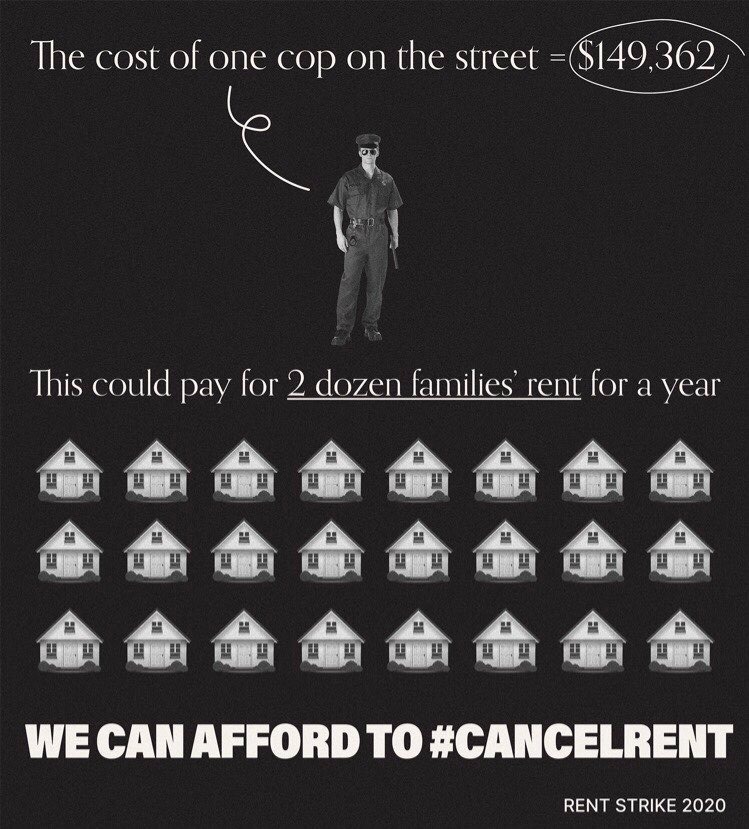
The meme is a satirical commentary on the cost of policing and the perceived value of police officers in society. The image juxtaposes a police officer with a mundane task, such as buying a house, to highlight the absurdity of the officer's salary being equivalent to a family's annual rent. The text "The cost of one cop on the street is equal to the rent for 2 dozen families for a year" drives home the point that police resources are being prioritized over community needs.
detailed-analysis (gemma3-27b-vision)
Okay, here's an analysis of the image, broken down by the requested theoretical frameworks. I’ll indicate where a framework doesn’t strongly apply.
Visual Description
The image is a stark black and white composition. The top section features a photograph of a uniformed police officer standing on a black background, posed in a formal, authoritative manner. Above the officer, a dollar sign is connected to the text "The cost of one cop on the street = $149,362" in a handwritten style.
Beneath the officer is a grid of identical, cartoon-like drawings of single-family homes. The text "This could pay for 2 dozen families’ rent for a year" is positioned above this grid.
At the very bottom, in large, bold white letters, is the phrase "WE CAN AFFORD TO #CANCELRENT" with the added text "RENT STRIKE 2020" in smaller font on the right. The overall aesthetic is direct, impactful, and designed for quick comprehension, suggesting it is intended as a piece of political propaganda or a social media graphic.
Foucauldian Genealogical Discourse Analysis
This image is rich for a Foucauldian analysis. It directly engages with power/knowledge dynamics.
- Discourse of Policing: The officer represents a discourse of policing – a system of thought, language, and practice that constructs crime, order, and control. The image doesn't simply show a cop, but the concept of policing, its cost (both financial and societal), and its perceived necessity.
- Genealogy of Cost & Value: Foucault would be interested in how "cost" itself is a historical construct. What does it mean to assign a monetary value to a police officer? This is not a natural value; it's a product of a specific historical and social formation that prioritizes security (and control) over housing. The image disrupts this accepted value by re-framing the cost – showing it could instead provide essential security for families (housing).
- Discipline & Normalization: The officer embodies a form of disciplinary power – the surveillance and normalization of behavior. The image implies that the resources dedicated to maintaining this disciplinary apparatus could be used for positive forms of social care.
- Counter-Discourse: "#CancelRent" is a clear counter-discourse to the dominant narrative that prioritizes law enforcement. It’s an attempt to reframe the problem – from a focus on “crime” to a focus on the root cause of precarity (lack of housing).
The image doesn't just present an argument; it performs an intervention in the discourses around security, cost, and social welfare. It attempts to "deconstruct" the assumed inevitability of high policing costs by juxtaposing it with the possibility of housing security.
Critical Theory
The image strongly resonates with tenets of the Frankfurt School and critical theory:
- Critique of Instrumental Rationality: The emphasis on the cost of the police officer – presented as a quantifiable figure – embodies instrumental rationality. Critical theorists would argue that this prioritization of efficiency and calculation ignores the broader social implications of policing – including its role in maintaining power imbalances and its impact on marginalized communities.
- Domination & Social Control: The image implicitly critiques the ways in which policing functions as a mechanism of social control, perpetuating existing power structures. The fact that the cost of maintaining this control could fund housing for vulnerable families highlights the misallocation of resources.
- Ideology Critique: The image challenges the ideology that justifies high levels of funding for law enforcement, framing it as a societal choice that has detrimental consequences for those without housing.
- Emancipation: By advocating for rent cancellation, the image seeks to create conditions for social emancipation – liberating people from the precarity of housing insecurity.
Marxist Conflict Theory
This image is extremely amenable to a Marxist reading:
- Class Conflict: The image is fundamentally about the conflict between classes. The cost of the police officer represents the resources allocated to protecting the interests of the dominant class (property owners, the wealthy), while the need for housing represents the basic needs of the working class.
- Means of Production & Surplus Value: Housing is a crucial means of production in a capitalist society – providing shelter for the workforce. The cost of rent extracts surplus value from workers. The call to "cancel rent" is a direct challenge to this system of exploitation.
- State as Instrument of Class Rule: The police are seen as an instrument of the state, used to enforce the rules of the capitalist system and protect the interests of the ruling class.
- Alienation: Housing insecurity leads to alienation – the separation of individuals from the products of their labor and from each other. Providing housing can alleviate this alienation and promote social solidarity.
- Revolutionary Potential: The call to "#CancelRent" is a form of collective action that could potentially challenge the existing power structure and move towards a more equitable distribution of resources.
Postmodernism
The application of Postmodernism is somewhat limited, but present:
- Deconstruction of Grand Narratives: The image challenges the "grand narrative" of law and order. It shows that the narrative of security comes with a real cost, and that cost could be re-allocated to prioritize basic human needs.
- Simulacra & Simulation: The cartoon-like houses could be seen as a simulacrum of housing – a representation of the ideal that is increasingly out of reach for many.
- Focus on Discourse & Representation: The image itself is a representation designed to influence perceptions and mobilize action. This emphasis on the power of representation is a key feature of postmodern thought.
- Critique of Universal Truths: The image suggests that there isn’t a single, universally accepted definition of “safety” or “security”. It implies that safety can also be achieved through providing basic necessities like housing, rather than solely through policing.
Queer Feminist Intersectional Analysis
This framework can bring further nuance to the reading:
- Intersectional Precarity: The image highlights how housing insecurity disproportionately affects marginalized groups, including queer and trans people, people of color, and women. Intersectional analysis would emphasize how these identities intersect to create unique forms of precarity.
- State Violence & Carceral Feminism: The police represent a form of state violence that often targets queer and trans people, especially trans women of color. The image challenges the notion that policing is a solution to social problems, arguing that it is often part of the problem.
- Care & Mutual Aid: The call to "#CancelRent" can be seen as an act of care and mutual aid – a way to support those who are most vulnerable and create a more just and equitable society.
- Challenging Heteronormative & Patriarchal Structures: Housing insecurity often stems from systemic inequalities rooted in heteronormative and patriarchal structures. For example, queer and trans people may face discrimination in housing, and women may be more likely to experience wage inequality and housing instability.
The image can be read as a call for a radical rethinking of social welfare, one that centers the needs of marginalized communities and challenges the systems of oppression that perpetuate housing insecurity.
In summary: The image is a powerfully layered piece of political communication. It lends itself well to a range of critical analyses, particularly those rooted in Marxist theory and critical theory, but also benefits from the added insight of Foucauldian discourse, postmodernism, and queer feminist intersectional frameworks.
simple-description (llama3.2-vision)
This meme is a humorous commentary on the cost of living in the United States. It features a cartoon image of a police officer, with a caption that reads "The cost of one cop on the street = $150,000/year" and "This could pay for 2,000 families' rent for a year". The meme is criticizing the allocation of funds in the US, suggesting that the money spent on policing could be used to support low-income families.
tesseract-ocr
The cost of one cop on the street -$149;362) a ur This could pay for 2 ae families’ rent for a year ce ee ee ee ee eo) ee ee ee ee ee) WE CAN AFFORD TO #CANCELRENT