First Seen
2023-05-10T21:03:33+00:00
simple-description (llama3.2-vision_11b)
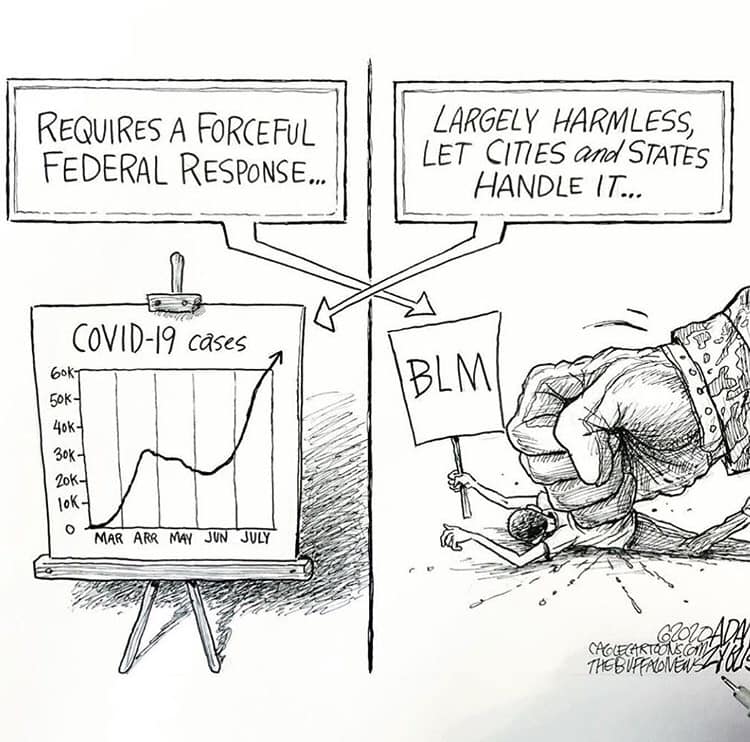
The meme is a humorous commentary on the COVID-19 pandemic and the response of the government. The image shows a graph of COVID-19 cases, with a caption "COVID-19 cases" on the left and a caption "Government Response" on the right. The right side shows a person being tackled by a giant hand labeled "Government", with a caption "Requires a Forceful Response".
detailed-analysis (gemma3-27b-vision)
Okay, let's break down this political cartoon with the requested theoretical lenses.
Visual Description
The cartoon is a black and white drawing that juxtaposes two scenarios through diverging lines emanating from a central point. On the left, a line leads to an easel displaying a rising graph labeled “COVID-19 Cases” (March – July). Above this graph is a sign stating, "Requires a forceful Federal Response..." On the right, the line leads to a depiction of a person, possibly representing protestors, being overwhelmed by police (or implied force), being pushed onto the ground, and holding a sign that says “BLM.” Above this is a sign that reads, “Largely Harmless, Let Cities and States Handle It…”
The stylistic choices are stark and direct, emphasizing the contrast. The person representing BLM/protestors is depicted as small and vulnerable in comparison to the implicit, powerful force acting upon them. The contrast in treatment is the central visual statement. The artist, Goodaddy, signs it with “Cool Car Toons” and “The Bitter End.”
Foucauldian Genealogical Discourse Analysis
This cartoon is deeply relevant to Foucault's ideas. It illustrates how power operates through discourse and the creation of categories.
- Power/Knowledge: The cartoon suggests that the "knowledge" about COVID-19 and protests shapes how power is wielded. The rising graph legitimizes a “forceful Federal Response,” implying that scientific data requires strong governmental action. Conversely, the protest is labeled “largely harmless,” which justifies a hands-off approach, delegating response to local authorities and implicitly minimizing its significance. This framing isn't about objective truth, but about how knowledge is constructed to enable specific power dynamics.
- Disciplinary Power: The depiction of the person being overwhelmed is symbolic of disciplinary power. It’s not overt brutality (though implied), but a normalizing, controlling force that seeks to manage and contain behavior deemed disruptive. The "Let Cities and States Handle It" message reinforces this; it delegates control, but also limits the scope of response, effectively silencing and containing the protest.
- Genealogy: Foucault would ask how these categories (“harmless protest” vs. “dangerous epidemic”) came to be. The cartoon implicitly critiques the historical development of these categorizations and the power relations embedded within them. What discourses (media narratives, political rhetoric, historical precedents) led to this differential treatment?
Critical Theory
The cartoon is ripe for analysis through the lens of the Frankfurt School's Critical Theory.
- Ideology: The cartoon exposes what Critical Theorists see as the ideological function of media and government messaging. The differential treatment of COVID and protests isn’t necessarily based on logic, but on maintaining the status quo. A strong federal response to a perceived threat (COVID) reinforces state power and control, while minimal intervention in a challenge to the status quo (protest) allows existing power structures to remain intact.
- Instrumental Reason: The graph representing COVID is presented as pure, objective data, but it serves a specific instrumental purpose: to justify a strong federal response. The emphasis on numbers masks the political implications of that response. The cartoon suggests a critique of how "reason" is used as a tool for control.
- Culture Industry: The cartoon could be interpreted as a critique of how the “culture industry” (media, government messaging) produces narratives that reinforce power relations. The contrasting framing is not organic; it’s produced to shape public opinion.
Marxist Conflict Theory
From a Marxist perspective, the cartoon illustrates class and power dynamics.
- Ruling Class/Oppressed: The COVID response can be seen as benefiting the ruling class by maintaining order and preventing economic disruption. The forceful response protects the status quo, while the suppression of protest (even if framed as “letting cities handle it”) protects the interests of the powerful by silencing dissent.
- State as an Instrument of Class Rule: The cartoon portrays the state (federal government) as acting in the interests of the ruling class. The forceful federal response to COVID safeguards the economic interests of the wealthy, while the hands-off approach to protest protects the established power structures.
- False Consciousness: The cartoon could suggest that the public has been misled into accepting this differential treatment. The framing obscures the underlying power dynamics and prevents a critical understanding of the situation.
Postmodernism
A Postmodern analysis focuses on the instability of meaning and the deconstruction of grand narratives.
- Meta-Narratives: The cartoon critiques the "meta-narrative" of state authority and the idea that governments are always acting in the best interests of the public. It suggests that these narratives are constructed and serve specific power dynamics.
- Deconstruction of Binary Oppositions: The cartoon exposes the artificiality of the binary opposition between “dangerous epidemic” and “harmless protest.” It suggests that these categories are not fixed or natural, but are socially constructed and used to justify differential treatment.
- Simulacra and Simulation: The graph representing COVID could be seen as a simulacrum—a copy without an original. It’s a representation of a threat, but the representation itself becomes more important than the underlying reality.
Queer Feminist Intersectional Analysis
While the cartoon doesn’t explicitly depict gender or sexuality, a Queer Feminist Intersectional lens can still offer insights:
- Differential Power Dynamics: The cartoon highlights the ways in which certain groups (those protesting) are disproportionately targeted by state power. A Queer Feminist analysis would ask who is likely to be represented in these protests and how existing systems of oppression (racism, sexism, homophobia) intersect to create vulnerability.
- Normalization of Violence: The implicit force used against the protestor can be seen as a form of normalized violence, particularly relevant in understanding how the state historically regulates marginalized bodies.
- Silencing of Dissent: The “let cities handle it” message can be understood as a tactic to silence dissenting voices, particularly those challenging patriarchal and systemic inequalities. This is consistent with how the state has historically suppressed social movements led by marginalized communities.
Let me know if you’d like me to elaborate on any of these analyses or explore other theoretical perspectives!
simple-description (llama3.2-vision)
This meme is a play on the COVID-19 pandemic and the Black Lives Matter (BLM) movement. The image depicts a graph showing a sharp increase in COVID-19 cases, with a caption "COVID-19 cases: 1,000,000,000" and a red line indicating a massive spike. The text at the top reads "Requires a Forceful Federal Response" and at the bottom "But let's be real, it's just BLM protests that need to be handled with an iron fist".
tesseract-ocr
A FORCEFUL || | || cARGELY HARMLES REQUIRES A FORCEFUL | S LET CITIES and STATES | FEDERAL RESPONSE...1 | || "HANDLE I7.. PS ~ 4 COVIDF cases 4 J~ |i | me \e ZE TENS BA - A 0 RR ra Ta I ZB EZ =Z SSS ee TYTN =r ora ,W ema e 2 jz