First Seen
2023-05-10T21:03:33+00:00
simple-description (llama3.2-vision_11b)
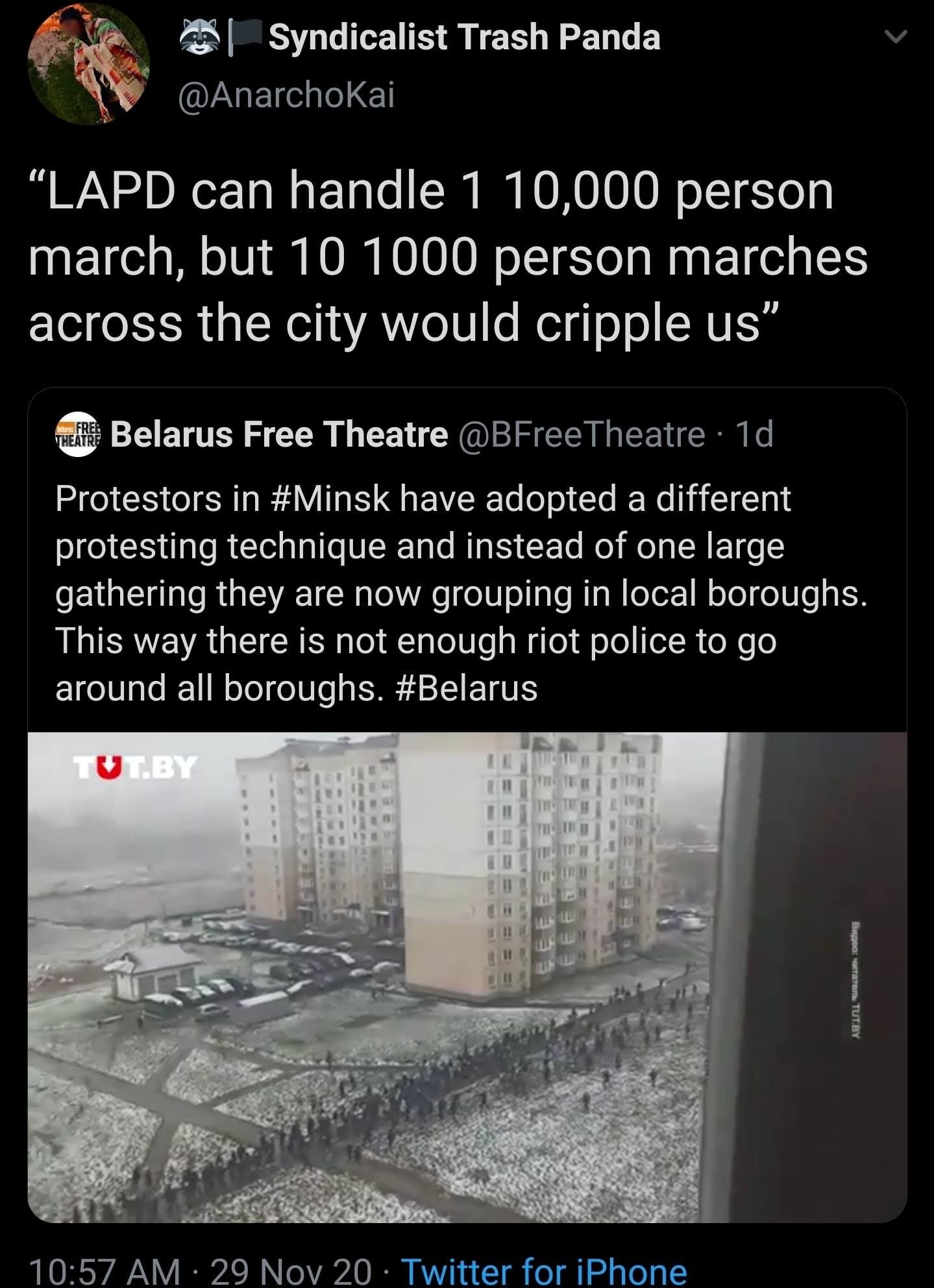
The meme is a screenshot of a tweet from the @AntiCops account, which is a Twitter handle that shares humorous and satirical content about police and law enforcement. The tweet reads: "LAPD can handle 1 10,000 person march, but 10 1000 person marches across the city would cripple us". The meme is likely being used to comment on the perceived hypocrisy of law enforcement agencies, who are often criticized for their handling of protests and demonstrations, but seem to have no problem with large crowds of protesters.
detailed-analysis (gemma3-27b-vision)
Okay, here's an analysis of the provided Twitter post and accompanying image, broken down into the requested sections. I'll indicate when a section doesn't apply.
Visual Description
The image appears to be a grainy, black-and-white photograph of a tall, Soviet-era apartment building. There are numerous windows visible, and small figures can be seen in some of them, suggesting people are present inside. In front of the building, along a street, there is a line of riot police in full gear, including helmets, shields, and potentially batons. The street appears relatively empty, but the scale of the building dwarfs the police line, highlighting the potential scope of unrest. The "tut.by" watermark suggests the source of the image is a Belarusian news outlet. The overall aesthetic is stark and suggests a tense, potentially oppressive environment.
Foucauldian Genealogical Discourse Analysis
This post is very rich for a Foucauldian interpretation.
- Power/Knowledge: The tweet explicitly outlines a struggle over power, not just physical but discursive. The statement about the Los Angeles Police Department (LAPD) and the Belarusian police reveals how authorities calculate and manage protest as a discourse. They define what is acceptable (a large, contained march) and what is threatening (numerous smaller protests). This is a deployment of "power/knowledge"—knowledge is not neutral, but is always linked to power and serves to maintain it. The police aren't just responding to a threat; they construct that threat through their categorization of protest forms.
- Genealogy of Protest: The tweet highlights a shift in protest strategy ("different protesting technique"). A genealogical approach would investigate how this shift came about. What historical forces, social conditions, and previous failed attempts led to this new strategy of decentralized, localized protests? What previous forms of protest were deemed ineffective, and how did protesters learn to adapt?
- Discipline and Punish: The statement that multiple smaller protests will "cripple" the police highlights the regime's concern with maintaining control through disciplined action. The police are a mechanism of discipline, and the shift in protest tactics threatens to disrupt that discipline by forcing them to disperse resources and lose centralized control.
Marxist Conflict Theory
The post directly illustrates core tenets of Marxist Conflict Theory:
- Class Struggle: While not explicitly stated, the context of protests in Belarus (and the parallel mention of LAPD) suggests a fundamental conflict between the ruling power (the government/police) and the oppressed (the protestors). The protests are a manifestation of underlying economic, social, and political inequalities.
- Ideology and Control: The statement from the police represents the ideology of the ruling class—an attempt to define the terms of conflict and maintain control. The authorities frame certain forms of protest as legitimate (and manageable) while demonizing others.
- Revolution and Resistance: The shift in protest strategy represents a form of resistance—an attempt to overcome the state's repressive apparatus and achieve social change. The decentralization of protests is a tactic to disrupt the state's ability to suppress the movement.
- The State as a Tool of Oppression: The police are clearly presented as agents of the state, used to maintain the existing power structure and suppress dissent.
Postmodernism
Postmodern themes are visible in several ways:
- Deconstruction of Authority: The shift in protest tactics can be seen as a deconstruction of the traditional, centralized model of protest, challenging the authority of the state to define and control dissent.
- Fragmentation and Localization: The move to smaller, localized protests reflects a broader postmodern emphasis on fragmentation and the rejection of grand narratives. The protestors are rejecting the idea of a single, unified movement and embracing a more decentralized, localized approach.
- Simulacra and Simulation: The statement from the police—focused on calculating the appearance of threat (number of protesters) rather than the underlying causes—hints at a postmodern concern with simulation and the blurring of reality and representation. They are reacting to the image of a threat as much as the threat itself.
Queer Feminist Intersectional Analysis
While this post doesn't explicitly address issues of gender, sexuality, or intersectionality, these perspectives can be brought to bear:
- The Interconnectedness of Oppression: The protests in Belarus likely involve a diverse range of participants, and their grievances may be shaped by multiple forms of oppression (political, economic, social, and potentially based on gender, sexuality, ethnicity, etc.). A queer feminist intersectional analysis would seek to understand how these different forms of oppression intersect and reinforce one another.
- The Role of Gender and Sexuality in Resistance: It's likely that women and LGBTQ+ individuals are participating in the protests, and their experiences of oppression may be unique and deserve attention. Their contributions to the resistance movement may be shaped by their gender or sexual identity.
- Challenging Dominant Power Structures: Queer feminist theory challenges traditional power structures and advocates for liberation from all forms of oppression. The protests in Belarus, as a resistance movement, can be seen as aligned with these goals.
I hope this detailed analysis is helpful. Let me know if you'd like me to elaborate on any particular aspect.
simple-description (llama3.2-vision)
This meme is a screenshot of a tweet that compares the response to a riot in Belarus to a hypothetical situation where the Los Angeles Police Department (LAPD) handles a similar riot. The text reads: "LAPD can handle 1 10,000 person march, but 10 1000 person marches across the city would cripple us."
tesseract-ocr
MN omy eer Cate e eee) v es \ OE eire) el “LAPD can handle 1 10,000 person march, but 10 1000 person marches across the city would cripple us” @ Belarus Free Theatre @BFreeTheatre - 1d Protestors in #Minsk have adopted a different protesting technique and instead of one large gathering they are now grouping in local boroughs. This way there is not enough riot police to go around all boroughs. #Belarus il | ee . é 7 ee f ae f g eae td ein aes rele 3 : | 10:57 AM: 29 Nov 20: Twitter for iPhone