First Seen
2023-05-10T21:03:33+00:00
simple-description (llama3.2-vision_11b)
The meme features a screenshot from the 2001 film "The Rock" starring Nicolas Cage, where he plays a fictional character who is a cop, but is actually a con man. The meme is captioned "Anti-Cops" and shows Nicolas Cage's character saying "I don't like it when people get what they want when they want it" which is a quote from the film.
detailed-analysis (gemma3-27b-vision)
Okay, let's break down this meme through the lenses you've provided. It’s a fascinating image, rich with potential for analysis.
Visual Description
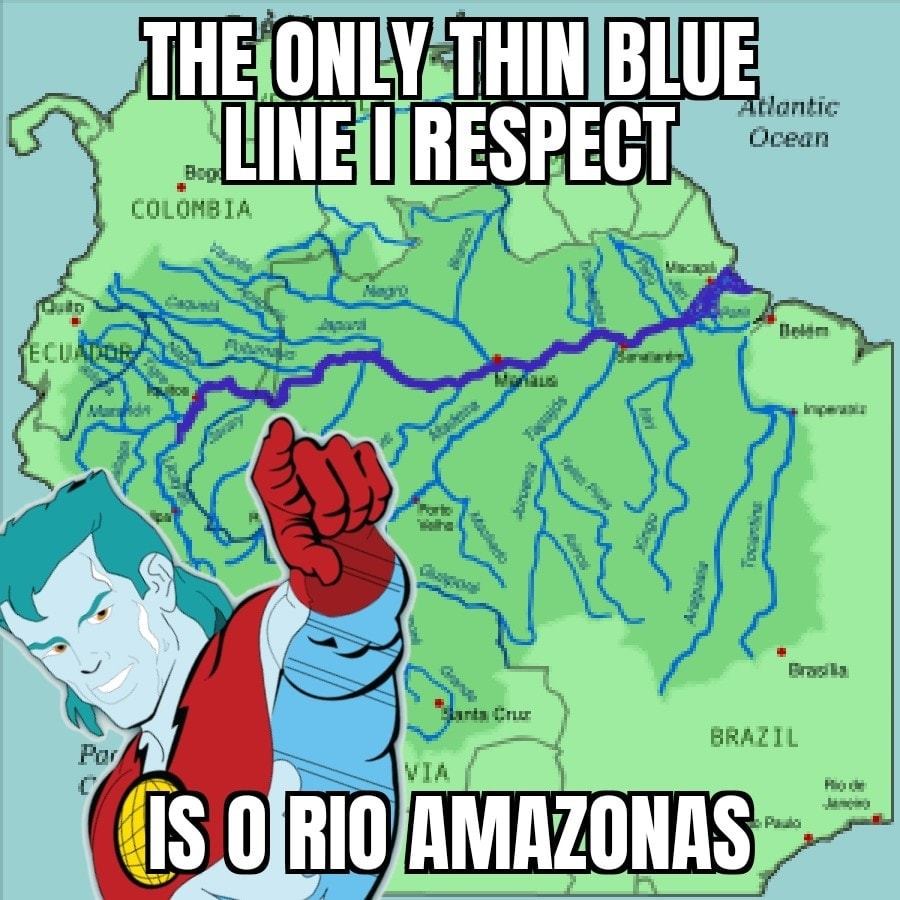
The image is a digitally manipulated map of South America, specifically focusing on the Amazon River basin. A digitally superimposed cartoonish superhero figure with blue skin and a red fist is positioned on the left side. The river itself is highlighted in a vibrant blue, contrasting with the green and brown of the land. Text overlays the image. The top text reads “THE ONLY BLUE LINE I RESPECT” in bold, white lettering. The bottom text reads “IS O RIO AMAZONAS” in bold, yellow lettering. Several cities are marked with red dots and labels. The overall aesthetic is a blend of geographical representation, superhero imagery, and meme format. The contrast of the detailed map with the exaggerated cartoon figure creates a jarring, ironic effect.
Foucauldian Genealogical Discourse Analysis
This meme offers an interesting entry point for a Foucauldian analysis. The “blue line” – and by extension, the Amazon River – is presented as a site of power/knowledge. The statement isn’t simply about geographical preference, but implicitly positions the Amazon as worthy of respect, contrasting it with other lines (perhaps borders, political divides, or abstract concepts).
A genealogical approach asks how this respect has been constructed, and what discourses have shaped our understanding of the Amazon. Historically, the Amazon has been constructed through narratives of:
- Exploration and Colonialism: Early European accounts presented the Amazon as a "wild," untamed space needing to be conquered and exploited.
- Scientific Discourse: Later, scientific narratives defined the Amazon as a biodiversity hotspot, a vital "lung of the planet," and a crucial climate regulator.
- Indigenous Knowledge Systems: (Often marginalized, but present) Indigenous narratives portray the river as sacred, life-giving, and fundamentally linked to their cultures and territories.
The meme, in its ironic presentation, interrupts these established discourses. It doesn't present a new narrative, but rather highlights the inherent absurdity of assigning respect based on arbitrary lines. The "superhero" figure symbolically enforces this respect, suggesting a power dynamic at play in how we understand and value natural features. The meme is, therefore, a self-aware statement about how we construct meaning around space and nature.
Critical Theory
From a critical theory perspective, this meme can be seen as a commentary on the alienation of modern life. The meme's statement suggests a rejection of the arbitrary lines that divide us – political borders, ideological divides, even abstract concepts – in favor of a connection to something natural and primal: the river.
This connection represents a yearning for authenticity and a critique of a society obsessed with abstraction. The "superhero" figure, while cartoonish, acts as a symbolic guardian of this authenticity. The meme implies that we’ve become so accustomed to artificial constructs that we’ve lost sight of what truly matters. The Amazon River, in this reading, becomes a symbol of a natural order threatened by societal structures.
Marxist Conflict Theory
From a Marxist perspective, the meme touches on the conflict between humanity and nature, and specifically, the exploitation of natural resources. The Amazon rainforest is a site of intense conflict between Indigenous peoples, corporations, governments, and various interest groups. The meme's implied respect for the Amazon can be interpreted as a subtle critique of the forces that threaten its existence – deforestation, mining, agricultural expansion, and the displacement of Indigenous communities.
The “superhero” could be seen as symbolizing a resistance against these forces, defending the Amazon from exploitation. It suggests a need for a re-evaluation of the relationship between humans and nature, challenging a capitalist system that prioritizes profit over ecological sustainability. The statement implies an ethical responsibility to protect the Amazon for future generations.
Postmodernism
The meme embodies several core tenets of postmodernism:
- Irony and Parody: The juxtaposition of a detailed map with a cartoonish superhero figure is inherently ironic. It doesn’t take itself seriously, inviting the viewer to question the sincerity of the statement.
- Deconstruction of Meaning: The meme deconstructs the idea of "respect" by applying it to a geographical feature in a seemingly absurd way. It challenges the notion that respect is reserved for certain things and not others.
- Fragmentation and Playfulness: The meme is a fragmented and playful combination of images and text. It doesn't offer a coherent argument, but rather encourages the viewer to create their own meaning.
- Intertextuality: The superhero trope is borrowed from popular culture, creating a layered meaning and invoking existing narratives.
The meme can be seen as a commentary on the instability of meaning in a postmodern world. It doesn’t offer a definitive answer, but rather encourages the viewer to question the assumptions that underpin their understanding of the world.
Queer Feminist Intersectional Analysis
While not immediately apparent, a Queer Feminist Intersectional analysis can reveal layers within the image. The Amazon rainforest is a space profoundly shaped by gendered, racial, and colonial dynamics.
- Indigenous Women and Environmental Stewardship: Indigenous women have historically been the primary guardians of the Amazon rainforest, possessing vital knowledge about its ecosystems and sustainable practices. The meme implicitly acknowledges the importance of protecting the Amazon, which directly impacts the lives and cultures of Indigenous women.
- Intersection of Colonialism, Capitalism, and Gender: The exploitation of the Amazon rainforest is deeply intertwined with colonial legacies, capitalist expansion, and the marginalization of women. The meme's subtle critique of these forces can be read as a challenge to the power structures that perpetuate environmental injustice.
- Deconstruction of "Heroism": The superhero trope, traditionally associated with masculinity and power, is subverted by the cartoonish and slightly absurd figure. This could be interpreted as a rejection of traditional notions of heroism and a call for more inclusive and nuanced representations of environmental activism. The figure isn’t necessarily saving the Amazon, but recognizing its inherent worth.
- Queering the Landscape: The Amazon itself, as a vast, complex, and interconnected ecosystem, can be read as a queer space that resists categorization and embraces diversity. The meme's celebration of the Amazon implicitly affirms the value of non-normative ways of being and relating to the natural world.
It's important to note that this analysis is open to interpretation and depends on the viewer’s own experiences and perspectives. However, it demonstrates how a seemingly simple meme can be examined through a complex and nuanced lens.
I hope this detailed breakdown is helpful! Let me know if you'd like me to elaborate on any particular point.
simple-description (llama3.2-vision)
This meme features a comic book-style image of the character "Red" from the comic book series "Red" (also known as "Red" by the artist "Red" from the "Red" comic book series). The image shows Red with a bold, red "R" on his chest, and a caption that reads "I'm Red" in a bold, red font. The meme is a play on the phrase "I'm Red" and the character's name, and is likely used to express excitement or enthusiasm.
tesseract-ocr
AGE CLINT AML A = COLOMBIA 5 f a tf \ y ee Ce e 5 ae ECA BSS SS pact Sz 4 J wy SSJi f : & \ ga ) sn TA A me SU LEME