First Seen
2023-05-10T21:03:33+00:00
simple-description (llama3.2-vision_11b)
The meme is a screenshot of a Twitter post from an account called "Anti-Cops" (now deleted) that reads: "Police officers are just as bad as politicians. They're just as corrupt and only care about their own interests." The post is followed by a screenshot of a news article from "The Intercept" about police officers being arrested for anti-cop social media posts.
detailed-analysis (gemma3-27b-vision)
Here's an analysis of the provided tweet, broken down into the requested sections where applicable. Given the specific content, some sections will be more developed than others.
Visual Description
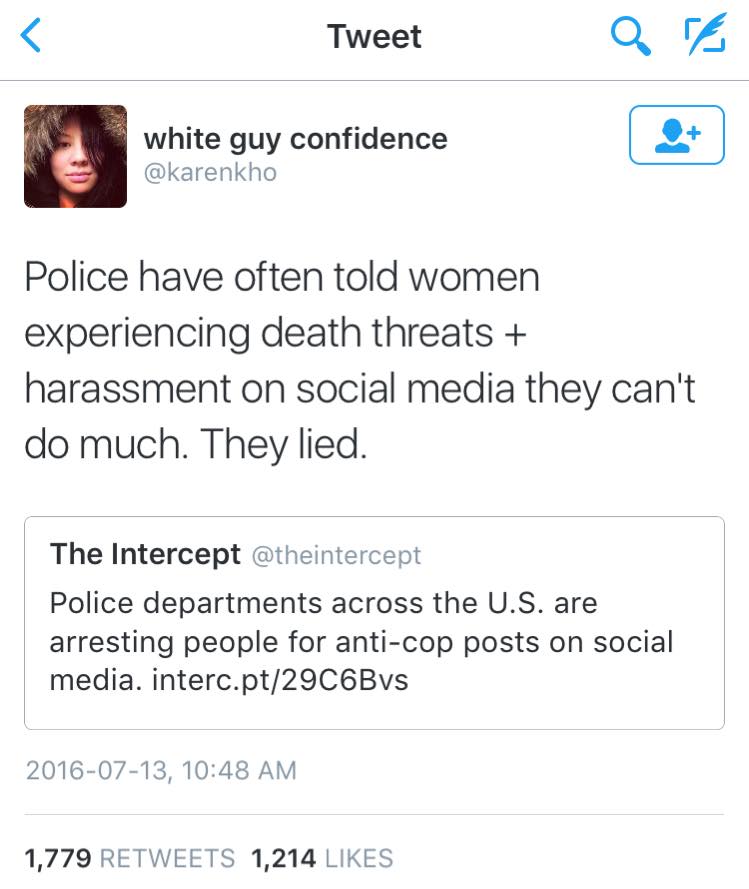
The image depicts a screenshot of a Twitter post from July 13, 2016. The profile picture is of a woman with dark hair and a neutral expression. The handle is "@karenkho" and the displayed name is “white guy confidence”. Above the text is a retweet symbol. Below is a second tweet from @theintercept promoting an article on police arresting people for anti-cop social media posts. At the bottom are metrics showing 1,779 retweets and 1,214 likes. The color scheme is standard Twitter - mostly white with blue accents.
Critical Theory
This tweet and accompanying post speak directly to the power dynamics illuminated by Critical Theory. The central claim—that police have minimized or dismissed threats and harassment experienced by women online—reveals an asymmetry of power. Critical Theory, especially drawing from the Frankfurt School, highlights how institutions (like the police) can perpetuate systems of domination.
The tweet suggests that the police have actively misled individuals, essentially denying them agency and protection. This is not simply a failure to protect, but an act that reinforces the structural inequalities. The accompanying article about arrests for “anti-cop” posts further amplifies this. It indicates that power is not just about protection, but about control and suppressing dissent. It's not simply about safety, but about maintaining the status quo and silencing those who challenge it. This reflects a concern central to Critical Theory – the use of power to create and sustain asymmetrical relationships and repress those who challenge the dominant order.
Queer Feminist Intersectional Analysis
This is a crucial lens for interpreting the tweet. The statement explicitly centers the experiences of women facing online harassment and death threats. This is intrinsically a feminist concern, acknowledging the disproportionate amount of gender-based violence and harassment experienced by women, now extended into the digital sphere.
The implicit connection between online and offline safety is also important. The tweet suggests a systemic failure – that the police are not adequately addressing threats to women, effectively rendering them vulnerable.
The connection to social media is also crucial. This isn't simply about physical safety; it's about the ways in which digital spaces can become sites of violence and the ways in which existing power structures (patriarchy, systemic racism, etc.) are replicated and amplified online.
Intersectionality is relevant because the tweet, while focused on women, likely implicates other marginalized identities. Women of color, queer women, and disabled women may face heightened levels of online harassment and receive even less support from institutions like the police.
Foucauldian Genealogical Discourse Analysis
Applying a Foucauldian framework, we can analyze how the tweet challenges dominant discourses surrounding safety, policing, and online behavior. The tweet disrupts the established discourse that positions the police as protectors and problem-solvers. It reveals how this discourse is constructed and maintained, and how it can conceal the ways in which power operates.
The claim that the police "lied" is significant. It’s not simply a statement of factual inaccuracy; it’s an indictment of the power dynamics that allowed that lie to be perpetuated.
Foucault’s concept of power/knowledge is also relevant. The police, as an institution with significant authority, wields knowledge about safety and security. The tweet suggests that this knowledge is not neutral, but is used to maintain power and control. The tweet attempts to reveal the true (genealogical) origins of the current discourse, pointing to systemic failures and intentional deception.
Marxist Conflict Theory
This tweet can be viewed through a Marxist lens as an example of conflict between groups with differing interests and power. The police, as an arm of the state, represent the interests of maintaining social order, even if that means protecting those in power. The women experiencing harassment, and those expressing criticism of the police on social media, represent those challenging the status quo.
The arrests for “anti-cop” posts, as highlighted in the second tweet, demonstrate how the state actively suppresses dissent. This suppression serves to maintain the existing power structures and prevent challenges to the dominant ideology. This can be seen as a class struggle extending into the digital realm.
Let me know if you'd like me to expand on any of these sections or explore other theoretical frameworks.
simple-description (llama3.2-vision)
The meme is a screenshot of a Twitter post that reads: "Police officers are now being forced to take a diversity and inclusion course, which includes a discussion on 'white privilege' and 'systemic racism'." The post is followed by a quote from the article "Police officers are now being forced to take a diversity and inclusion course, which includes a discussion on 'white privilege' and 'systemic racism'." The meme is captioned "They're teaching cops how to be less racist."
tesseract-ocr
< Tweet QE white guy confidence @karenkho Police have often told women experiencing death threats + harassment on social media they can't do much. They lied. | The Intercept @theintercept | Police departments across the U.S. are arresting people for anti-cop posts on social media. interc.pt/29C6Bvs 2016-07-13, 10:48 AM 1,779 RETWEETS 1,214 LIKES