First Seen
2023-05-10T21:03:33+00:00
simple-description (llama3.2-vision_11b)
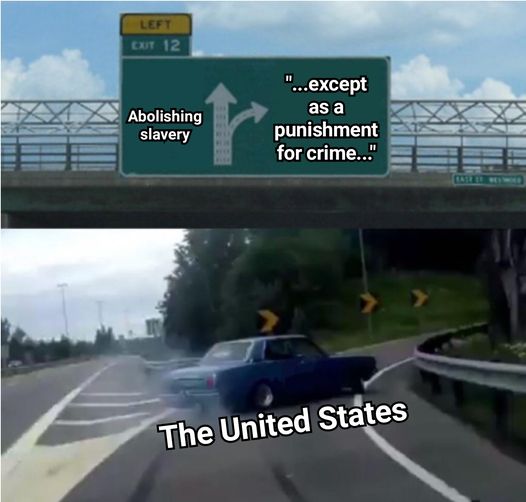
This meme is from the Anti-Cops category, which is a subreddit focused on criticizing and satirizing law enforcement and the justice system. The meme features a screenshot of a highway sign with the words "Abolishing Slavery" replaced with "Abolishing Slavery... except as a punishment for crime". The image is a humorous commentary on the hypocrisy of the US justice system, where the country's founding principles of freedom and equality are often contradicted by the harsh realities of mass incarceration and racial disparities in the justice system.
detailed-analysis (gemma3-27b-vision)
Okay, let's break down this image/meme with the requested theoretical lenses. It’s a potent and complex piece of visual communication, so we’ll get into some depth.
I. Visual Description
The image is a first-person perspective shot from inside a car traveling on a highway. The point of view makes the viewer feel like they are in the car and thus being driven forward. The highway extends into the distance.
Above the highway is a green highway sign with two directional arrows. One arrow is labeled “Abolishing slavery”. The second arrow points to “...except as a punishment for crime”. Below the image are the words “The United States”. The composition is designed to mimic a road trip. The viewer is presented with a "choice" to take a road to abolishing slavery or to continue driving in the direction of the prison industrial complex.
II. Foucauldian Genealogical Discourse Analysis
This meme is highly resonant with Michel Foucault's work, particularly his ideas around power, knowledge, and discourse, and his genealogical method.
- Discipline and Punishment: The image directly references the 13th Amendment to the US Constitution, which abolished slavery except as punishment for a crime. Foucault would see this as a demonstration of how power shifts – it doesn't simply disappear. Slavery wasn't ended so much as transformed into a system of mass incarceration. This meme highlights the continuity of control, even under the guise of abolition.
- Genealogy of the Prison: Foucault’s Discipline and Punish traces the shift from public, brutal physical punishments to the modern prison as a system of discipline. The image suggests that the “punishment” exception in the 13th Amendment laid the groundwork for the exponential growth of the prison industrial complex.
- Power/Knowledge: The statement on the sign is not a neutral one; it’s a discursive formation. It asserts a particular relationship between crime, punishment, and social control. By presenting this as an “exception,” it normalizes the idea of forced labor within the prison system. The image challenges viewers to question the “knowledge” that underpins this system.
- Biopower: The image speaks to biopower – the way modern states exercise power over bodies and populations. Mass incarceration, fueled by the 13th Amendment loophole, can be seen as a form of biopolitical control – regulating who lives, who dies, and under what conditions.
III. Critical Theory
Drawing from the Frankfurt School, particularly thinkers like Adorno and Horkheimer, the image critiques the dialectic of enlightenment.
- Instrumental Reason: Critical theorists argue that enlightenment rationality, while intended to liberate, can become a tool for domination. This meme suggests that the "rational" justification for the 13th Amendment exception – punishing crime – served as a means to perpetuate a system of exploitation.
- Culture Industry: This meme is a form of cultural commentary, using a simple visual metaphor to expose a complex political and historical reality. It’s a deconstruction of the dominant narrative surrounding abolition and criminal justice.
- False Consciousness: The meme implicates those who view the 13th Amendment as a simple victory for human rights, ignoring its exploitative implications. It aims to raise awareness and disrupt "false consciousness".
IV. Marxist Conflict Theory
From a Marxist perspective, this image highlights the inherent contradictions of capitalism and class struggle.
- Exploitation of Labor: The 13th Amendment loophole allowed for the continuation of forced labor, primarily impacting formerly enslaved people and disproportionately targeting communities of color. This is a clear example of exploitation, where one group benefits from the unpaid or underpaid labor of another.
- Class Conflict: The prison industrial complex is a system that perpetuates and exacerbates class inequalities. It removes individuals from the labor force, creates barriers to employment and economic mobility, and disproportionately impacts marginalized communities.
- State as Tool of the Ruling Class: Marxists would argue that the state (and the legal system) serve the interests of the ruling class. The preservation of forced labor through the 13th Amendment loophole demonstrates how the state can be used to maintain existing power structures and maximize profit.
V. Queer Feminist Intersectional Analysis
This lens adds significant depth by considering how race, gender, sexuality, and class intersect to create unique experiences of oppression.
- Intersectional Oppression: The impact of the prison industrial complex is not uniform. Black women, transgender women of color, and other marginalized groups are disproportionately impacted by mass incarceration. The meme, viewed through this lens, acknowledges the compounded forms of oppression that these individuals face.
- Gendered Labor: Historically, enslaved women were subjected to specific forms of exploitation, including sexual assault and reproductive control. The continuation of forced labor within the prison system extends these patterns of gendered violence and control.
- Deconstruction of Normativity: This meme challenges the dominant narrative of abolition as a simple story of progress. It exposes the ways in which the system continues to reproduce forms of domination and exploitation, even under the guise of justice.
- Queer Resistance: The meme’s deconstruction of historical narratives can be understood as a form of queer resistance, disrupting linear conceptions of progress and highlighting the ongoing struggle for liberation.
In conclusion: This image/meme is a powerful visual statement that invites critical reflection on the complex history of slavery, race, and the criminal justice system in the United States. Its layered meaning can be explored through multiple theoretical frameworks, revealing the interconnectedness of power, exploitation, and oppression.
Let me know if you'd like me to elaborate on any of these points or apply other theoretical frameworks!
simple-description (llama3.2-vision)
This meme is a humorous take on the idea that the United States is a country that is supposed to be a beacon of freedom and democracy, but in reality, it has a long history of slavery and racism. The image shows a road sign that says "Abolishing slavery... except as a punishment for crime" with an arrow pointing to the right, implying that the country is still struggling to overcome its past. The text at the top of the image reads "The United States".
tesseract-ocr
or a Abolishing Se SS Ea punishment ee mn ce et t Pa ¢ ce if Bi on