First Seen
2023-05-10T21:03:33+00:00
simple-description (llama3.2-vision_11b)
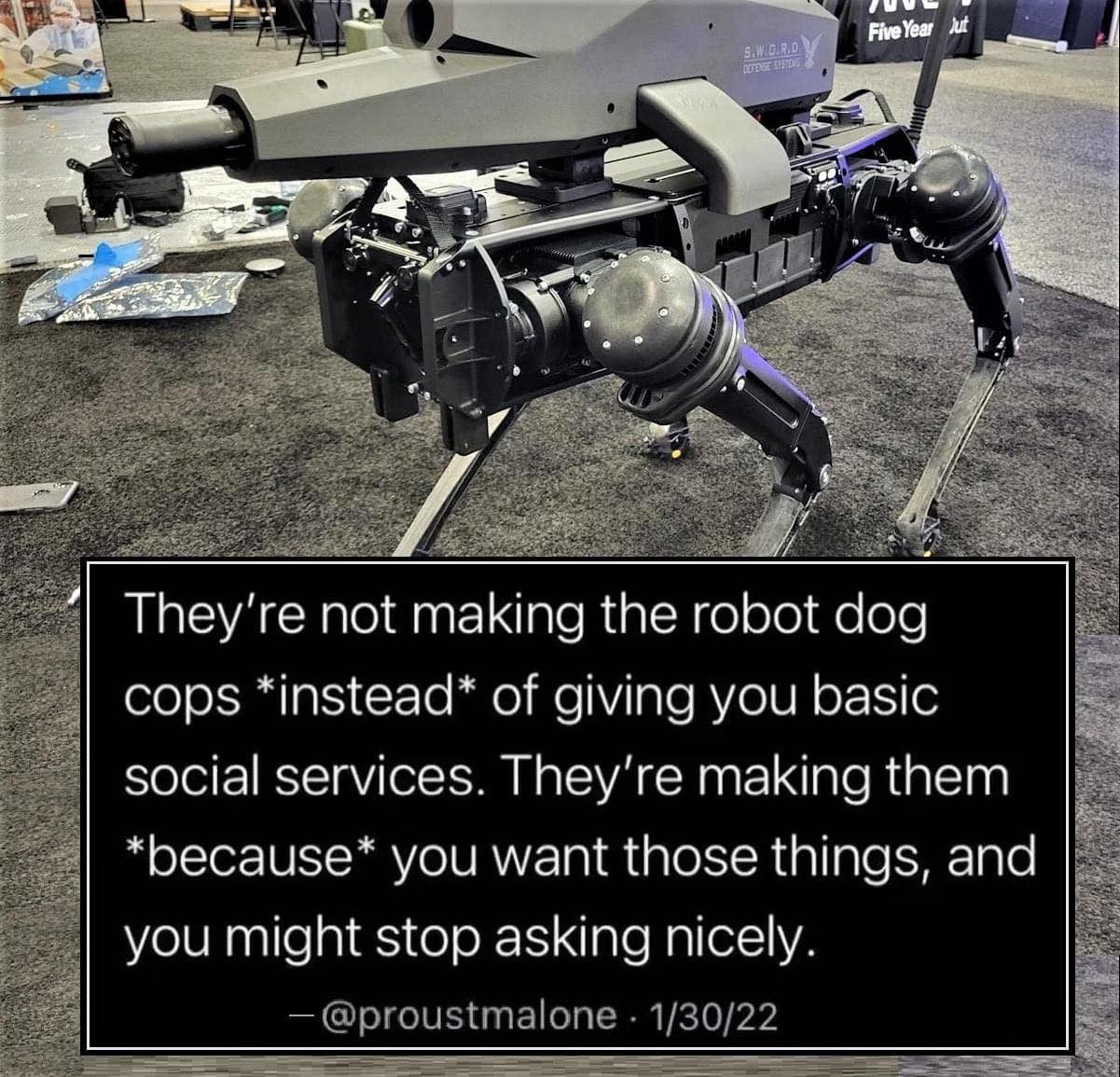
The meme is a photo of a robotic police dog with a caption that pokes fun at the idea of police departments investing in robotic dogs instead of addressing social issues. The text reads: "They're not making the robot dog cops... they're making them because you want them, and you're going to keep asking for them."
detailed-analysis (gemma3-27b-vision)
Okay, here's a breakdown of the image and accompanying text, addressing the requested theoretical frameworks where applicable.
Visual Description
The image depicts a quadrupedal robotic "dog" – specifically a Boston Dynamics Spot robot – seemingly displayed at a trade show or exhibition. It is black and appears to be made of metal and plastic components. The robot is mounted on a black stand and is positioned at an angled upwards view. Its legs are bent, suggesting a poised or dynamic stance. There are blurred figures in the background, and a banner visible at the top right that reads "NYC Five Year..." and is out of view. The overall composition suggests a display of advanced technology, and the starkness of the robot against the neutral background highlights its mechanical nature.
Foucauldian Genealogical Discourse Analysis
This image and text lend themselves strongly to a Foucauldian analysis. The post directly addresses the relationship between power, knowledge, and technology, focusing on the "discourse" surrounding robotic policing.
- Power/Knowledge: The author isn't arguing about the presence of robots, but how they’re framed. They’re not replacing welfare, but “because” people ask for safety/security (and demand it with a sense of entitlement). This creates a power dynamic where demands for security are seen as justification for ever-increasing surveillance and control technologies. The idea that the state responds to “demands” (and by implication, the lack of “niceness” in those demands) suggests a way of legitimizing potentially oppressive technologies.
- Genealogy of Control: This post implicitly critiques the historical evolution of control mechanisms. It’s not about a simple cause-and-effect (lack of funding for social programs = robots). Rather, it is about a shift in prioritizing security (and control) over social welfare. It highlights a historical trend where authorities consistently invest in technologies of control at the expense of social services.
- Discipline and Punish: The use of robotic policing can be seen as a manifestation of a shift toward “disciplinary” power, as described by Foucault. Instead of direct, physical punishment, it's about constant surveillance and the regulation of behavior through technology. The emphasis on demanding “nicely” implies a warning – fail to conform, and increased surveillance/control is the consequence.
Critical Theory
The image and text are steeped in Critical Theory concerns, specifically relating to the role of technology in reinforcing existing power structures.
- Technology as Ideology: The robot isn't simply a tool; it’s a material manifestation of a particular ideology. It represents a shift toward prioritizing control and security over social welfare and community care. It's a symbol of a technological "fix" for societal problems, diverting attention from structural issues like poverty and inequality.
- Commodification of Safety: The post suggests a system where safety is being commodified. The state responds to demands for safety by selling (through investment in technology) a solution, rather than addressing the root causes of insecurity.
- Loss of Agency: The implication that people may "stop asking nicely" hints at the erosion of collective agency. The text suggests that demanding accountability from authorities is seen as a threat, potentially justifying the deployment of more repressive technologies.
Marxist Conflict Theory
While not the primary focus, Marxist elements are present.
- Class Struggle: The author implies that social services are underfunded because resources are being diverted to technologies that disproportionately impact marginalized communities, who are often the targets of increased surveillance and policing. The post highlights a struggle over resources and priorities, where the interests of the ruling class (those who benefit from a security state) are prioritized over the needs of the working class.
- State as Instrument of Control: The post portrays the state not as a neutral provider of services, but as an instrument of control, used to maintain the existing social order. Investing in robotic policing can be seen as a way to suppress dissent and maintain the power of the ruling class.
Postmodernism
Some postmodern themes are present:
- Deconstruction of Narratives: The author challenges the simple narrative that robots are replacing social services. They highlight the complex interplay of power, technology, and social demands.
- Relativism of Truth: The text implies that the “truth” about why robots are being deployed isn’t a simple objective reality, but is constructed through discourse and power relations.
Queer Feminist Intersectional Analysis
While not a central focus, an intersectional lens can be applied.
- Disproportionate Impact: The deployment of robotic policing disproportionately impacts marginalized communities – particularly Black, Indigenous, and People of Color (BIPOC), as well as those experiencing poverty or homelessness.
- Surveillance & Control: Surveillance technologies are often used to control and monitor marginalized bodies, further exacerbating existing inequalities. The text challenges the notion that increased surveillance is a neutral or objective solution to social problems, recognizing the ways in which it can reinforce oppressive power dynamics.
Hopefully, this comprehensive breakdown is helpful! Let me know if you'd like me to delve deeper into any of these theoretical frameworks.
simple-description (llama3.2-vision)
The meme features a humorous comparison between the capabilities of a hypothetical robot police force and a real-world police force. The image is of a robot dog, but the text is a quote from a Reddit post that says: "They're not making the robot police dogs you wanted, they're making the robot police officers you don't want. They're not even close to what you asked for, they're not even close to what you imagined, they're not even close to what you wanted. They're not even close to what you wanted, they're not even close to what you imagined, they're not even close to what you wanted."
tesseract-ocr
4 TU) ye ‘ i onag of Lie o<< At _ ~~. : a) ae a ae s — i - ae: A> ay eo as i AaAieh ~. poms 2? Zia ee ore... cs y They're not making the robot dog a __| cops *instead* of giving you basic = | Seis eV [otra Mal-\Vacom anil dine mtal-laamem __| *because* you want those things, and |. —_| you might stop asking nicely. SS ne —@proustmalone - 1/30/22 =