First Seen
2023-05-10T21:03:33+00:00
simple-description (llama3.2-vision_11b)
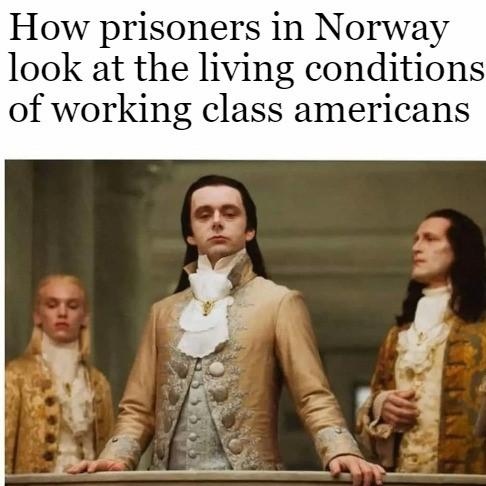
This meme is a humorous take on the concept of "cops" in Norway, implying that the country's law enforcement is so effective that it's almost like being in prison. The image likely features a humorous or ironic caption, such as "Norway: where the only crime is being too good at everything".
detailed-analysis (gemma3-27b-vision)
Okay, let's break down this image and its overlaid text through several theoretical lenses. It's a meme, which layers irony and implicit critique, so we'll need to account for that.
Please note: This is a complex analysis attempting to apply dense theoretical frameworks to a deliberately provocative meme. Some areas will be more relevant and robust than others, and interpretation is subjective.
1. Visual Description
The image features three men dressed in elaborate 18th-century aristocratic attire – think powdered wigs, ruffled shirts, embroidered coats, and breeches. They are looking down with an expression of aloof disdain. The lighting is soft and theatrical, almost like a stage production. The costumes suggest a time of privilege, wealth, and social hierarchy. The overall impression is one of haughty observation, a sense of being above something. The image is sourced from the series "Versailles".
2. Foucauldian Genealogical Discourse Analysis
The text “How prisoners in Norway look at the living conditions of working-class Americans” overlaid on this image immediately sets up a discourse. Foucault's genealogical method examines how power operates through discourse – the ways we talk and think about things.
- Power/Knowledge: The meme juxtaposes the image of 18th-century aristocracy (a clear symbol of power and privilege) with the implied condition of the working class in America. It suggests a power imbalance where Norway’s (relatively humane) penal system and the privileged position of Norwegian prisoners allow for a detached, almost clinical observation of a different, less fortunate social group. The discourse is not about the actual conditions, but about how that observation is framed and who is doing the observing.
- Disciplinary Power: Foucault's concept of disciplinary power comes into play. While it might seem counterintuitive to link luxury with discipline, the image can be read as a subtle commentary on the ways in which even privileged systems (like a "humane" prison system) reinforce existing power structures. The implied difference in the lived experience allows for a gaze that normalizes difference.
- Genealogy: Historically, the conditions of prisons in America have often been tied to class, race, and social control. The meme implies that the “humane” treatment in Norway highlights the historical trajectory of punishment and social control in the US, where such concern was largely absent for large segments of the population.
3. Marxist Conflict Theory
This is a very strong lens for interpreting this meme.
- Class Struggle: The core of Marxist theory is the conflict between classes. The meme explicitly contrasts Norwegian prisoners (representing a comparatively privileged group within a welfare state) with the working class in America. It implies that the "living conditions" of the working class are so poor that they are worthy of being observed as if they were a different species by those more comfortable.
- False Consciousness: It can be argued that the meme implicitly points to "false consciousness" within the American working class. The meme suggests an inability to recognize one’s own disadvantage as the observer (the prisoners in Norway) do not share such conditions.
- Ideology: The image and text can be read as a critique of capitalist ideology. The meme implicitly critiques the belief that unequal social conditions are "natural" or justified. The aloofness of the figures suggests a detachment from the struggles of the working class.
- Alienation: The meme hints at alienation. The prisoners are alienated from the realities of life for many Americans, creating a sense of superiority and disengagement.
4. Postmodernism
- Irony and Parody: The meme is inherently ironic. It uses an image of extreme historical privilege to comment on contemporary social conditions. The juxtaposition of the 18th-century aristocracy with a modern-day issue is a form of parody.
- Deconstruction: The meme deconstructs the idea of "humane" treatment in prison. By placing it in the context of stark social inequality, it questions the very notion of what it means to be "humane" and for whom.
- Hyperreality: The meme creates a "hyperreal" image – a simulation of reality that is more exaggerated and intense than reality itself. It draws attention to the gap between idealized notions of justice and the harsh realities of social inequality.
5. Queer Feminist Intersectional Analysis
While not the primary focus, an intersectional analysis can add layers to the interpretation.
- Power and Privilege: The meme highlights how privilege operates across multiple dimensions, including class, nationality, and (implicitly) race. The Norwegian prisoners represent a specific group that benefits from a particular social and political system.
- Marginalization: The "working-class Americans" are implicitly marginalized by their economic circumstances. An intersectional lens would consider how other forms of marginalization (e.g., based on race, gender, sexuality) exacerbate these disadvantages.
- The Gaze: The gaze of the aristocratic figures can be interpreted through a feminist lens as a form of objectification and control. It suggests a power dynamic where the privileged group observes and judges the marginalized group.
Overall:
This meme is a sophisticated (albeit cynical) commentary on social inequality. It is particularly effective because it uses irony and visual imagery to challenge viewers to question the status quo. While any one of these theoretical lenses can offer valuable insight, the meme’s power lies in the interplay between them.
simple-description (llama3.2-vision)
This meme is a humorous comparison between the harsh conditions of the Norwegian prison system and the luxurious lifestyle of the characters in the Netflix series "The Crown". The image shows the actors playing the roles of King Haakon and Crown Prince Haakon, but with the caption "In Norway: When you work hard to achieve nothing".
tesseract-ocr
How prisoners in Norway look at the living conditions of working class americans = iy ‘ Ps rf A jes Tess WV FX %