First Seen
2023-05-10T21:03:33+00:00
simple-description (llama3.2-vision_11b)
This meme is a screenshot of a 2011 documentary interview with a former neo-Nazi, where he discusses the ideology of his former group. The text "You see, there are people who believe the function of the police is to protect and serve. I disagree. The function of the police is social control and protection of property. And that's not true. The function of the police is to fight crime." is a quote from the interview, highlighting the former neo-Nazi's perspective on the role of the police.
detailed-analysis (gemma3-27b-vision)
Okay, here's an analysis of the image, broken down into sections according to your requested theoretical frameworks. Note that not every framework will apply as strongly, and I'll explain that as needed.
Image Description
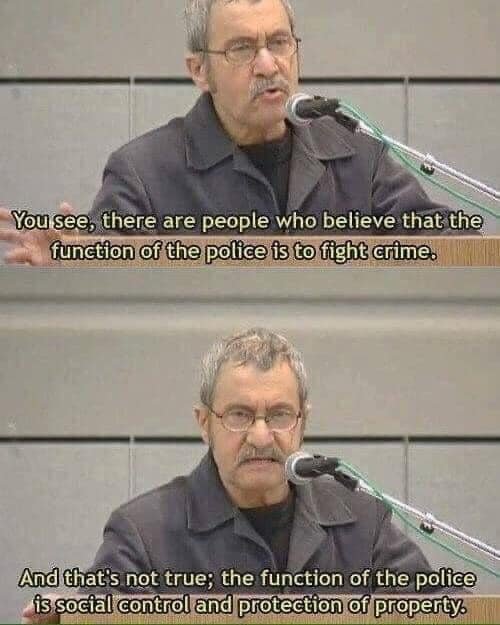
The image is a screen capture of a man speaking at a podium. The man is middle-aged with graying hair, a mustache, and appears to be wearing a dark jacket or coat. The background is a simple gray wall. There are two panels with text appearing as subtitles.
- Panel 1 Text: "You see, there are people who believe the function of the police is to fight crime."
- Panel 2 Text: "And that's not true; the function of the police is social control and protection of property."
The image is framed to emphasize the speaker's facial expression and the assertion he's making. The lighting is neutral, and the overall aesthetic feels like a capture from a lecture or public discussion.
Foucauldian Genealogical Discourse Analysis
This image is strongly amenable to a Foucauldian analysis. Michel Foucault's work on power, knowledge, and discourse is directly engaged by the speaker's statement.
- Discourse on Policing: The image challenges the dominant discourse around policing. The widely accepted (and often perpetuated by media and political rhetoric) idea that the police "fight crime" is presented as a naive belief. The speaker argues this is not the true function.
- Power/Knowledge: Foucault argued that power and knowledge are inextricably linked. The discourse around crime fighting is produced to legitimize the power of the police. The speaker is attempting to disrupt this. By asserting that the true function is "social control and protection of property", he's exposing what he sees as the underlying power dynamics. It highlights how the discourse of ‘fighting crime’ masks the real operation of policing.
- Genealogy: A genealogical approach would examine how the idea of police as crime fighters became dominant. What historical processes, institutions, and power relations led to this accepted "truth"? A genealogical inquiry would trace the origins of policing not as a neutral force of law enforcement, but as an instrument of maintaining social order, particularly to protect the interests of those who have property.
- Disciplinary Power: This statement can be tied to Foucault’s notion of disciplinary power, where institutions, like the police, function not simply through repression, but through normalization and surveillance, shaping individuals and controlling populations.
Critical Theory
The image aligns strongly with Critical Theory, particularly the Frankfurt School tradition.
- Ideology Critique: The statement is an example of ideology critique. The speaker is challenging the widely held belief about the police to reveal the underlying power structures at play. The idea that police "fight crime" is presented as an ideology that obscures the true function of maintaining social hierarchy and protecting the interests of the ruling class.
- Hegemony: The "common sense" belief about police being crime fighters is a form of Gramscian hegemony – the dominance of a particular worldview through consent rather than force. The speaker is attempting to disrupt this hegemony by revealing the hidden dynamics.
- Rationalization/Bureaucracy: The emphasis on "protection of property" can be linked to Max Weber's work on rationalization and bureaucracy. Modern policing, as a bureaucratic institution, is primarily concerned with maintaining the system that allows for the accumulation and protection of capital.
- Critique of Enlightenment Reason: A critical theory lens might suggest that the Enlightenment notion of law and order as universal principles is a fiction masking the interests of the dominant groups.
Marxist Conflict Theory
This image is profoundly resonant with Marxist Conflict Theory.
- Class Struggle: The statement implicitly positions the police as an instrument of class struggle. "Protection of property" directly benefits the owning class (bourgeoisie) while often being used to suppress the working class (proletariat).
- The State as an Instrument of Class Rule: Marxists view the state, including its police forces, not as a neutral arbiter of justice, but as a tool used by the ruling class to maintain its power and control. The statement explicitly points to this function – protecting the property of the dominant class.
- False Consciousness: The belief that the police are simply "fighting crime" can be seen as a form of false consciousness, where people are unaware of the true economic and power dynamics at play.
- Material Conditions: This image calls attention to the material conditions that shape policing. The focus on property protection isn’t about abstract notions of justice, but about the concrete interests of those who own and control the means of production.
Postmodernism
While less directly applicable than the above frameworks, a postmodern reading is possible.
- Deconstruction of "Truth": Postmodernism questions grand narratives and absolute truths. The speaker is rejecting the "truth" of the police as crime fighters, exposing it as a constructed narrative.
- Power and Discourse: Similar to Foucault, postmodernism emphasizes the role of language and discourse in constructing power relations. The speaker is disrupting the dominant discourse surrounding policing.
- Relativism: A postmodern perspective might suggest there isn't one "true" function of the police, but rather multiple, often conflicting, functions shaped by social, economic, and political context.
- Challenge to Metanarratives: The statement challenges the metanarrative of the police as neutral protectors of the public.
Queer Feminist Intersectional Analysis
This image can be analyzed through a queer feminist intersectional lens, though it requires some extrapolation.
- The State and Control: Queer and feminist theories often critique the state as a vehicle of patriarchal and heteronormative control. Policing, as an extension of the state, often disproportionately targets marginalized groups (people of color, LGBTQ+ individuals, the poor, etc.).
- Property and Power: The emphasis on "protection of property" can be linked to historical patterns of ownership and dispossession. Historically, systems of property ownership have been used to deny rights and control bodies, particularly those of women and marginalized communities.
- Intersectional Harm: The speaker's statement implies that policing is about maintaining the existing social order, which is inherently built on systems of oppression. The "protection of property" is often achieved through the surveillance, harassment, and violence targeted at those who challenge the status quo.
- Disproportionate Impact: Policing and the preservation of property often occurs at the expense of marginalized communities, who bear the brunt of police violence and surveillance.
I hope this comprehensive analysis is helpful! Let me know if you'd like me to elaborate on any of these points or explore other theoretical frameworks.
simple-description (llama3.2-vision)
This meme is a satirical commentary on the idea that some people believe the function of the police is to fight crime, but in reality, they also control and protect property. The image shows an older man speaking into a microphone, with a quote overlayed: "You see, there are people who believe that the function of the police is to fight crime. And that's not true; the function of the police is social control and protection of property." The man's serious expression and the quote's dark tone suggest that he is highlighting the often-undiscussed aspects of police work. The meme is meant to be thought-provoking, encouraging viewers to consider the true role of law enforcement.
tesseract-ocr
ni ae \ $<. —_ pe “a eS Leo ki 2G WYoutsee; there are people who believe ous ey functionfofjthe}policelisitojfighticrimer penne . _namenemneeians * U ) ae) Pca : s oF L & xe! Sie } . e tS a ~~ Lod CECE oler aU ea ie ates ola Cod im anloo tel lte> = Zistsocialfeonthalfand|protectionlofjpropenty.