First Seen
2023-05-10T21:03:33+00:00
simple-description (llama3.2-vision_11b)
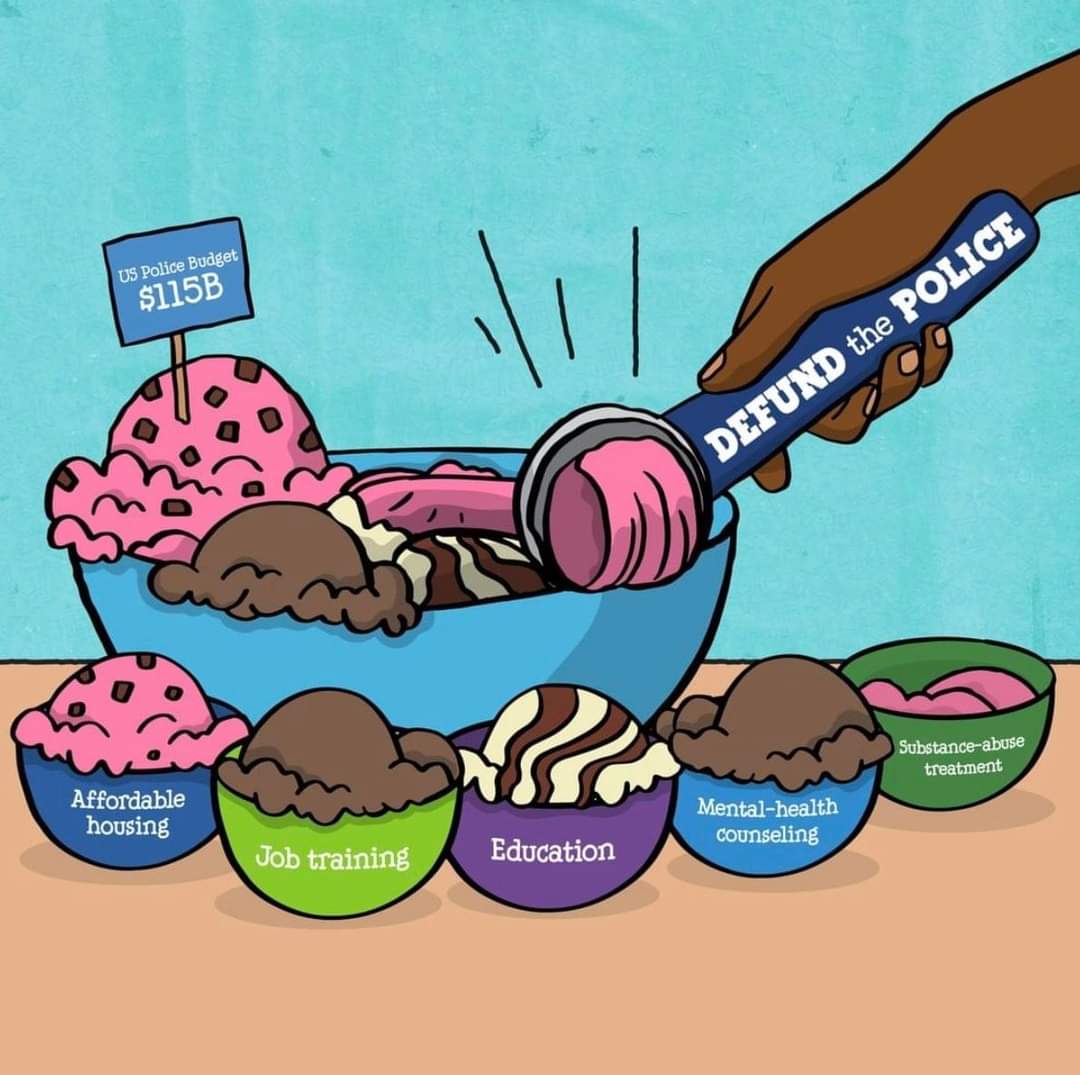
This meme is a humorous critique of the US police budget, comparing it to a massive ice cream sundae. The image features a giant sundae with a sign that says "US Police Budget: $115B", implying that the money allocated to police could be used to provide essential services like affordable housing, education, and healthcare. The meme is a satirical commentary on the prioritization of police funding over social welfare programs.
detailed-analysis (gemma3-27b-vision)
Okay, let's break down this image through the lenses you've provided. It's a politically charged image, ripe for analysis.
Visual Description
The image depicts a colorful, cartoon-style bowl of brightly colored "ice cream" scoops representing social programs. These include "Affordable Housing," "Job Training," "Education," "Mental Health Counseling," and "Substance Abuse Treatment." A hand is pouring a bright blue liquid labeled “Defund the Police” onto the bowl, seemingly dissolving or overwriting the “US Police Budget $115B” sign stuck into the ice cream. The liquid is overflowing, creating a visible mess. The background is a solid, pale blue. The overall impression is one of disruption and a deliberate shift in resource allocation, with the emphasis on investing in social programs rather than policing. The imagery evokes a playful, almost childlike aesthetic, contrasting with the serious political message.
Foucauldian Genealogical Discourse Analysis
This image is deeply embedded within a discourse around policing, safety, and the allocation of public resources. A Foucauldian approach would look at how the categories of “police,” “crime,” “safety,” and “social welfare” are constructed through history, and how power operates through these constructions.
- Genealogy of Policing: The image implicitly questions the historical development of policing in the United States. The "US Police Budget $115B" isn’t presented as a natural or inevitable fact, but as something created through specific power dynamics and decisions. The argument is that this budget has been built up over time through discourses that prioritize punishment and control over prevention and support.
- Discipline and Punishment: Michel Foucault’s work on Discipline and Punish suggests that modern forms of power move away from spectacular, visible punishments (like public executions) towards more subtle forms of surveillance and normalization. The image implicitly critiques the modern policing apparatus as a disciplinary force, suggesting that investing in social programs (the “ice cream” scoops) offers a more constructive path to social order.
- Power/Knowledge: The image disrupts the dominant "knowledge" about safety. It suggests that safety isn't solely achieved through policing, but through addressing the root causes of crime – poverty, lack of education, mental health issues, and substance abuse. By associating these social programs with the idea of "safety," the image attempts to reconstruct the power/knowledge relation and establish a new understanding of what constitutes true safety. The liquid "Defund the Police" is not just a removal of funds, but also a shift in understanding how resources are allocated for community well-being.
Critical Theory
This image strongly aligns with the tenets of Critical Theory, particularly the Frankfurt School's focus on challenging dominant ideologies and structures of power.
- Ideology Critique: The image critiques the ideology that equates safety solely with policing. It suggests that the large police budget isn't a neutral, objective response to crime, but a reflection of systemic inequalities and a prioritization of control over social well-being. The ice cream scoops representing social programs represent a shift from reactive policing to proactive social investment.
- Reason and Emancipation: Critical Theorists like Jürgen Habermas advocate for a rational, communicative form of action aimed at emancipation from oppressive structures. The image can be seen as a call for a more rational allocation of resources, arguing that investing in social programs will ultimately lead to a more just and equitable society. It argues against the rationalization of violence and control inherent in the current system.
- Critique of Instrumental Reason: The image implicitly critiques the "instrumental reason" of a system that prioritizes the "efficiency" of policing (arrests, convictions) over the long-term well-being of communities. The ice cream scoops represent human needs and community investment.
Marxist Conflict Theory
From a Marxist perspective, the image highlights the inherent contradictions within capitalist society and the ongoing class struggle.
- Resource Allocation and Class Interests: The massive police budget can be interpreted as serving the interests of the ruling class – protecting private property and maintaining social control. The image suggests that these resources could be better used to address the material needs of the working class – affordable housing, education, job training – which would fundamentally challenge the existing power structure.
- State Apparatus as Instrument of Control: Marxists view the state (and its apparatus, like the police) as an instrument of class rule. The image can be read as a critique of this dynamic, arguing that the police primarily serve to maintain the status quo and suppress dissent.
- Alienation and Social Problems: The image implicitly acknowledges that social problems like poverty, addiction, and mental health issues are not simply individual failings, but the products of a capitalist system that alienates individuals from their labor, their communities, and their own potential. The social programs are presented as a way to address these systemic issues.
Postmodernism
From a Postmodern perspective, the image plays with the deconstruction of grand narratives and the fluidity of meaning.
- Deconstruction of "Safety": The image challenges the single meaning of “safety.” It suggests that the dominant narrative – safety equals policing – is not the only possible interpretation. It opens up space for alternative understandings of safety that prioritize social welfare and community well-being.
- Rejection of Metanarratives: Postmodernism questions overarching narratives about progress, justice, and social order. The image implicitly rejects the idea that policing is a necessary and inevitable component of a functioning society.
- Playfulness and Irony: The cartoon-like style and the association of serious political concepts with ice cream are inherently playful and ironic. This can be seen as a postmodern strategy for engaging with complex issues in a way that challenges conventional modes of thought.
- Fluidity of Meaning: The image doesn’t offer a simple, prescriptive solution. It invites viewers to question their assumptions and consider alternative possibilities.
Queer Feminist Intersectional Analysis
This image, while not explicitly focused on gender or sexuality, lends itself to an intersectional analysis informed by Queer Feminist thought.
- Disrupting Power Structures: Queer and Feminist theories focus on dismantling oppressive power structures based on gender, sexuality, race, class, and other social categories. The act of "defunding" and reallocating resources can be seen as a challenge to the established power dynamics that perpetuate systemic inequalities.
- Addressing Root Causes of Violence: Many Queer Feminist scholars argue that violence is not simply an individual act, but a product of systemic oppression. The emphasis on social programs (affordable housing, mental health counseling, substance abuse treatment) acknowledges that these issues are often linked to social marginalization and economic insecurity.
- Intersectionality: The image implicitly acknowledges that social problems are often interconnected and disproportionately affect marginalized communities. Access to affordable housing, education, and healthcare is particularly crucial for those who face multiple forms of discrimination.
- Reframing Safety: The Queer Feminist movement has often challenged traditional notions of safety, arguing that the policing system often harms marginalized communities. The image implicitly calls for a reimagining of safety that prioritizes community well-being and addresses the root causes of harm.
In conclusion, this image is a visually striking and intellectually provocative piece that can be interpreted through a variety of theoretical lenses. It effectively communicates a message about the need for systemic change and the importance of investing in social programs as a way to create a more just and equitable society.
simple-description (llama3.2-vision)
This meme is a humorous illustration of a person's hands holding a giant ice cream cone, with a scoop of ice cream labeled "Defund the Police" being poured into a bowl labeled "Police Budget". The text "Defund the Police" is written in bold, playful font, while the bowl is labeled with a tongue-in-cheek " Police Budget" of "$1.2 trillion". The image is meant to be a satirical commentary on the idea of "defunding" the police, implying that the police budget is a massive, indulgent treat that's too expensive to justify.
tesseract-ocr
ioe | 7 aa ) Py | | J > 5 se . | rs j sah \\e CT Ve 7 ce 5, Ll a bere <( FA Re Las bel 3 re ee Peco Buc bbevesl sy Education counseling