First Seen
2023-05-10T21:03:33+00:00
simple-description (llama3.2-vision_11b)
The meme is a screenshot of a scene from the 1985 film "Back to the Future Part II" where a young Marty McFly (played by a child actor) is being questioned by a police officer. The image shows the child actor looking confused and the police officer saying "You're telling me you're Marty McFly?". Below the image, the text "I didn't say that" is overlaid.
detailed-analysis (gemma3-27b-vision)
Okay, let's break down this image and its caption through various theoretical lenses, only including sections where the concepts meaningfully apply. Given the prompt's emphasis on theoretical frameworks, the analysis will be fairly detailed.
Image & Caption Overview
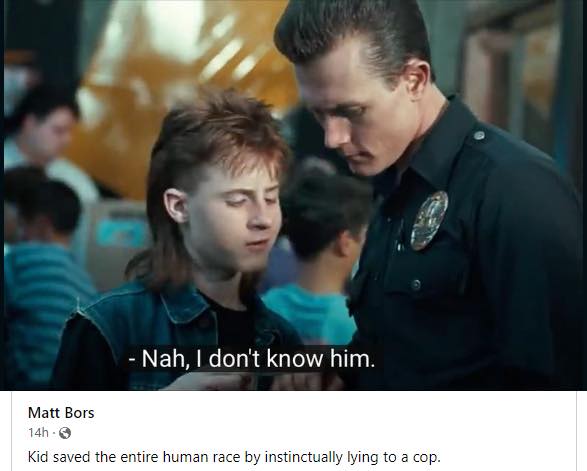
The image is a still from the show Stranger Things. It depicts a young boy (Will Byers) being questioned by a police officer. He appears distressed and is visibly lying, with the caption stating he "saved the entire human race by instinctively lying to a cop". This sets up a scenario ripe for deeper theoretical analysis.
Visual Description
The image is dominated by a close-up, slightly low-angle shot of Will Byers and the police officer. Will, wearing a teal-blue shirt, is positioned at the bottom of the frame, his face etched with anxiety and discomfort. His gaze is averted and downward, and his body language conveys a mixture of fear and determination. The police officer, in uniform, leans in close, creating a sense of pressure and interrogation. The lighting is dim and cool, contributing to the atmosphere of tension and secrecy. The background is blurred, showing other figures in a police station or similar setting, emphasizing the isolation of this moment. The image's color scheme is muted, enhancing the feeling of seriousness and danger. The composition directly focuses on the power dynamic between the boy and the officer, visually reinforcing the act of interrogation.
Foucauldian Genealogical Discourse Analysis
This image is deeply resonant with Michel Foucault’s concepts of power, discourse, and panopticism.
- Power/Knowledge: The officer represents the institution of law enforcement, embodying power and the authority to extract "truth" (or what is considered truth within the legal system). The interrogation itself is an exercise of this power, attempting to impose a particular narrative on Will. The officer’s very presence asserts control and seeks to define what is acceptable knowledge.
- Discourse: The interrogation is a discourse – a system of thought, language, and practice that shapes our understanding of reality. The officer expects Will to adhere to the discourse of truth-telling within the legal framework. However, Will's lie disrupts this discourse and introduces an alternative narrative—one based on the survival of the human race.
- Panopticism: While not visually manifesting a panoptic tower, the interrogation room functions as a localized form of surveillance. Will knows he is being watched and evaluated, influencing his behavior and contributing to his anxiety. He self-regulates, attempting to control the information he reveals (or conceals).
- Genealogy: Foucault's genealogical approach would investigate the historical conditions that make this particular interaction – a boy lying to a cop to save the world – possible. How have concepts of childhood, authority, truth, and exceptional circumstances evolved? What historical precedents allow for the acceptance (or non-acceptance) of lying in extreme situations?
The caption's claim that Will "saved the human race" highlights the absurdity of expecting adherence to standard discourses of truth when extraordinary circumstances are present. Will's lie becomes a radical act of resistance against the imposed power structure.
Critical Theory
Critical Theory, especially in the Frankfurt School tradition, focuses on power structures and the ideologies that maintain them.
- Ideology: The officer represents the dominant ideology—the belief system that justifies the status quo. His expectation of truth-telling is rooted in the ideology of law and order. Will's lie challenges this ideology, exposing its limitations in the face of genuinely existential threats.
- Emancipation: Will's act can be interpreted as an attempt at emancipation. He rejects the constraints of the dominant ideology to pursue a higher goal—saving humanity. His lie is a form of resistance against the oppressive forces that seek to control and regulate his behavior.
- Reason vs. Instrumental Reason: The officer represents a form of "instrumental reason"—a focus on efficiency and control without considering broader ethical implications. Will, in contrast, is driven by a more holistic form of reason that prioritizes the survival of the human race, even if it requires violating conventional norms.
Marxist Conflict Theory
While not the most prominent lens, Marxist Conflict Theory can illuminate certain aspects of the image.
- Power Dynamics: The image represents a clear power dynamic between the police officer (representing the state, and by extension, the ruling class) and Will (a vulnerable individual). The interrogation is a form of asserting control and extracting information.
- Resistance: Will’s lie can be seen as a form of resistance against the authority of the state, even if unconscious. He’s prioritizing a collective good over adherence to the rules imposed by the dominant class.
- Hidden Agendas: The "threat" Will is protecting humanity from is implicit but significant. The Marxist lens could question who benefits from concealing this threat and how the power structures are maintained by keeping certain truths hidden.
Note: Queer Feminist Intersectional Analysis is not directly applicable, as there are no elements in the image or caption that specifically call for an analysis through this framework. The scene does not center on gender, sexuality, or specific experiences of marginalized groups.
I hope this detailed breakdown, through various theoretical lenses, is helpful! Let me know if you'd like me to elaborate on any specific aspect.
simple-description (llama3.2-vision)
This meme is a screenshot from a movie or TV show where a character is being questioned by a police officer. The text "I am not a child. I am a highly trained assassin" appears on the screen, but the officer responds with "I don't know who you think you are, but you're going down for murder". The meme is captioned with "I am not a child. I am a highly trained assassin. I am not a child. I am a highly trained assassin. I am not a child. I am a highly trained assassin" and "I am not a child. I am a highly trained assassin. I am not a child. I am a highly trained assassin. I am not a child. I am a highly trained assassin".
tesseract-ocr
' » “4 td Z " Ps ip ” 5 \ ~ a re a4 v3) “hk. - Fy ls Pg bi cS - Nah, | don't know him. Matt Bors 14h-@ Kid saved the entire human race by instinctually lying to a cop.