First Seen
2023-05-10T21:03:33+00:00
simple-description (llama3.2-vision_11b)
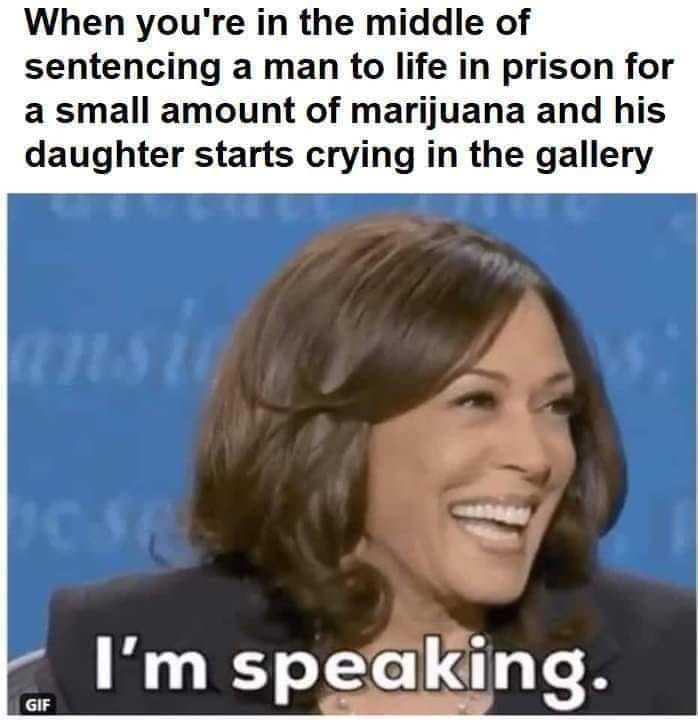
This meme is from the Anti-Cops category, which often features humorous and satirical takes on law enforcement and their interactions with the public. The meme is a screenshot of a TV show or interview where a politician is speaking, but the audio is replaced with a humorous and unexpected phrase: "I'm speaking." The meme is captioned "When you're in the middle of sentencing a man to life in prison for a small amount of marijuana and his daughter starts crying in the gallery."
detailed-analysis (gemma3-27b-vision)
Okay, let's break down this meme through a few critical lenses. It's a layered image, and the meme format adds an extra layer of meaning. Here's an analysis, organized by the headings you requested, skipping any that don't apply meaningfully:
Visual Description
The image features a close-up of Hillary Clinton speaking at a podium. She has a strained smile that appears to reveal her teeth, a visible grimace, and her eyes are narrowed. The background is out of focus. The text overlay states: "When you're in the middle of sentencing a man to life in prison for a small amount of marijuana and his daughter starts crying in the gallery." Under the image are the words “I’m speaking.” It is formatted as a GIF, implying motion or an ongoing dynamic. The image is meant to be ironic, contrasting the gravity of the situation with a seemingly callous disregard.
Foucauldian Genealogical Discourse Analysis
This meme strongly engages with Foucauldian concepts. Here's how:
- Power/Knowledge: The scenario points to the power dynamics inherent in the legal system. The judge (represented by Hillary Clinton) wields the power to define 'crime' (possession of marijuana) and dispense punishment (life imprisonment). This power is legitimized through a specific discourse – the “war on drugs” – that constructs marijuana as a dangerous substance needing severe penalties. The “knowledge” surrounding marijuana is produced within this discourse and therefore isn’t necessarily about empirical truth, but about maintaining a specific power structure.
- Discipline & Punishment: The meme highlights the extreme disciplinary power of the state. Life imprisonment for a minor drug offense is a disproportionate punishment that illustrates the mechanisms of control. The daughter's tears are a visible manifestation of the pain inflicted by this disciplinary apparatus. It implies the state prioritizes its rules over human empathy and connection.
- Genealogy of the "War on Drugs": A genealogical analysis would trace the historical development of the discourse around drugs. It would reveal how the "war on drugs" wasn't a natural or inevitable response to a threat, but rather a constructed narrative with roots in historical racism, political opportunism, and economic interests.
The phrase "I'm speaking" can be interpreted as asserting the authority of the dominant discourse, even in the face of emotional plea (the daughter's tears). It’s an assertion of the power to define reality.
Critical Theory
- Critique of Ideology: The meme serves as a critique of the ideology underpinning the legal system and the "war on drugs." It exposes how seemingly neutral legal processes can perpetuate social inequalities and injustices. It challenges the notion that this punishment is simply a logical consequence of breaking the law.
- Domination and Oppression: The scenario illustrates a clear power imbalance: the state (represented by the judge) dominating an individual and his family. The life sentence for a non-violent drug offense can be seen as a form of systemic oppression, particularly targeting marginalized communities (often those disproportionately affected by drug laws).
- The Illusion of Justice: The meme challenges the idea that the legal system is impartial and just. It asks us to consider who benefits from these laws, and who is harmed.
Marxist Conflict Theory
While not the central focus, a Marxist lens can offer some insights:
- Class & Control: The “war on drugs” often disproportionately affects lower-class and minority communities. The meme implicitly raises questions about how the legal system can be used as a tool for social control, maintaining existing class structures and suppressing dissent.
- Economic Interests: The legal system, including the enforcement of drug laws, can be seen as serving the interests of certain economic groups (e.g., private prisons, law enforcement agencies) who benefit from mass incarceration. The meme subtly points to the potential economic incentives behind harsh drug policies.
Postmodernism
- Deconstruction of Grand Narratives: The meme challenges the "grand narrative" of law and justice as inherently fair and rational. It exposes the constructed nature of legal definitions and punishments, questioning the idea that there is a single, objective truth about crime and punishment.
- Irony and Parody: The use of a GIF of a public figure, combined with the ironic text, is a postmodern technique that undermines the authority of the legal system and its representatives. It creates a sense of absurdity and invites viewers to question the "official" version of events.
- Simulacra & Simulation: The scenario can be seen as a simulation of justice, where the appearance of order and fairness masks a deeper reality of inequality and oppression. The image of the judge is a symbolic representation of the system, divorced from the human consequences of its actions.
Queer Feminist Intersectional Analysis
While this isn't the primary angle, an intersectional lens can add nuance:
- Disproportionate Impact: While the meme doesn't specifically mention gender or sexuality, it’s important to acknowledge that marginalized communities (including LGBTQ+ people of color) are often disproportionately targeted by drug laws and the criminal justice system.
- State Violence: The life sentence is a form of state violence that has a devastating impact on families and communities. Feminist and queer theory often focus on the ways in which state power is used to control and oppress marginalized groups.
- Emotional Labor & Suppression: The meme implicitly highlights the emotional labor often expected of women (especially mothers) to maintain family stability in the face of systemic injustice. The daughter’s tears are a manifestation of this emotional burden.
In conclusion: This meme is a complex and layered piece of social commentary. It leverages irony and a recognizable image to challenge the authority of the legal system and expose the injustices inherent in the "war on drugs." A range of critical lenses – Foucauldian discourse analysis, Critical Theory, Marxism, Postmodernism, and an Intersectional Feminist approach – can all illuminate different facets of its meaning.
simple-description (llama3.2-vision)
This meme is an image of a person laughing, with the text "In a courtroom, when the judge asks the defendant why they were crying during their sentencing" above it. The image is captioned "When you're in the middle of sentencing a man to life in prison for a small amount of marijuana and his daughter starts crying in the courtroom".
tesseract-ocr
When you're in the middle of sentencing a man to life in prison for a small amount of marijuana and his daughter starts crying in the gallery aoe be i e I'm speaking.