First Seen
2023-05-10T21:03:33+00:00
simple-description (llama3.2-vision_11b)
The meme is a screenshot of a Twitter notification that says "Tweet no longer exists" with a link to a tweet that has been deleted. The tweet in question was likely a joke or a satirical commentary on the current state of the internet, specifically the censorship of online content. The meme is likely from the Anti-Cops category, which is a subreddit that focuses on criticizing and exposing the actions of law enforcement and government agencies, and the tweet in question was likely a commentary on the censorship of online content and the lack of free speech.
detailed-analysis (gemma3-27b-vision)
Okay, here’s an analysis of the image, broken down into relevant theoretical frameworks. It's important to note that these lenses are often overlapping and can inform one another. I'll focus on the most strongly applicable ones given the image's content.
Visual Description
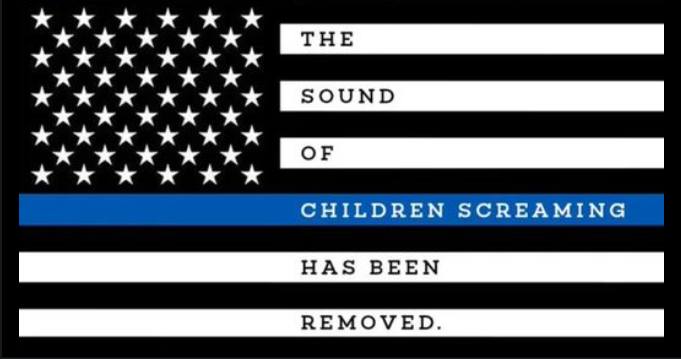
The image is a modified American flag. It retains the standard rectangular shape and the blue field with white stars in the upper left corner. However, the red stripes have been replaced with white horizontal bands, each containing a line of black text. The text, when read in sequence from top to bottom, forms the phrase: “THE SOUND OF CHILDREN SCREAMING HAS BEEN REMOVED.” A thin blue line runs horizontally through the center of the flag where the red would traditionally be.
The color scheme is stark—black, white, and blue—which contributes to the image's aggressive and unsettling aesthetic. The modification of a national symbol, coupled with the disturbing text, immediately establishes a sense of protest or indictment.
Foucauldian Genealogical Discourse Analysis
This image lends itself strongly to a Foucauldian analysis. We can examine it as a disruption of established discourses around national identity, security, and childhood.
- Discourse and Power: The American flag is a site of powerful discourse. It traditionally symbolizes freedom, democracy, and national unity. The image disrupts this discourse by associating it with violence and trauma ("children screaming"). The 'thin blue line' evokes imagery of police support and perceived law and order which is now tainted.
- Genealogy of the "Thin Blue Line": The "thin blue line" has become a symbol appropriated by some in law enforcement and their supporters. Tracing the history of this symbol reveals a genealogy from its origins (a reference to law enforcement as the last line of defense against chaos) to its current uses (often associated with pro-police movements and, in some cases, more extremist ideologies). The image implicitly critiques this appropriation.
- "Removal" as Disciplinary Power: The phrase “HAS BEEN REMOVED” is particularly interesting. It suggests a silencing, a covering up, or an erasure. Foucault would be interested in who is removing the sound and what that act reveals about power dynamics. It implies a system that actively suppresses the recognition of harm inflicted on children.
- The Power/Knowledge Nexus: The image suggests a connection between power and knowledge. The 'removal' of the sound suggests a deliberate attempt to control the narrative, preventing acknowledgement of the trauma and therefore maintaining existing power structures.
Critical Theory
The image engages with many core themes of Critical Theory, particularly those related to social critique and the exposure of hidden power structures.
- Ideology and Hegemony: The image challenges the dominant ideology surrounding the American flag and its symbols. The modification forces viewers to question the assumed meanings of patriotism, security, and national pride.
- Deconstruction of Symbols: The image actively deconstructs the American flag. It dismantles the perceived innocence and inherent goodness associated with the symbol, exposing a darker undercurrent of violence and silencing.
- The Subversive Nature of Art: The image functions as a form of protest art. It uses symbolic disruption to challenge the status quo and raise awareness about difficult social issues.
- Critique of State Power: The image can be interpreted as a critique of the state's power to protect its citizens, particularly vulnerable groups like children. The "removal" of the sound suggests a failure of protection or an active complicity in harm.
Marxist Conflict Theory
While not as central as the Foucauldian or Critical Theory approaches, a Marxist lens can illuminate certain aspects of the image.
- Power Dynamics and Class: The image subtly suggests a power imbalance. The silencing of children’s screams implies a systemic issue where the voices of the vulnerable are marginalized by those in power.
- Ideology as a Tool of Oppression: The image challenges the dominant ideology surrounding nationalism and law enforcement. It suggests that these ideologies can be used to justify or conceal systemic injustice.
- The Struggle for Recognition: The "removed" sound can be seen as a metaphor for the silencing of marginalized voices in a class-based society. The image calls attention to the need for recognition and redress of grievances.
Summary
The image is a complex and provocative work that uses symbolic disruption to challenge established power structures and raise awareness about difficult social issues. It lends itself particularly well to Foucauldian and Critical Theory analyses, which can illuminate the image's critique of ideology, power dynamics, and the silencing of marginalized voices. It is likely designed as a statement about systemic issues like abuse or violence against children and the potential complicity of those in positions of power.
Disclaimer: My analysis is based on the visual information provided and my understanding of the theoretical frameworks. The interpretation of art is subjective, and other readings are possible.
simple-description (llama3.2-vision)
This meme is a humorous take on the phrase "I can explain it better than a video" from the TV show "The Office". The image is a screenshot of a Windows error message, but the text has been replaced with "I can explain it better than a video" and "The Office" is written in the title bar. The meme is poking fun at the idea that someone is trying to explain something complex, but is actually just being sarcastic and unhelpful.
tesseract-ocr
KK KK KX ttt > ie ie aie aie aes ee SOUND kk kK wk > i ie ie aie, aie g atten kK Keke aK CHILDREN SCREAMING HAS BEEN REMOVED.