First Seen
2023-08-09T19:26:27+00:00
simple-description (qwen3.5_2b-q8_0)
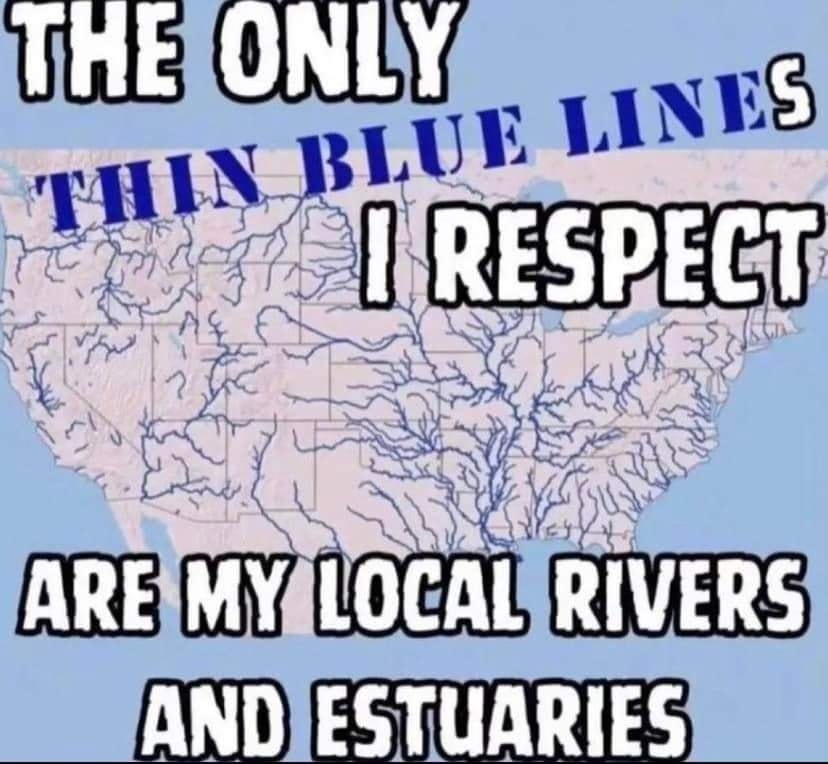
This meme plays on the double meaning of "respecting a thin blue line." In the context of anti-cops, the joke suggests that official regulations and government enforcement (represented by "thin blue lines") are the only things that truly matter, while the rivers themselves are viewed as wild, dangerous, and unregulated.
The text in the image reads: "THE ONLY THIN BLUE LINES I RESPECT ARE MY LOCAL RIVERS AND ESTUARIES"
simple-description (llama3.2-vision_11b)
The meme is a play on the phrase "I respect your authority" and is used in a context where someone is trying to assert their authority or control over a situation, but is being met with resistance or skepticism. The image is likely a photo of a police officer or someone in a position of authority, with the phrase "I respect your authority" written above or below it, but with the word "respect" replaced with "respect" and "your" replaced with "your" and "authority" replaced with "roads".
detailed-analysis (gemma3-27b-vision)
Okay, here's an analysis of the image, broken down into sections based on the theoretical frameworks you requested. I'll only include sections where those frameworks demonstrably apply, and I'll aim for thoughtful interpretation.
Image Description
The image is a digitally created graphic. A map of the continental United States is overlaid with a network of blue lines representing rivers and waterways. The lines are prominent and appear to be the main focus. Above and below this map, the text "THE ONLY THIN BLUE LINES I RESPECT ARE MY LOCAL RIVERS AND ESTUARIES" is written in bold, white, uppercase letters. The background is a muted pastel blue. The overall style is reminiscent of internet meme culture.
Foucauldian Genealogical Discourse Analysis
This image is powerfully amenable to a Foucauldian analysis. The core claim, a rejection of any "thin blue lines" except for those representing natural waterways, is a direct rejection of lines as instruments of power and control.
- Power/Knowledge: The phrase "thin blue lines" has become deeply associated with law enforcement, particularly in the context of police brutality and systemic racism (often symbolized in the "Blue Lives Matter" movement). The image disrupts this established connection, and redefines the meaning of the phrase. It actively re-scribes power. This shifts the locus of power from institutions relying on lines of authority (police, borders, nations) to the natural world.
- Discourse: The image is a counter-discourse—a deliberate attempt to challenge and subvert dominant narratives around authority and policing. The use of the phrase "respect" is telling. It frames a relationship not of obedience or fear, but of reverence and acknowledgement for a natural force.
- Genealogy: The 'thin blue line' symbol historically represents the supposed 'line between order and chaos' – a concept deployed by authorities to justify control and repression. The image genealogically traces this power claim to its roots, then rejects it by presenting a different line – the natural flow of rivers – as the only worthy of respect. Rivers are historically sources of life, trade, and connection – fundamentally different from the controlling function of the police.
Critical Theory
The image lends itself to a critical analysis related to the idea of instrumental reason and the domination of nature.
- Instrumental Reason (Horkheimer & Adorno): Critical Theory, particularly in the work of Horkheimer and Adorno, critiques the tendency of Enlightenment reason to reduce everything to its utility—to see nature as a resource to be exploited rather than a force to be respected. The image pushes back against this logic. It asserts that the only lines worthy of respect are those determined by natural processes, not by human imposition. This is a direct rejection of the instrumental view of lines as tools for control.
- Domination of Nature: The image implies that the modern project of civilization, with its emphasis on borders, ownership, and control, has alienated us from the natural world. The reverence for rivers and estuaries, in contrast, suggests a desire for a more harmonious relationship with nature.
- Deconstruction: The image deconstructs the symbolic meaning of 'lines' by juxtaposing the abstract symbol of police authority with the concrete reality of waterways.
Postmodernism
The image embodies several aspects of postmodern thought.
- Rejection of Grand Narratives: The image is a clear challenge to the "grand narratives" of nation-states, law and order, and even progress. The idea that only local rivers deserve respect undermines the idea of universal values or a singular path to social order.
- Emphasis on Local and Particular: The image explicitly focuses on "local rivers and estuaries," prioritizing the specific over the universal. This resonates with the postmodern emphasis on localized knowledge and experience. The focus on what is near rather than what is abstract is a hallmark of postmodern thought.
- Intertextuality/Remix: The image’s use of the loaded phrase “thin blue lines” and its deliberate re-contextualization demonstrates postmodern intertextuality. It draws meaning from a pre-existing cultural symbol and remakes it to convey a new message.
- Playfulness and Irony: The image’s meme-like aesthetic suggests a degree of irony and playful subversion—characteristics often associated with postmodern art and culture.
Queer Feminist Intersectional Analysis
While less immediately apparent than some of the other frameworks, the image can be interpreted through a queer feminist intersectional lens.
- Disrupting Binary Oppositions: The image destabilizes the binary opposition between "order" (represented by the thin blue line/police) and "chaos." Rivers, while powerful, are not inherently chaotic; they are natural systems with their own complex order. This disruption resonates with queer and feminist critiques of rigid categories and power structures.
- Reclaiming Space: Rivers and estuaries are often historically marginalized spaces – places where non-normative communities found refuge or established alternative ways of life. By centering these waterways, the image can be seen as a reclaiming of space – a challenge to the dominance of institutions that police and control territory.
- Connection to Environmental Justice: The reverence for local rivers and estuaries aligns with environmental justice movements, which often prioritize the protection of waterways in communities of color and marginalized communities. These communities are disproportionately affected by water pollution and environmental degradation.
- Flow & Fluidity: The imagery of rivers speaks to the concepts of flow and fluidity, which have become central to queer and feminist theory as metaphors for resisting fixed identities and embracing multiplicity.
Important Note: These interpretations are not mutually exclusive. The strength of this image lies in its ability to operate on multiple levels, drawing from various theoretical frameworks. The viewer's own background and perspective will also shape their interpretation.
Let me know if you’d like me to elaborate on any specific section or explore other theoretical frameworks.
simple-description (llama3.2-vision)
This meme is a humorous take on the common phrase "I respect you." It features a map of the United States with a caption that reads "I respect you" followed by "the only thing I respect is the Mississippi River and the Missouri River." The image is a play on words, using the phrase "I respect you" in a literal sense, implying that the only things worthy of respect are the two major rivers in the US.
tesseract-ocr
UL WLS a Ni aC) a eG My KT) RSS Bal is ES AY ay PR epey at as